
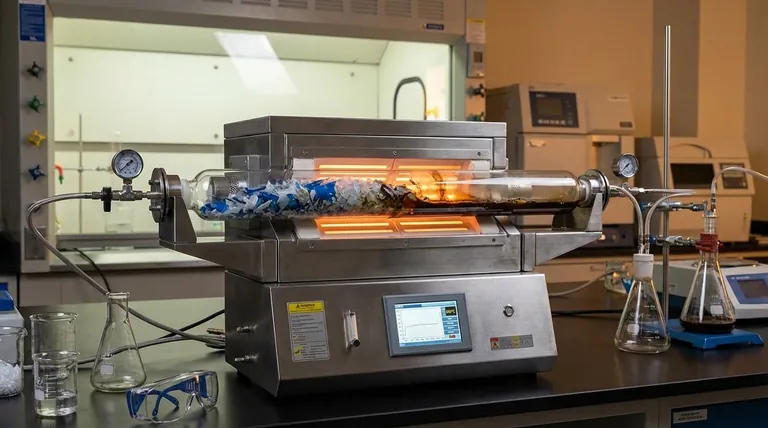
The horizontal tube furnace acts as the primary thermal driver in the plastic waste pyrolysis process. It provides the strictly controlled, high-temperature environment necessary to thermally decompose solid polymers into valuable gaseous or liquid fuel precursors without combustion.
The core function of this furnace is to facilitate the breaking of long-chain hydrocarbons into shorter chains by maintaining a uniform temperature, typically between 400°C and 900°C. It serves as the external energy source that triggers the endothermic chemical reactions required for material conversion.
The Mechanics of Thermal Decomposition
Precise Temperature Regulation
The fundamental role of the horizontal tube furnace is to generate and maintain high heat. For plastic pyrolysis, this requires a specific operating window, generally ranging from 400°C to 900°C.
The furnace utilizes a structural stainless steel shell housing internal heating elements. These elements provide the intense thermal energy required to reach the activation energy of the plastic polymers.
Breaking the Polymer Chain
At these elevated temperatures, the furnace triggers thermal decomposition. This is the chemical process where the material breaks down under heat.
Plastic consists of long-chain hydrocarbons. The heat provided by the furnace causes these long chains to snap, resulting in shorter-chain molecules. These shorter chains eventually exit the system as combustible gases or liquid fuel precursors.
Ensuring Uniform Heat Transfer
A critical advantage of the horizontal tube design is uniformity. The furnace is engineered to deliver consistent heat to the reaction vessel placed inside it.
Uniform heat transfer prevents "cold spots" where plastic might remain solid, and "hot spots" that could lead to excessive charring. This consistency is vital for maximizing the yield of usable fuel products.
Environmental Control and Atmosphere
Atmosphere Regulation
While the primary reference focuses on heat, supplementary data indicates that tube furnaces are essential for controlling the reaction atmosphere.
Pyrolysis requires an anaerobic (oxygen-free) environment. The tube furnace design allows for the reaction vessel to be sealed or purged with inert gases like nitrogen. This ensures the plastic decomposes rather than burns.
Consistency for Data Reliability
For research and pilot applications, the tube furnace offers a highly enclosed environment. This allows operators to precisely regulate heating rates and residence times.
By minimizing external interference, the furnace creates a standardized environment. This is particularly important when generating datasets for analysis or optimizing the removal of pollutants during the breakdown process.
Operational Considerations and Trade-offs
Batch vs. Continuous Limitations
Horizontal tube furnaces are excellent for controlled environments, but they often operate on a batch or semi-continuous basis.
While they provide high precision, loading and unloading the reaction vessel can be a bottleneck compared to continuous flow reactor designs used in massive industrial plants.
Heat Transfer Challenges
Plastics often have poor thermal conductivity. While the furnace provides uniform heat to the vessel, ensuring that heat penetrates the center of the plastic mass can be challenging.
Operators must carefully manage the heating rate. If heated too quickly, the outer layer of plastic may degrade before the core reaches the target temperature.
Making the Right Choice for Your Goal
The horizontal tube furnace is an instrument of precision, best suited for applications where variable control is more critical than raw throughput.
- If your primary focus is Research and Development: Prioritize the furnace's ability to control atmosphere and heating rates to generate standardized, reproducible data.
- If your primary focus is Fuel Quality Optimization: Leverage the precise temperature zones (400°C–900°C) to fine-tune the molecular weight of your output, balancing between gas and liquid yields.
By ensuring uniform heat transfer and a controlled environment, the horizontal tube furnace transforms a waste disposal challenge into a resource recovery opportunity.
Summary Table:
| Feature | Role in Plastic Pyrolysis | Benefit to Process |
|---|---|---|
| Temperature Range | 400°C to 900°C | Reaches activation energy for polymer chain breaking. |
| Uniform Heat Transfer | Consistent thermal distribution | Prevents cold spots and maximizes fuel yield quality. |
| Atmosphere Control | Sealed anaerobic environment | Ensures decomposition without combustion (oxygen-free). |
| Thermal Regulation | Precise heating rates | Enables data reliability for R&D and pollutant removal. |
Revolutionize Your Waste-to-Energy Research with KINTEK
Maximize your fuel recovery and research precision with KINTEK’s advanced thermal solutions. Backed by expert R&D and manufacturing, KINTEK offers high-performance Tube, Muffle, Rotary, Vacuum, and CVD systems, all fully customizable to meet the unique challenges of plastic waste pyrolysis. Whether you are optimizing liquid fuel yields or analyzing pollutant removal, our equipment provides the uniform heating and atmosphere control necessary for superior results.
Ready to scale your resource recovery? Contact KINTEK today for a customized furnace solution!
Visual Guide

References
- Hitesh Panchal. Fuel Extraction from Plastic Waste. DOI: 10.22214/ijraset.2025.66489
This article is also based on technical information from Kintek Furnace Knowledge Base .
Related Products
- Vertical Laboratory Quartz Tube Furnace Tubular Furnace
- 1700℃ High Temperature Laboratory Tube Furnace with Alumina Tube
- Vacuum Sealed Continuous Working Rotary Tube Furnace Rotating Tube Furnace
- Split Multi Heating Zone Rotary Tube Furnace Rotating Tube Furnace
- Laboratory Vacuum Tilt Rotary Tube Furnace Rotating Tube Furnace
People Also Ask
- What are the key differences between single-zone and multi-zone vertical tube furnaces? Choose the Right Furnace for Your Lab
- How does a vertical single-temperature zone tube furnace facilitate the growth of high-quality PdSe2 single crystals?
- What is the purpose of using an industrial-grade vertical tube furnace in phosphorus recovery? High-Fidelity Simulation
- How are wafers loaded and unloaded in a vertical tube furnace? Achieve Precision and Purity in Wafer Processing
- How do heat treatment processes influence the configuration of a vertical tube furnace? Optimize for Quenching, Annealing, and More



















