
The primary contribution of an atmosphere-controlled tube furnace to the synthesis of In2O3/C (Indium Oxide/Carbon) composites is the creation of a high-purity inert environment that enables simultaneous carbonization and crystallization.
Specifically, by maintaining an argon atmosphere at 600 °C, the furnace facilitates the pyrolytic conversion of organic precursors (like PVP) into a carbon framework while preventing these carbon elements from burning off. This process anchors ultra-fine In2O3 particles within the carbon structure, preventing the complete oxidation of the composite material.
Core Takeaway The tube furnace acts as a dual-function reactor that decouples thermal decomposition from oxidation. It allows the organic binder to convert into a conductive carbon matrix (pyrolysis) rather than burning away (combustion), ensuring the In2O3 nanoparticles are securely encapsulated and electrically connected.
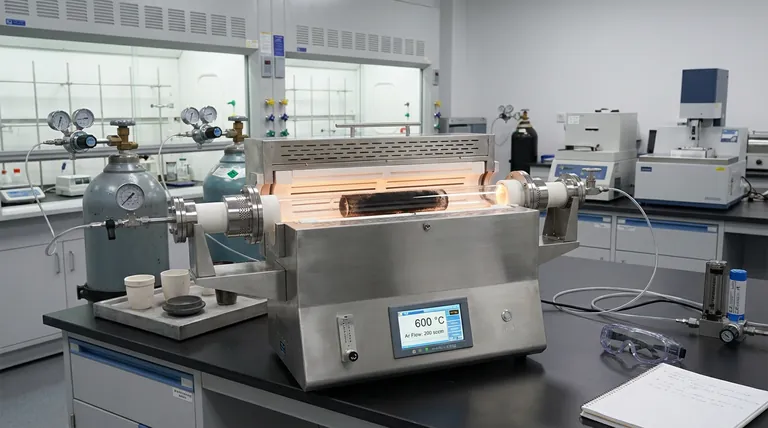
The Role of the Inert Atmosphere
Preventing Carbon Loss
In a standard oven containing air, heating organic polymers to 600 °C would cause them to react with oxygen and burn away completely.
The tube furnace replaces this air with high-purity argon.
This inert environment ensures that the carbon source (such as Polyvinylpyrrolidone or PVP) undergoes pyrolysis rather than combustion, retaining the carbon atoms necessary to build the composite matrix.
Protecting the Material Integrity
Beyond the carbon source, the inert atmosphere protects the overall chemical stability of the composite.
It prevents the complete oxidation of the material system, which would otherwise degrade the structural properties of the final product.
Thermal Control and Structure Formation
Pyrolytic Carbonization
At the target temperature of 600 °C, the furnace drives the chemical transformation of the polymer precursor.
The stable thermal field ensures the organic matter decomposes completely into a carbon fiber framework.
This creates a conductive network that acts as the backbone for the composite material.
In-Situ Anchoring of In2O3
Simultaneously, the heat promotes the growth of indium oxide (In2O3) crystals.
However, because this happens within the developing carbon matrix, the In2O3 particles are anchored in-situ.
This prevents the particles from aggregating into large clumps, maintaining them as "ultra-fine" particles dispersed evenly throughout the carbon fibers.
Understanding the Trade-offs
Sensitivity to Atmosphere Purity
The success of this process is entirely dependent on the integrity of the inert atmosphere.
Even a minor leak or insufficient argon flow will introduce oxygen, leading to the rapid combustion of the carbon matrix and destroying the composite structure.
Thermal Precision vs. Particle Growth
While high temperatures are needed for carbonization, excessive heat or uncontrolled ramp rates can have negative effects.
If the temperature is too high or uncontrolled, the In2O3 crystals may grow too large (sintering), reducing the active surface area of the material.
Conversely, if the temperature is too low, the polymer may not fully carbonize, resulting in poor electrical conductivity.
Making the Right Choice for Your Goal
To maximize the performance of your In2O3/C composites, align your furnace settings with your specific material requirements:
- If your primary focus is Electrical Conductivity: Ensure the furnace reaches the full carbonization temperature (e.g., 600–700 °C) to fully convert the amorphous carbon precursors into a highly conductive network.
- If your primary focus is Particle Size Control: Utilize a precise heating program (e.g., 5 °C/min) to prevent thermal shock and inhibit the excessive growth or agglomeration of the In2O3 nanoparticles.
The tube furnace is not just a heating element; it is a chemical reactor that dictates the final architecture of your composite through precise atmospheric control.
Summary Table:
| Feature | Role in In2O3/C Synthesis | Benefit to Composite Structure |
|---|---|---|
| Argon Atmosphere | Prevents combustion of organic precursors (PVP) | Preserves the conductive carbon framework |
| Controlled Pyrolysis | Converts polymers into carbon at 600°C | Creates a stable, high-conductivity matrix |
| Thermal Precision | Regulates In2O3 crystal growth | Prevents particle agglomeration/sintering |
| In-Situ Anchoring | Encapsulates particles during carbonization | Ensures uniform dispersion of ultra-fine particles |
Elevate Your Materials Synthesis with KINTEK
Precision is the difference between a failed burn-off and a high-performance composite. KINTEK provides industry-leading, atmosphere-controlled solutions tailored for advanced carbonization and crystallization processes.
Backed by expert R&D and manufacturing, we offer Muffle, Tube, Rotary, Vacuum, and CVD systems, all fully customizable to meet your specific temperature and gas-purity requirements. Whether you are scaling up In2O3/C production or researching new semiconductor frameworks, our technical team is ready to help you achieve perfect thermal stability and material integrity.
Ready to optimize your lab's high-temperature processes?
Contact KINTEK today to discuss your unique needs.
References
- Wenhe Xie, Xiaolei Sun. Encapsulating Ultrafine In2O3 Particles in Carbon Nanofiber Framework as Superior Electrode for Lithium-Ion Batteries. DOI: 10.3390/inorganics12120336
This article is also based on technical information from Kintek Furnace Knowledge Base .
Related Products
- 1200℃ Controlled Inert Nitrogen Atmosphere Furnace
- Mesh Belt Controlled Atmosphere Furnace Inert Nitrogen Atmosphere Furnace
- 1400℃ Controlled Inert Nitrogen Atmosphere Furnace
- Controlled Inert Nitrogen Hydrogen Atmosphere Furnace
- 1700℃ Controlled Inert Nitrogen Atmosphere Furnace
People Also Ask
- What controlled-atmosphere furnace conditions are required for sintering powder metallurgy copper alloy compacts? Ideal Setup
- Why is a controlled atmosphere furnace required for 316L debinding? Ensure Structural Integrity & Zero Cracks
- How does a controlled atmosphere furnace prevent oxidation and decarburization? Master Precision Heat Treatment
- What are the four main types of controlled atmospheres used in these furnaces? Optimize Your Heat Treatment Processes
- How do surface oxide layers on ceramic powders like silicon nitride affect sintering? Master Atmosphere Control



















