
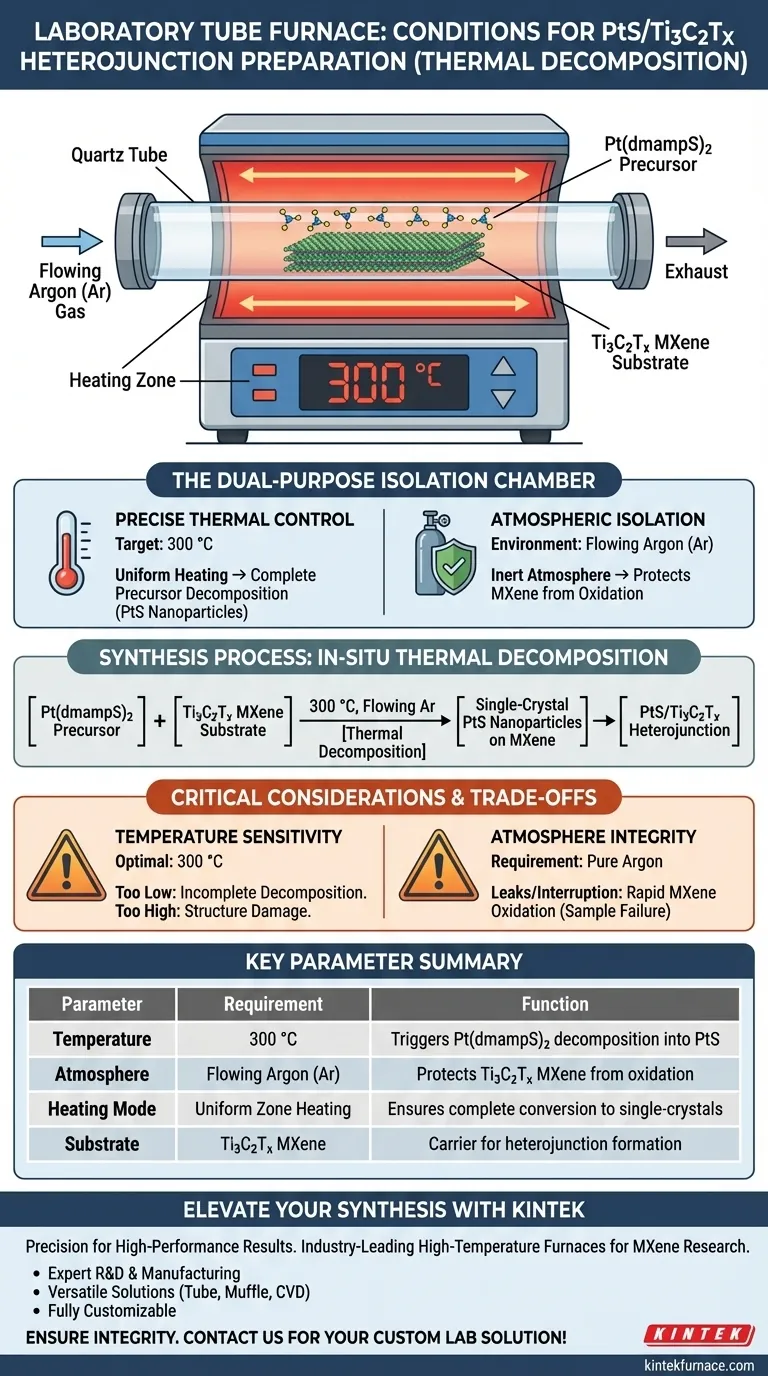
A laboratory tube furnace establishes the critical environment for synthesizing PtS/Ti3C2Tx heterojunctions by maintaining a precise temperature of 300 °C under a continuous flow of Argon (Ar) gas. This specific combination allows for the in-situ thermal decomposition of the Pt(dmampS)2 precursor directly onto the MXene surface without degrading the substrate.
The tube furnace functions as a dual-purpose isolation chamber: it provides the thermal energy required to decompose precursors into single-crystal nanoparticles while simultaneously maintaining an inert atmosphere that strictly protects the sensitive MXene carrier from high-temperature oxidation.
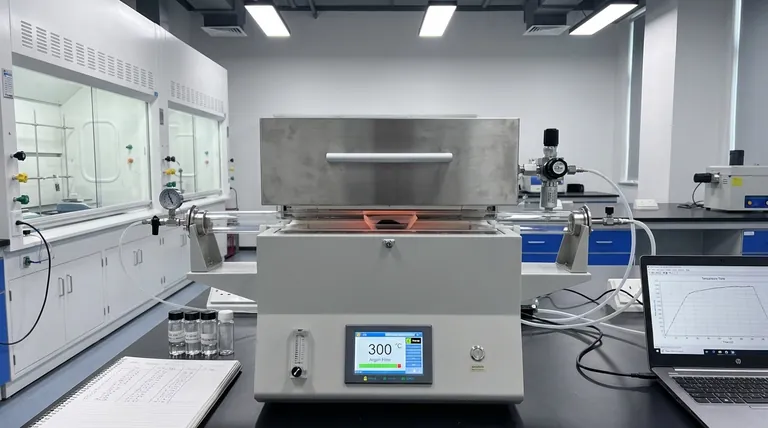
Precise Thermal Control
Targeting the Decomposition Threshold
The synthesis relies on holding the reaction environment at exactly 300 °C. This specific temperature is calibrated to trigger the conversion of the Pt(dmampS)2 precursor.
Ensuring Complete Conversion
The laboratory tube furnace provides uniform heating throughout the reaction zone. This consistency guarantees the complete decomposition of the precursor, resulting in the formation of single-crystal platinum monosulfide (PtS) nanoparticles.
Atmospheric Isolation
The Role of Inert Gas
The process must occur under a flowing Argon (Ar) atmosphere. This continuous flow flushes out ambient air and creates a stable, inert environment within the tube.
Preventing Substrate Degradation
The Ti3C2Tx MXene carrier is highly susceptible to oxidation when exposed to heat. By excluding environmental contaminants and oxygen, the Ar atmosphere ensures the MXene retains its structural integrity during the formation of the heterojunction.
Critical Considerations and Trade-offs
Temperature Sensitivity
While 300 °C is the optimal setpoint, deviation can compromise the material. Temperatures that are too low may result in incomplete precursor decomposition, while excessive heat could damage the heterojunction structure even within an inert atmosphere.
Atmosphere Integrity
The success of this method is entirely dependent on the purity of the Argon environment. Any leak in the furnace seals or interruption in gas flow will lead to rapid oxidation of the MXene, rendering the sample unusable.
Optimizing Your Synthesis Strategy
To ensure the successful preparation of PtS/Ti3C2Tx heterojunctions, focus on the strict regulation of heat and gas flow.
- If your primary focus is Material Purity: Ensure the Argon flow is fully established to purge contaminants before the heating ramp begins.
- If your primary focus is Crystallinity: Maintain the 300 °C temperature with high precision to facilitate the growth of high-quality single-crystal PtS nanoparticles.
Precise control over these environmental variables acts as the safeguard for creating high-performance heterojunctions.
Summary Table:
| Key Parameter | Requirement | Function in Synthesis |
|---|---|---|
| Temperature | 300 °C | Triggers Pt(dmampS)2 decomposition into PtS |
| Atmosphere | Flowing Argon (Ar) | Protects Ti3C2Tx MXene from high-temp oxidation |
| Heating Mode | Uniform Zone Heating | Ensures complete conversion to single-crystal nanoparticles |
| Substrate | Ti3C2Tx MXene | Serves as the carrier for heterojunction formation |
Elevate Your Material Synthesis with KINTEK
Precision is the difference between a high-performance heterojunction and a failed sample. KINTEK provides industry-leading laboratory high-temperature furnaces designed for the rigorous demands of MXene research and thermal decomposition.
Why choose KINTEK?
- Expert R&D & Manufacturing: Our systems offer the ultra-stable thermal zones and gas-tight integrity required for sensitive Ar-flow processes.
- Versatile Solutions: From standard Tube and Muffle furnaces to Rotary, Vacuum, and CVD systems.
- Fully Customizable: We tailor our equipment to meet your unique temperature profiles and atmospheric needs.
Ensure the integrity of your PtS/Ti3C2Tx heterojunctions with KINTEK’s reliable heating technology. Contact us today to find your custom lab solution!
Visual Guide
References
- Young-Hee Park, Jongsun Lim. Direct Growth of Platinum Monosulfide Nanoparticles on MXene via Single‐Source Precursor for Enhanced Hydrogen Evolution Reaction. DOI: 10.1002/smsc.202500407
This article is also based on technical information from Kintek Furnace Knowledge Base .
Related Products
- 1400℃ High Temperature Laboratory Tube Furnace with Alumina Tube
- Laboratory Quartz Tube Furnace RTP Heating Tubular Furnace
- Laboratory Vacuum Tilt Rotary Tube Furnace Rotating Tube Furnace
- 1700℃ High Temperature Laboratory Tube Furnace with Alumina Tube
- Vertical Laboratory Quartz Tube Furnace Tubular Furnace
People Also Ask
- How does zone-melting in tube furnaces synthesize bismuth micro-wires? Master Single-Crystal Thermoelectric Growth
- How are high-temperature laboratory tube furnaces applied in long-term vacuum homogenization heat treatments for intermetallic samples?
- How do high-temperature laboratory tube furnaces ensure environmental stability? Precision Thermal Reduction Tips
- How are high-temp tube furnaces used to measure diffusion coefficients per Fick's law? Master Precision Annealing
- How are high-temperature tube furnaces applied in testing ceramic-supported alloy membranes? Insights



















