
A high-temperature tube furnace equipped with inert atmosphere protection is critical for successfully converting polymer precursors into functional PCFC composites. It provides the precise thermal environment needed to transform polyacrylonitrile (PAN) into a conductive carbon skeleton while simultaneously decomposing sacrificial polymers to create essential micro-channels.
The furnace enables a dual-process mechanism: stabilizing the carbon structure through graphitization and creating ordered porosity via sacrificial decomposition. Without the inert atmosphere and controlled heating curves, the material would oxidize rather than carbonize, destroying both the conductive framework and the catalytic active sites.
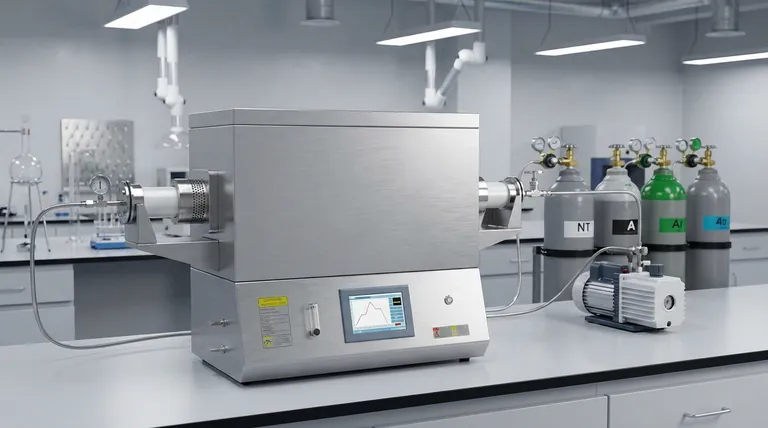
Creating the Structural Foundation
Formation of the Conductive Skeleton
The primary function of the furnace is to execute a precise heating curve that drives chemical changes in the base material. Under these conditions, polyacrylonitrile (PAN) undergoes cyclization and carbonization. This transformation is what creates the material's conductive skeleton.
Creating Ordered Porosity
While the skeleton forms, the furnace acts on the sacrificial polymer (PS). The thermal environment causes the PS to undergo thermal decomposition, effectively removing it from the composite. This process leaves behind highly ordered parallel channels, which are distinct from the structural skeleton.
Determining Graphitization
The peak temperature and dwell time directly influence the material's final properties. This thermal history determines the graphitization degree of the carbon fibers. A higher degree of graphitization generally correlates with improved structural stability and conductivity.
Activating the Chemical Properties
Bonding Active Sites
Beyond structure, the high-temperature treatment is chemical in nature. It ensures that Co-N-C active sites are firmly bonded to the carbon substrate. This bonding is essential for the material's catalytic performance in its final application.
In-Situ Nanoparticle Formation
The tube furnace environment facilitates the reduction of adsorbed metal salts. As the polymer backbone decomposes into carbon, these salts are reduced into highly dispersed catalytic nanoparticles. This simultaneous reaction integrates the catalyst directly into the carbon structure.
The Role of the Inert Atmosphere
Preventing Oxidation
The inclusion of an inert atmosphere, typically nitrogen, is strictly required to create an oxygen-free environment. Without this protection, the organic precursors would burn (oxidize) at high temperatures rather than carbonize.
Controlled Volatile Removal
The flowing inert gas aids in the removal of volatile components released during heating. This controlled removal is necessary to transform the polymers into structurally stable carbonized materials. It initiates the development of the micropore structure that supports subsequent active component loading.
Understanding the Trade-offs
Sensitivity to Heating Rates
While the furnace allows for high temperatures, the heating ramp rate must be precisely controlled (e.g., 1 °C per minute). Rapid heating can lead to excessive shrinkage or structural collapse. Precise programmed control is vital for maintaining dimensional accuracy.
Complexity of Atmosphere Control
Maintaining a strictly inert atmosphere requires rigorous system integrity. Any leakage of oxygen during the high-temperature phase can compromise the Co-N-C bonding and degrade the carbon skeleton. The quality of the outcome is heavily dependent on the purity and flow consistency of the nitrogen gas.
Making the Right Choice for Your Goal
The necessity of this equipment lies in its ability to balance destructive decomposition (of the sacrificial polymer) with constructive carbonization (of the skeleton).
- If your primary focus is Structural Integrity: Prioritize a slow, controlled heating ramp to minimize shrinkage and ensure highly ordered channel formation.
- If your primary focus is Catalytic Activity: Ensure the peak temperature is sufficient to achieve high graphitization and firm bonding of the Co-N-C active sites.
Ultimately, the tube furnace acts as a precise reactor that orchestrates the simultaneous physical shaping and chemical activation of the PCFC composite.
Summary Table:
| Process Component | Role in PCFC Fabrication | Key Outcome |
|---|---|---|
| Inert Atmosphere (N₂) | Prevents oxidation & burning | Stable carbon skeleton |
| Controlled Heating (1°C/min) | Manages sacrificial decomposition | Ordered micro-channels |
| High-Temp Graphitization | Drives structural transformation | High conductivity & stability |
| Thermal Reduction | Converts metal salts to nanoparticles | Co-N-C active site bonding |
Elevate Your Materials Research with KINTEK Precision
Ready to achieve perfect graphitization and ordered porosity in your PCFC composites? KINTEK provides high-performance high-temperature furnaces designed for the rigors of carbonization. Backed by expert R&D and manufacturing, we offer Muffle, Tube, Rotary, Vacuum, and CVD systems—all fully customizable to meet your unique atmosphere and thermal ramp requirements.
Contact KINTEK today to optimize your carbonization process and see how our advanced heating solutions can empower your lab's next breakthrough.
Visual Guide

References
- Ying Liu, Jou‐Hyeon Ahn. Redox‐Active Interlayer with Gradient Adsorption and Catalytic Conversion Functionality for High‐Sulfur‐Loading Lithium‐Sulfur Batteries. DOI: 10.1002/sstr.202500178
This article is also based on technical information from Kintek Furnace Knowledge Base .
Related Products
- 1700℃ Controlled Inert Nitrogen Atmosphere Furnace
- 1400℃ Controlled Inert Nitrogen Atmosphere Furnace
- 1200℃ Controlled Inert Nitrogen Atmosphere Furnace
- 1400℃ High Temperature Laboratory Tube Furnace with Alumina Tube
- 1700℃ High Temperature Laboratory Tube Furnace with Alumina Tube
People Also Ask
- How does oxygen partial pressure control affect ceramic sintering? Master Defect Chemistry
- Why is thorough binder burnout necessary before sintering advanced ceramics? Ensure Peak Density & Zero Defects
- How do controlled-atmosphere furnaces support polymer pyrolysis? Master SiC & Si3N4 Ceramic Conversion
- How does real-time dilatometric analysis in a controlled-atmosphere furnace optimize PZT ceramic sintering?
- Why is controlled-atmosphere heating required for functional ceramics and sensors? Master Defect Engineering



















