
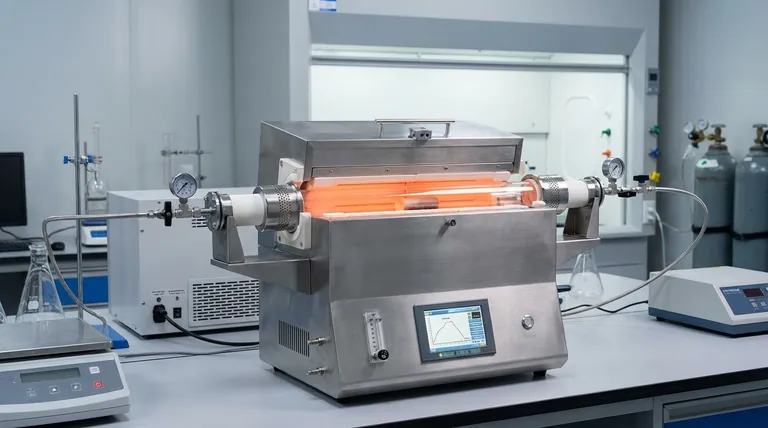
The primary function of a high-temperature tube furnace is to provide precise thermal activation energy to reactants while maintaining a strictly controlled atmospheric environment. Unlike standard heating elements, these furnaces allow you to isolate solid-state reactions in vacuum, reducing, or inert gas conditions to prevent oxidation and ensure chemical integrity.
The Core Value Proposition
In solid-state synthesis, temperature alone is insufficient; control over the reaction environment is equally vital. The tube furnace differentiates itself by delivering high thermal uniformity within a sealed atmosphere, making it the definitive tool for ensuring phase purity and correct crystal structures in sensitive materials.
The Mechanics of Synthesis Control
Precise Thermal Activation
At its most fundamental level, the tube furnace supplies the activation energy required to initiate solid-state reactions. By using resistance heating coils, the furnace generates consistent heat, often reaching temperatures up to 1400°C or higher depending on the model. This energy is essential for driving diffusion processes between solid reactants, such as in the reactive sintering of metal powders.
Atmospheric Isolation and Control
The defining feature of a tube furnace is its ability to modify the atmosphere surrounding the sample. The cylindrical chamber can be evacuated to create a vacuum or purged with specific gases like argon or nitrogen. This protects active metals (such as titanium) from oxidation and allows for reduction reactions that would be impossible in an open-air environment.
Ensuring Phase Purity
The primary reference highlights that high temperature uniformity is critical for the resulting material's quality. Variations in temperature can lead to incomplete reactions or the formation of secondary, unwanted phases. The tube furnace minimizes these risks by maintaining consistent thermal zones, ensuring the synthesized chemical products achieve complete crystal structures.
Advanced Process Capabilities
Uniform Thermal Distribution
Tube furnaces are engineered to reduce temperature gradients along the length of the heating zone. This longitudinal uniformity ensures that the entire sample experiences the exact same thermal history. This is vital for experimental integrity, as even minor fluctuations can compromise the stoichiometry of complex materials like MAX phase precursors.
Programmable Heating Profiles
Modern synthesis requires more than just "getting hot"; it requires a specific thermal journey. Advanced controllers allow for complex heating profiles, including specific ramp rates, soak times, and controlled cooling. This allows researchers to precisely manage reaction kinetics, such as the simultaneous carbonization and activation of biomass materials.
Understanding the Trade-offs
Sample Geometry Limitations
The cylindrical design, while excellent for atmosphere control, limits the size and shape of the samples you can process. You are restricted to boats or crucibles that fit within the diameter of the tube. This makes the tube furnace ideal for small-batch research or precise calcination, but less suitable for processing large, bulky components compared to box or muffle furnaces.
Complexity of Setup
Achieving the high purity promised by a tube furnace requires rigorous setup. You must manage gas flow rates, ensure vacuum seals are tight, and monitor pressure levels. If the gas lines are not properly connected or the tube is not securely mounted, you risk contaminating the sample despite the furnace's capabilities.
Making the Right Choice for Your Goal
To maximize the utility of a high-temperature tube furnace, align your operational settings with your specific chemical objectives:
- If your primary focus is Phase Purity: Prioritize the use of inert gas flows (like Argon) to eliminate oxygen and prevent surface contamination during the reaction.
- If your primary focus is Crystal Structure: utilize programmable ramp and soak times to ensure the sample remains in the optimal thermal zone long enough for complete diffusion.
- If your primary focus is Reproducibility: rigorous calibration of the temperature controller is required to maintain the uniformity that prevents batch-to-batch variations.
Ultimately, the high-temperature tube furnace is the bridge between raw reactants and a defined, pure solid-state material, provided the thermal and atmospheric controls are synchronized perfectly.
Summary Table:
| Feature | Primary Function in Synthesis | Benefit to Solid-State Materials |
|---|---|---|
| Thermal Activation | Supplies energy (up to 1400°C+) | Initiates diffusion and reaction between solid powders |
| Atmospheric Isolation | Vacuum, inert, or reducing gas control | Prevents oxidation and ensures chemical integrity |
| Thermal Uniformity | Consistent heating across the sample | Ensures phase purity and prevents secondary phases |
| Programmable Cycles | Controlled ramp, soak, and cooling | Manages reaction kinetics and crystal structure formation |
Elevate Your Material Research with KINTEK
Precision in thermal processing is the difference between a successful synthesis and a failed experiment. KINTEK provides high-performance Tube, Muffle, Rotary, Vacuum, and CVD systems designed to meet the rigorous demands of modern solid-state chemistry.
Backed by expert R&D and manufacturing, our systems are fully customizable to your unique thermal and atmospheric requirements. Whether you are scaling up synthesis or refining crystal structures, our laboratory high-temperature furnaces deliver the uniformity and control you need.
Ready to optimize your synthesis process? Contact KINTEK experts today to find your custom heating solution.
Visual Guide

References
- Xiaoyan Xiong, Tao Jin. Ta/Organo‐In Nanomaterials for Low‐Power or Room Temperature Triethylamine Response. DOI: 10.1002/slct.202405960
This article is also based on technical information from Kintek Furnace Knowledge Base .
Related Products
- 1400℃ High Temperature Laboratory Tube Furnace with Alumina Tube
- 1700℃ High Temperature Laboratory Tube Furnace with Alumina Tube
- 1200℃ Split Tube Furnace Laboratory Quartz Tube Furnace with Quartz Tube
- Vertical Laboratory Quartz Tube Furnace Tubular Furnace
- 1700℃ High Temperature Muffle Oven Furnace for Laboratory
People Also Ask
- How do high-temperature laboratory tube furnaces ensure environmental stability? Precision Thermal Reduction Tips
- How are high-temp tube furnaces used to measure diffusion coefficients per Fick's law? Master Precision Annealing
- How are high-temperature laboratory tube furnaces applied in long-term vacuum homogenization heat treatments for intermetallic samples?
- How are high-temperature tube furnaces applied in testing ceramic-supported alloy membranes? Insights
- How does a laboratory high-temperature tube furnace contribute to the conversion of electrospun fibers? Expert Insights



















