
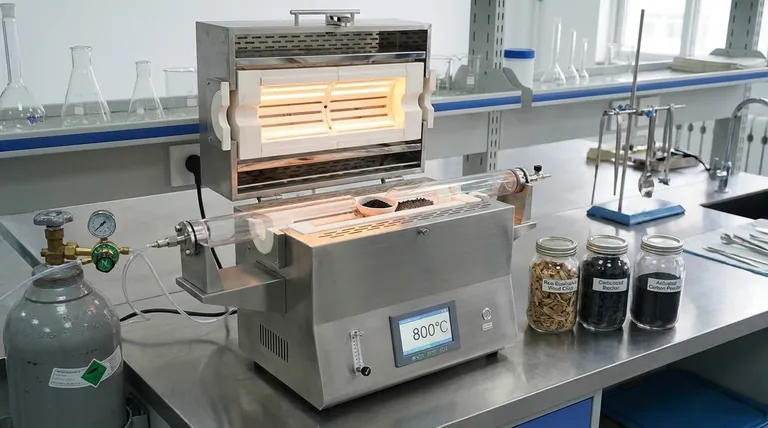
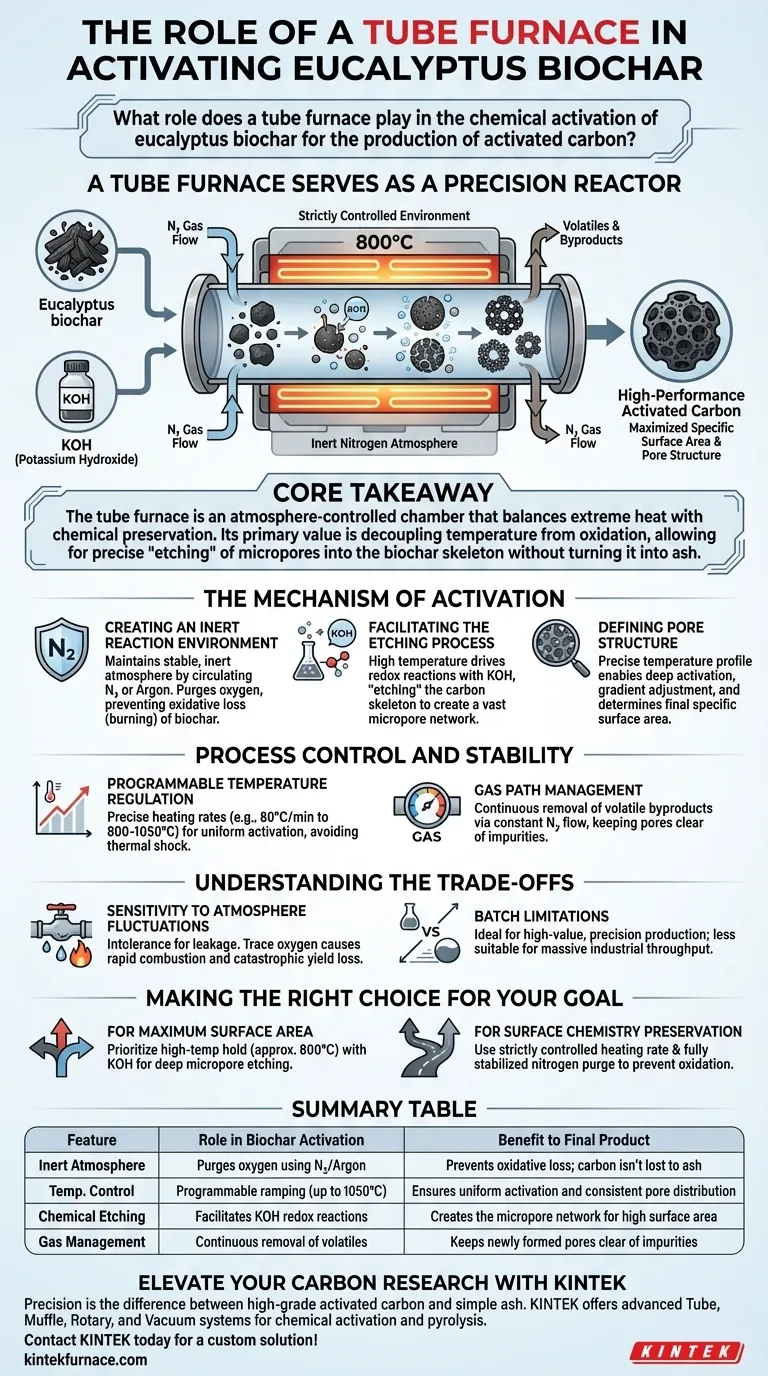
A tube furnace serves as a precision reactor that facilitates the chemical activation of eucalyptus biochar, transforming it into high-performance activated carbon. It provides a strictly controlled environment—typically at 800°C under an inert nitrogen atmosphere—that allows activation agents like potassium hydroxide (KOH) to etch the carbon structure without burning it away. This specific setup is required to maximize the material's specific surface area and develop the pore structure necessary for electrochemical applications.
Core Takeaway: The tube furnace is not merely a heating element; it is an atmosphere-controlled chamber that balances extreme heat with chemical preservation. Its primary value lies in decoupling temperature from oxidation, allowing for the precise "etching" of micropores into the biochar skeleton while preventing the material from turning into ash.
The Mechanism of Activation
Creating an Inert Reaction Environment
The most critical role of the tube furnace is maintaining a stable, inert atmosphere. By circulating nitrogen (N2) or argon, the furnace purges oxygen from the chamber.
This prevents oxidative loss, ensuring the eucalyptus biochar does not burn (oxidize) into carbon dioxide when subjected to extreme heat. Instead of consuming the carbon, the environment forces a targeted chemical reaction between the biochar and the activation agent.
Facilitating the Etching Process
Inside the furnace, the high temperature drives a reaction between the eucalyptus biochar and the chemical agent, specifically potassium hydroxide (KOH).
This process involves redox reactions that "etch" the carbon skeleton. The furnace provides the thermal energy required to drive this etching, creating a vast network of micropores within the material.
Defining Pore Structure
The specific surface area of the final product is directly determined by the furnace's operation.
By strictly controlling the temperature profile, the furnace enables the deep activation of the carbon. This physical restructuring allows for the gradient adjustment of the material's properties, resulting in a high specific surface area essential for superior electrochemical performance.
Process Control and Stability
Programmable Temperature Regulation
Precise heating rates are essential for uniform activation. The tube furnace allows for programmed temperature ramping, such as heating at 80°C/min up to target temperatures of 800°C or even 1050°C.
This precise control ensures the chemical activation occurs at the optimal rate. It prevents thermal shock to the material and ensures the pore size distribution is consistent throughout the batch.
Gas Path Management
A sophisticated gas path system ensures the continuous removal of volatile byproducts generated during pyrolysis.
By delivering a constant flow of nitrogen, the furnace sweeps away impurities that could reclog the newly formed pores. This flow management is a core physical requirement for keeping the activated sites accessible.
Understanding the Trade-offs
Sensitivity to Atmosphere Fluctuations
The primary vulnerability of using a tube furnace is its intolerance for leakage. If the gas seal is compromised or the nitrogen flow is interrupted, oxygen will ingress immediately.
At 800°C, even trace amounts of oxygen will cause rapid combustion of the biochar. This results in a catastrophic loss of yield and destroys the carefully engineered pore structure.
Batch Limitations
While excellent for precision, tube furnaces are typically batch-processing units. They are ideal for high-value, laboratory, or pilot-scale production where quality supersedes quantity.
For massive industrial throughput, the geometric constraints of the tube can be a limiting factor compared to continuous rotary kilns, though the tube furnace offers superior atmosphere control.
Making the Right Choice for Your Goal
To maximize the quality of your eucalyptus-derived activated carbon, align your furnace settings with your specific end-goal:
- If your primary focus is Maximum Surface Area: Prioritize a high-temperature hold (approx. 800°C) with KOH to drive deep micropore etching.
- If your primary focus is Surface Chemistry Preservation: Use a strictly controlled heating rate and ensure the nitrogen purge is fully stabilized before ramping up heat to prevent surface oxidation.
The tube furnace acts as the gatekeeper of quality, determining whether your biochar becomes high-grade activated carbon or simply ash.
Summary Table:
| Feature | Role in Biochar Activation | Benefit to Final Product |
|---|---|---|
| Inert Atmosphere | Purges oxygen using N2/Argon | Prevents oxidative loss; ensures carbon isn't lost to ash |
| Temp. Control | Programmable ramping (up to 1050°C) | Ensures uniform activation and consistent pore distribution |
| Chemical Etching | Facilitates KOH redox reactions | Creates the micropore network for high surface area |
| Gas Management | Continuous removal of volatiles | Keeps newly formed pores clear of impurities |
Elevate Your Carbon Research with KINTEK
Precision is the difference between high-grade activated carbon and simple ash. Backed by expert R&D and manufacturing, KINTEK offers advanced Tube, Muffle, Rotary, and Vacuum systems designed to meet the rigorous demands of chemical activation and pyrolysis.
Whether you need strictly controlled atmosphere management or customizable heating profiles for eucalyptus biochar research, our high-temp lab furnaces provide the stability and durability your project requires.
Ready to optimize your activation process? Contact KINTEK today for a custom solution!
Visual Guide
References
- Bordin Weerasuk, Tanagorn Kwamman. Enhanced dye removal and supercapacitor performance of polyethyleneimine-impregnated activated carbon derived from local eucalyptus biochar. DOI: 10.1039/d4su00421c
This article is also based on technical information from Kintek Furnace Knowledge Base .
Related Products
- Inclined Rotary Plasma Enhanced Chemical Deposition PECVD Tube Furnace Machine
- Vertical Laboratory Quartz Tube Furnace Tubular Furnace
- Inclined Rotary Plasma Enhanced Chemical Deposition PECVD Tube Furnace Machine
- Slide PECVD Tube Furnace with Liquid Gasifier PECVD Machine
- Custom Made Versatile CVD Tube Furnace Chemical Vapor Deposition CVD Equipment Machine
People Also Ask
- What are the main advantages of PECVD tube furnaces compared to CVD tube furnaces? Lower Temp, Faster Deposition, and More
- What is plasma in the context of PECVD? Unlock Low-Temperature Thin Film Deposition
- What are the typical conditions for plasma-enhanced CVD processes? Achieve Low-Temperature Thin Film Deposition
- What plasma source is used in PE-CVD tube furnaces? Unlock Low-Temperature, High-Quality Deposition
- What types of materials can be processed in rotary tube furnaces? Optimize Your Thermal Processing with Versatile Solutions



















