
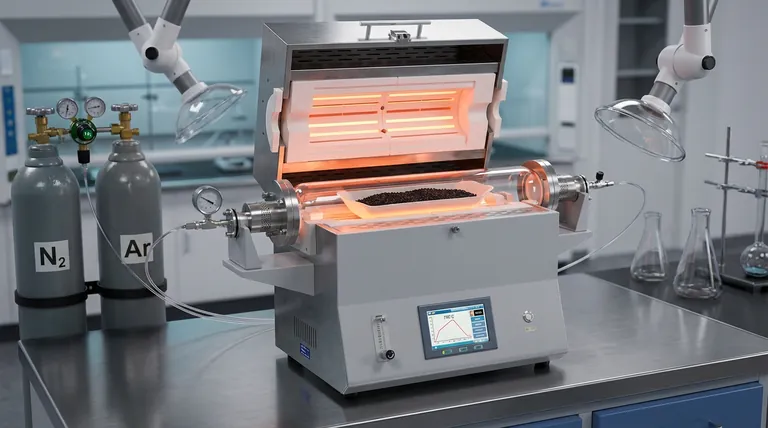
A high-performance tube furnace is mandatory for the chemical activation of carbon at 700°C because it guarantees the structural stability and gas-tight integrity required for the process to succeed. This specific equipment ensures the activation agent (such as zinc chloride or KOH) fully penetrates the carbon matrix, a prerequisite for accurately engineering the material's final pore size distribution and specific surface area.
The chemical activation process is a controlled etching of the carbon skeleton, not merely a heating phase. The high-performance tube furnace provides the requisite thermal precision and inert environment to transform raw carbonized material into a highly porous structure with immense surface area.
The Critical Role of Environmental Integrity
Maintaining Structural Stability
At temperatures approaching 700°C, the chemical reactions between carbon and activation agents are aggressive. A high-performance furnace is engineered to maintain structural stability throughout this thermal stress.
This stability prevents mechanical failure or warping of the containment vessel, which could disrupt the uniform distribution of heat needed for the reaction.
Ensuring Gas-Tight Operations
The primary requirement for this process is a gas-tight environment. The furnace must seal completely to prevent the ingress of oxygen, which would burn the carbon rather than activate it.
Furthermore, a gas-tight system contains the volatile byproducts of activation agents like zinc chloride, ensuring safety and process consistency over extended periods.
Facilitating Inert Atmospheres
To prevent uncontrolled oxidation, the process requires a continuous flow of inert gases, such as nitrogen or argon.
The tube furnace design is specifically optimized to manage this gas flow, protecting the carbon matrix while allowing for the directional removal of oxygen-containing functional groups.
Driving the Activation Mechanism
Achieving Full Agent Penetration
For activation to be effective, the chemical agent must do more than sit on the surface; it must permeate the material.
The precise thermal environment of the tube furnace ensures the activation agent melts or vaporizes correctly to fully penetrate the carbon matrix. This deep penetration is what induces the formation of the internal pore structure.
Controlling the Etching Process
The reaction at 700°C is often a redox reaction that "etches" the carbon skeleton.
By maintaining a consistent temperature, the furnace drives this reaction at a predictable rate, creating a dense network of micropores and mesopores rather than destroying the material entirely.
Defining Material Properties
Managing Pore Size Distribution
The ultimate goal of chemical activation is to tailor the porosity of the final product.
The level of control provided by a high-performance furnace allows operators to dictate the final pore size distribution. This ensures the activated carbon is optimized for its specific application, whether that is gas filtration or water purification.
Maximizing Specific Surface Area
Precision heating directly correlates to the total surface area of the activated carbon.
Variations in temperature or heating rate can collapse pores. A stable thermal environment preserves these structures, allowing for specific surface areas that can reach exceptionally high values (e.g., exceeding 2900 m²/g in optimized conditions).
Understanding the Trade-offs
Throughput Limitations
While tube furnaces offer unmatched precision, they often have limited volume compared to industrial rotary kilns or fluidized beds.
This makes them ideal for research, pilot testing, or high-value batch production, but potentially a bottleneck for mass production requiring tonnage-scale throughput.
Complexity of Operation
High-performance units require rigorous management of gas flows, heating ramps, and dwell times.
Achieving the results described above requires not just the hardware, but a skilled operator to program the segmented heating profiles (e.g., ramp rates of 80°C/min or multi-stage holds) correctly.
Making the Right Choice for Your Goal
- If your primary focus is material quality and precision: Prioritize a furnace with programmable heating zones and high-integrity vacuum sealing to maximize surface area and pore uniformity.
- If your primary focus is process safety: Ensure the furnace is rated for corrosive off-gassing management to handle agents like zinc chloride or hydroxides without degrading the heating elements.
The high-performance tube furnace is the defining tool that bridges the gap between raw carbonized matter and advanced, high-adsorption activated carbon.
Summary Table:
| Feature | Requirement for Activation | Benefit in Tube Furnaces |
|---|---|---|
| Atmosphere | Oxygen-free/Inert (N2/Ar) | Gas-tight seals prevent carbon oxidation |
| Temp. Stability | Consistent 700°C | Uniform etching for stable pore distribution |
| Corrosion Resist | Handle ZnCl2/KOH vapors | Durable materials withstand chemical etching |
| Surface Area | Maximize m²/g | Precise ramp rates preserve micro-pore structures |
| Control | Programmable segments | Optimized penetration of activation agents |
Elevate Your Material Research with KINTEK Technology
Precision chemical activation requires equipment that never compromises on environmental integrity. Backed by expert R&D and manufacturing, KINTEK offers high-performance Tube, Muffle, Rotary, and Vacuum systems tailored for the most demanding thermal processes.
Whether you are engineering microporous carbons or scaling pilot production, our customizable lab high-temp furnaces provide the thermal precision and gas-tight reliability you need to maximize specific surface area and material quality.
Ready to optimize your activation process? Contact KINTEK today to discuss your unique technical requirements.
References
- Rohit Yadav, Kusum Kumari. Synthesis and Electrochemical Characterization of Activated Porous Carbon Derived from Walnut Shells as an Electrode Material for Symmetric Supercapacitor Application. DOI: 10.3390/engproc2023059175
This article is also based on technical information from Kintek Furnace Knowledge Base .
Related Products
- 1700℃ High Temperature Laboratory Tube Furnace with Alumina Tube
- Vertical Laboratory Quartz Tube Furnace Tubular Furnace
- 1400℃ High Temperature Laboratory Tube Furnace with Alumina Tube
- Electric Rotary Kiln Small Rotary Furnace for Activated Carbon Regeneration
- High Pressure Laboratory Vacuum Tube Furnace
People Also Ask
- How does zone-melting in tube furnaces synthesize bismuth micro-wires? Master Single-Crystal Thermoelectric Growth
- How are high-temperature laboratory tube furnaces applied in long-term vacuum homogenization heat treatments for intermetallic samples?
- How are high-temp tube furnaces used to measure diffusion coefficients per Fick's law? Master Precision Annealing
- How do high-temperature laboratory tube furnaces ensure environmental stability? Precision Thermal Reduction Tips
- How are high-temperature tube furnaces applied in testing ceramic-supported alloy membranes? Insights



















