
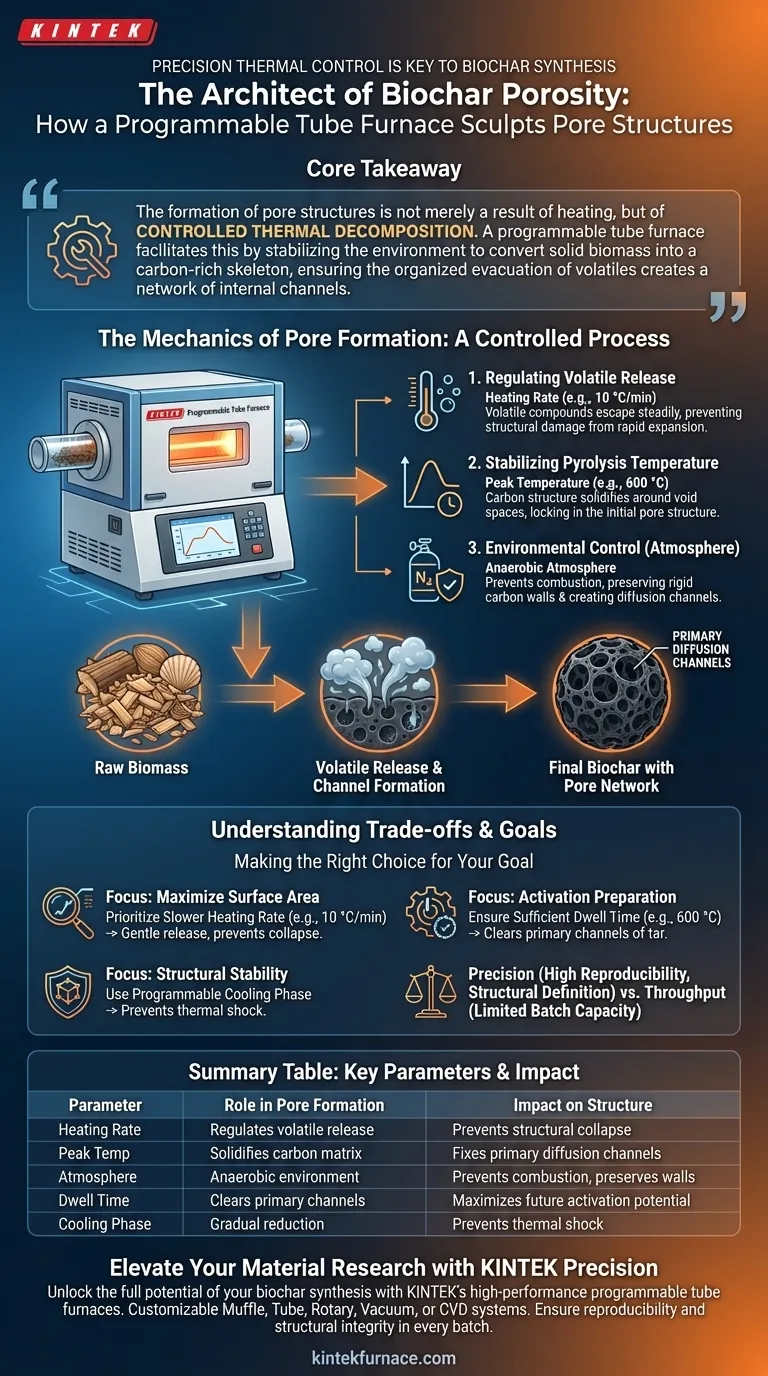
A programmable temperature control tube furnace acts as the architect of biochar porosity by precisely regulating the release of volatile compounds during pyrolysis. By enforcing a controlled heating rate (typically 10 °C/min) and maintaining a stable peak temperature (often 600 °C), the furnace ensures that volatile organic compounds escape steadily rather than explosively. This controlled off-gassing excavates "primary channels" within the carbon matrix, creating the essential void spaces and diffusion paths required for high-quality biochar.
Core Takeaway The formation of pore structures is not merely a result of heating, but of controlled thermal decomposition. A programmable tube furnace facilitates this by stabilizing the environment to convert solid biomass into a carbon-rich skeleton, ensuring the organized evacuation of volatiles creates a network of internal channels rather than a collapsed or chaotic structure.
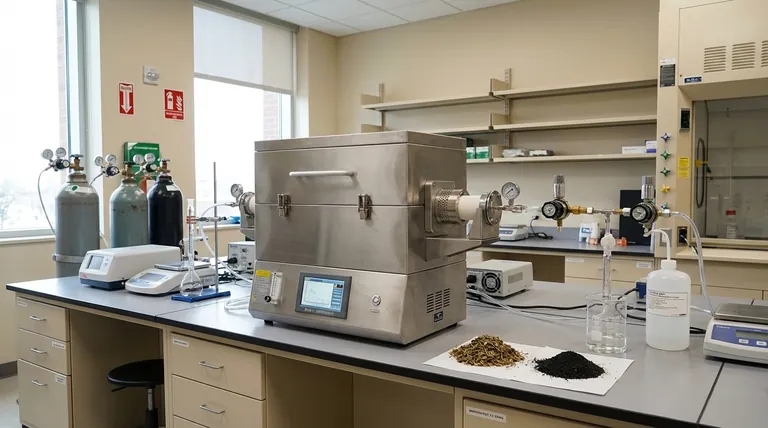
The Mechanics of Pore Formation
Regulating Volatile Release
The fundamental mechanism for creating pores is the removal of non-carbon elements. As the furnace ramps up heat, volatile organic compounds within the biomass (such as oil palm shell) begin to vaporize.
The programmable nature of the furnace allows you to set a specific heating rate, such as 10 °C/min. This strictly controlled pace ensures the volatiles are released steadily, preventing structural damage that might occur from rapid, uncontrolled expansion.
Stabilizing the Pyrolysis Temperature
Once the target temperature is reached, maintaining stability is critical for pore fixation. The primary reference highlights a steady hold at 600 °C.
At this temperature, the furnace ensures the complete release of remaining volatiles without inducing excessive thermal stress. This constant thermal environment allows the carbon structure to solidify around the void spaces left by the escaping gases, effectively locking in the initial pore structure.
Environmental Control and Matrix Development
Creating Primary Diffusion Channels
The structures formed in the tube furnace are often referred to as "primary channels." These are not necessarily the final micropores, but rather the macro- and meso-pathways through the material.
These channels are vital because they serve as diffusion paths. If you intend to perform subsequent physical or chemical activation on the biochar, these initial channels allow activating agents to penetrate deep into the matrix later in the process.
Atmosphere Management
While temperature is the chisel, the atmosphere is the shield. Tube furnaces typically operate under a controlled flow of nitrogen or other inert gases to create an anaerobic (oxygen-free) environment.
This protects the carbon skeleton from combustion. Instead of burning away the biomass structure, the oxygen-limited environment forces the material to undergo carbonization, preserving the rigid carbon walls that define the pore structure.
Understanding the Trade-offs
Precision vs. Throughput
A programmable tube furnace excels at reproducibility and structural definition. It allows you to dial in the exact "recipe" to maximize surface area and pore volume for research or high-value applications.
However, this precision comes at the cost of volume. Tube furnaces are generally batch-process tools with limited capacity compared to continuous industrial kilns. They are ideal for defining the optimal parameters for pore formation, but scaling that precise thermal profile to mass production requires careful engineering.
Heating Rate Sensitivity
While a controlled rate creates better pores, it is a slower process. Extremely slow heating rates might yield excellent structures but significantly increase the residence time and energy consumption per batch. Conversely, rushing the heating rate in a programmable furnace defeats the purpose, potentially leading to pore collapse or surface sealing before the internal volatiles can escape.
Making the Right Choice for Your Goal
To maximize the utility of your programmable tube furnace, align your settings with your specific structural objectives:
- If your primary focus is maximizing surface area: Prioritize a slower heating rate (e.g., 10 °C/min) to ensure gentle volatile release and prevent pore collapse.
- If your primary focus is preparing for activation: Ensure your dwell time at peak temperature (e.g., 600 °C) is sufficient to fully clear the primary channels of tar and volatiles.
- If your primary focus is structural stability: Use the programmable cooling phase to lower the temperature gradually, preventing thermal shock to the newly formed carbon skeleton.
Success in biochar synthesis lies in using the furnace not just as a heater, but as a precision instrument to sculpt the empty spaces within the material.
Summary Table:
| Parameter | Role in Pore Formation | Impact on Biochar Structure |
|---|---|---|
| Heating Rate | Regulates volatile release | Prevents structural collapse; ensures steady off-gassing |
| Peak Temperature | Solidifies carbon matrix | Fixes primary diffusion channels at optimal levels (e.g., 600°C) |
| Atmosphere | Anaerobic environment | Prevents combustion; preserves rigid carbon walls |
| Dwell Time | Clears primary channels | Removes residual tars to maximize future activation potential |
| Cooling Phase | Gradual temperature reduction | Prevents thermal shock to the newly formed carbon skeleton |
Elevate Your Material Research with KINTEK Precision
Unlock the full potential of your biochar synthesis with KINTEK’s high-performance programmable tube furnaces. Backed by expert R&D and world-class manufacturing, we provide the precision thermal control necessary to sculpt perfect pore structures and maximize surface area for your research or industrial applications.
Whether you need Muffle, Tube, Rotary, Vacuum, or CVD systems, our equipment is fully customizable to meet your unique laboratory requirements. Ensure reproducibility and structural integrity in every batch with our advanced heating technology.
Ready to optimize your thermal processes? Contact us today to find the perfect furnace for your lab!
Visual Guide
References
- Aik Chong Lua. Conversion of Oil Palm Kernel Shell Wastes into Active Biocarbons by N2 Pyrolysis and CO2 Activation. DOI: 10.3390/cleantechnol7030066
This article is also based on technical information from Kintek Furnace Knowledge Base .
Related Products
- 1200℃ Controlled Inert Nitrogen Atmosphere Furnace
- 1400℃ High Temperature Laboratory Tube Furnace with Alumina Tube
- Multi Heating Zones CVD Tube Furnace Machine for Chemical Vapor Deposition Equipment
- Custom Made Versatile CVD Tube Furnace Chemical Vapor Deposition CVD Equipment Machine
- 1700℃ High Temperature Laboratory Tube Furnace with Alumina Tube
People Also Ask
- What controlled-atmosphere furnace conditions are required for sintering powder metallurgy copper alloy compacts? Ideal Setup
- What are the operational considerations for a controlled atmosphere furnace? Master Key Factors for Material Processing
- What are the advantages of a controlled atmosphere furnace over tube furnaces? Superior Process Control for Sensitive Materials
- How does a controlled atmosphere furnace prevent oxidation and decarburization? Master Precision Heat Treatment
- How does a vacuum or controlled atmosphere furnace facilitate sessile-drop experiments? Optimize Alloy Wetting Analysis



















