
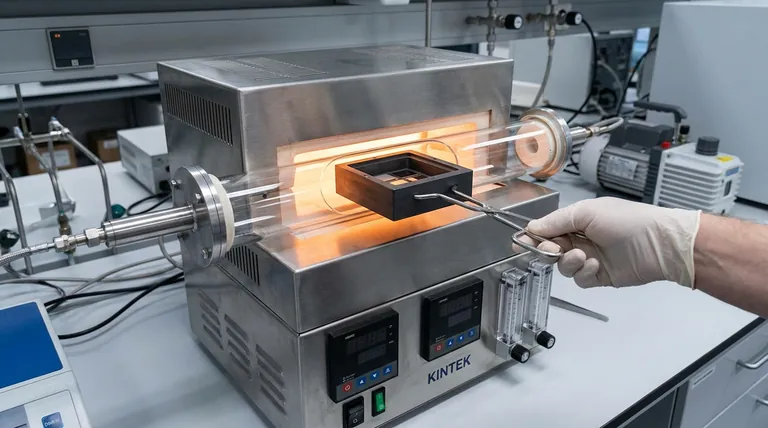
The combination of a tube furnace and a graphite box serves as a precision reactor for controlling volatile vapors. During the reactive thermal annealing of Sb2Se3 thin films, this specific configuration creates a localized, closed, quasi-equilibrium environment. The graphite material’s exceptional thermal conductivity ensures that Selenium (Se) vapor distributes evenly, reacting thoroughly with the pre-deposited Antimony (Sb) layer to synthesize quasi-one-dimensional (Q1-D) crystals at low temperatures (320 °C).
The graphite box acts as a thermal equalizer and vapor containment vessel, preventing the loss of volatile Selenium while ensuring a uniform reaction across the substrate surface.
Establishing the Quasi-Equilibrium Environment
The Function of the Closed System
The primary purpose of the graphite box is to create a micro-environment within the larger tube furnace. By physically enclosing the samples, the box minimizes the volume in which the reaction occurs. This confinement allows the system to reach a state of quasi-equilibrium rapidly.
Managing Vapor Pressure
Selenium is highly volatile and prone to evaporation. In an open system, Se vapor would easily disperse, leading to incomplete reactions or stoichiometry issues. The graphite box traps the Se vapor generated from the crucibles, maintaining the necessary vapor pressure to drive the reaction with the Antimony layer.
Lowering Process Temperatures
The efficiency of this contained environment facilitates synthesis at relatively low temperatures, specifically around 320 °C. This is significantly lower than annealing processes for many other thin films, reducing thermal stress on the substrate and conserving energy.
Ensuring Thermal and Chemical Uniformity
Leveraging Thermal Conductivity
Graphite possesses high thermal conductivity. When placed inside the heating zone of a tube furnace, the box absorbs and redistributes heat rapidly. This eliminates thermal gradients, ensuring that every part of the thin film experiences the exact same temperature profile.
Promoting Uniform Reactions
Temperature uniformity is directly linked to reaction uniformity. Because the heat is evenly distributed, the Selenium powder vaporizes at a consistent rate. This ensures the Se vapor reacts thoroughly with the Sb layer across the entire film surface, rather than creating localized islands of reaction.
Achieving Q1-D Crystal Structure
The ultimate goal of this uniformity is structural control. This specific thermal setup drives the formation of quasi-one-dimensional (Q1-D) Sb2Se3 crystals. This structural orientation is critical for the material's performance, as it relies on the precise, controlled interaction enabled by the graphite box.
Understanding the Trade-offs
Equipment Complexity
While effective, introducing a graphite box adds a variable to the annealing process. The box must be machined to precise tolerances to ensure it closes properly; a poor seal will result in vapor leakage and a loss of the equilibrium state.
Material Interaction Risks
Graphite is generally inert, but in high-temperature chemical processes, one must always ensure the box material does not contaminate the film. Furthermore, the box acts as a "thermal mass," meaning the heating and cooling rates of the samples inside will lag slightly behind the furnace setpoints, requiring calibration.
Making the Right Choice for Your Goal
Whether you utilize this setup depends on the specific structural requirements of your thin film application.
- If your primary focus is Crystal Quality: The graphite box is essential to ensure the high uniformity and correct stoichiometry required for Q1-D structures.
- If your primary focus is Process Efficiency: This setup allows you to achieve complete reactions at lower temperatures (320 °C), protecting sensitive substrates from high-heat damage.
By strictly controlling the thermal and chemical atmosphere, the graphite box transforms a standard furnace into a precision tool for high-quality crystal growth.
Summary Table:
| Feature | Function in Sb2Se3 Annealing | Benefit for Thin Film Synthesis |
|---|---|---|
| Graphite Box | Creates a closed quasi-equilibrium environment | Prevents Selenium vapor loss and ensures stoichiometry |
| Thermal Conductivity | Distributes heat rapidly and evenly | Eliminates thermal gradients for uniform crystal growth |
| Vapor Containment | Traps volatile Se vapor near the substrate | Drives thorough reaction at low temperatures (320 °C) |
| Q1-D Control | Precision thermal and chemical regulation | Facilitates the formation of quasi-one-dimensional crystals |
Elevate your material synthesis with KINTEK’s precision thermal solutions. Backed by expert R&D and manufacturing, KINTEK offers advanced Muffle, Tube, Rotary, Vacuum, and CVD systems—all fully customizable to meet your unique annealing and crystal growth requirements. Whether you are developing Q1-D thin films or complex semiconductors, our high-temperature furnaces provide the thermal stability and atmospheric control your research demands. Contact KINTEK today to discuss your custom furnace needs and optimize your lab's performance.
References
- Maykel Jiménez-Guerra, Edgardo Saucedo. KCN Chemical Etching of van der Waals Sb<sub>2</sub>Se<sub>3</sub> Thin Films Synthesized at Low Temperature Leads to Inverted Surface Polarity and Improved Solar Cell Efficiency. DOI: 10.1021/acsaem.3c01584
This article is also based on technical information from Kintek Furnace Knowledge Base .
Related Products
- 2200 ℃ Graphite Vacuum Heat Treat Furnace
- 1200℃ Split Tube Furnace Laboratory Quartz Tube Furnace with Quartz Tube
- Magnesium Extraction and Purification Condensing Tube Furnace
- Vacuum Sealed Continuous Working Rotary Tube Furnace Rotating Tube Furnace
- Vertical Laboratory Quartz Tube Furnace Tubular Furnace
People Also Ask
- Why are vacuum heat treating furnaces essential for aerospace? Ensure Superior Material Integrity for High-Stakes Applications
- What is the primary application of vacuum heat treating furnaces in aerospace? Enhance Component Performance with Precision
- How does a vacuum heat treating furnace improve the condition of metal alloys? Achieve Superior Metal Performance
- What is the process of vacuum heat treating? Achieve Superior Metallurgical Properties
- How does vacuum heat treating work in terms of temperature and time control? Master Precise Material Transformations



















