
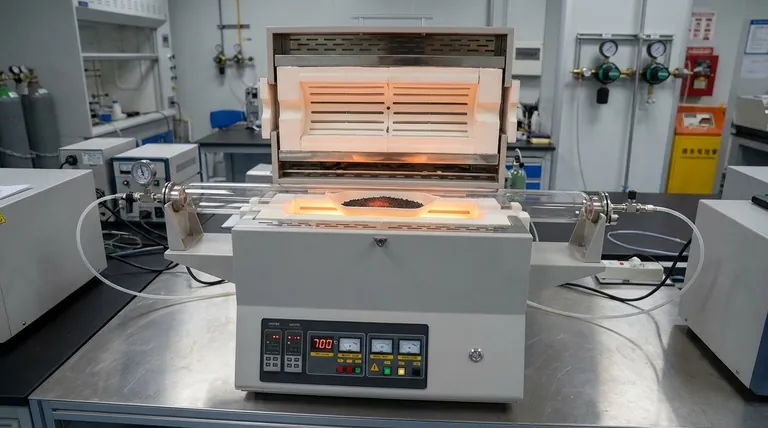
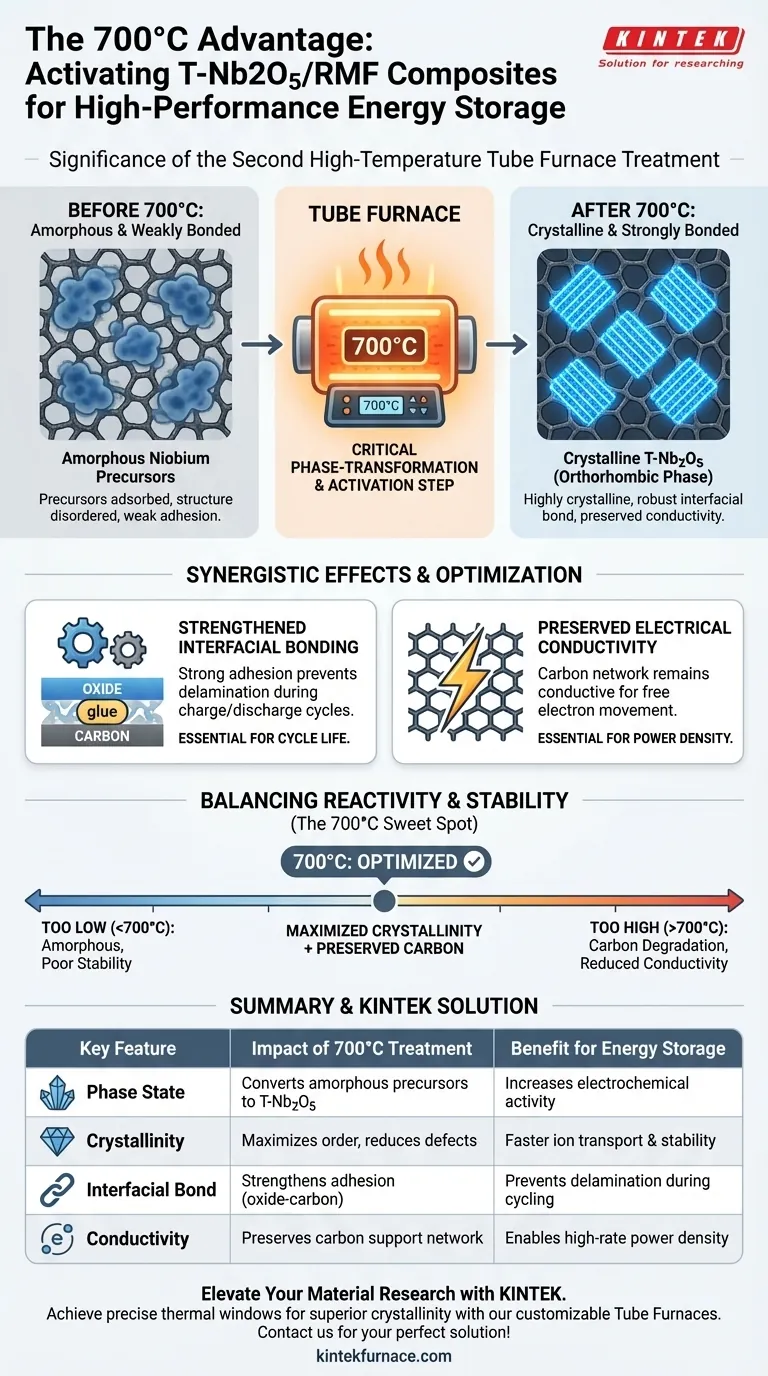
The significance of the second high-temperature tube furnace treatment at 700°C is that it acts as the primary crystallization and activation step. This process converts amorphous niobium precursors into the specific orthorhombic phase of niobium pentoxide (T-Nb2O5) while simultaneously creating a robust structural bond with the carbon support.
The 700°C treatment is not merely a drying step; it is a critical phase-transformation process that balances the formation of highly crystalline T-Nb2O5 with the preservation of the carbon support's electrical conductivity, directly unlocking high pseudocapacitive performance and long-term cycling stability.
The Mechanism of Phase Transformation
Creating the Orthorhombic Phase
The primary chemical objective of heating the composite to 700°C is to transform the niobium precursors.
These precursors, which are adsorbed within the carbon pores, are converted into the orthorhombic crystalline phase (T-Nb2O5). This specific crystal structure is essential for the material's electrochemical activity.
Enhancing Material Crystallinity
Beyond simple conversion, this high-temperature treatment significantly enhances the overall crystallinity of the material.
High crystallinity reduces internal defects within the metal oxide structure. This is crucial for facilitating efficient ion transport and ensuring the material performs reliably as an anode.
Synergistic Effects on the Composite Structure
Strengthening Interfacial Bonding
A critical physical change occurs at the boundary between the metal oxide and the carbon support.
The heat treatment strengthens the interfacial bonding between the T-Nb2O5 and the porous carbon matrix. This strong adhesion prevents the active material from detaching during the physical stress of charge/discharge cycles.
Preserving Electrical Conductivity
While high heat is used to crystallize the oxide, the process is tuned to protect the carbon support.
The 700°C treatment ensures the carbon retains its electrical conductivity. This conductive network is vital for allowing electrons to move freely through the composite, complementing the ion storage capabilities of the niobium oxide.
Understanding the Trade-offs
Balancing Reactivity and Stability
The selection of 700°C represents a precise optimization point for this composite material.
If the temperature were significantly lower, the niobium might remain amorphous or fail to reach the desired T-Nb2O5 phase, resulting in poor stability. Conversely, unchecked heating could degrade the carbon support or reduce its conductivity. The success of this material relies on hitting the specific thermal window where crystallinity is maximized without compromising the conductive carbon backbone.
Making the Right Choice for Your Goal
The 700°C treatment is the defining step for tailoring T-Nb2O5/RMF composites for high-performance energy storage.
- If your primary focus is Cycle Life: This treatment is essential because the strengthened interfacial bonding prevents material degradation and delamination over repeated uses.
- If your primary focus is Power Density: The preservation of the carbon's electrical conductivity ensures low resistance, allowing for rapid charge transfer and high pseudocapacitive rates.
By strictly adhering to the 700°C protocol, you ensure the creation of a robust, high-rate anode material that effectively leverages the strengths of both the metal oxide and the carbon support.
Summary Table:
| Key Feature | Impact of 700°C Treatment | Benefit for Energy Storage |
|---|---|---|
| Phase State | Converts amorphous precursors to T-Nb2O5 | Increases electrochemical activity |
| Crystallinity | Maximizes crystalline order while reducing defects | Faster ion transport & stability |
| Interfacial Bond | Strengthens adhesion between oxide and carbon | Prevents delamination during cycling |
| Conductivity | Preserves the carbon support's network | Enables high-rate power density |
Elevate Your Material Research with KINTEK
Precision heating is the backbone of advanced material synthesis. At KINTEK, we understand that achieving the exact thermal window for T-Nb2O5 crystallization requires uncompromising temperature uniformity and control.
Backed by expert R&D and world-class manufacturing, KINTEK offers a comprehensive range of Tube, Muffle, Rotary, Vacuum, and CVD systems. Whether you are optimizing anode composites or developing next-generation catalysts, our lab high-temp furnaces are fully customizable to meet your unique research needs.
Ready to achieve superior crystallinity in your composites? Contact us today to find the perfect furnace solution!
Visual Guide
References
- Qi Chen, Licheng Ling. Enhanced Electrochemical Performance of Dual-Ion Batteries with T-Nb2O5/Nitrogen-Doped Three-Dimensional Porous Carbon Composites. DOI: 10.3390/molecules30020227
This article is also based on technical information from Kintek Furnace Knowledge Base .
Related Products
- 1700℃ High Temperature Laboratory Tube Furnace with Alumina Tube
- 1700℃ Controlled Inert Nitrogen Atmosphere Furnace
- Molybdenum Vacuum Heat Treat Furnace
- 1400℃ High Temperature Laboratory Tube Furnace with Alumina Tube
- Vertical Laboratory Quartz Tube Furnace Tubular Furnace
People Also Ask
- How does zone-melting in tube furnaces synthesize bismuth micro-wires? Master Single-Crystal Thermoelectric Growth
- How are high-temp tube furnaces used to measure diffusion coefficients per Fick's law? Master Precision Annealing
- How do high-temperature laboratory tube furnaces ensure environmental stability? Precision Thermal Reduction Tips
- How are high-temperature laboratory tube furnaces applied in long-term vacuum homogenization heat treatments for intermetallic samples?
- How are high-temperature tube furnaces applied in testing ceramic-supported alloy membranes? Insights



















