
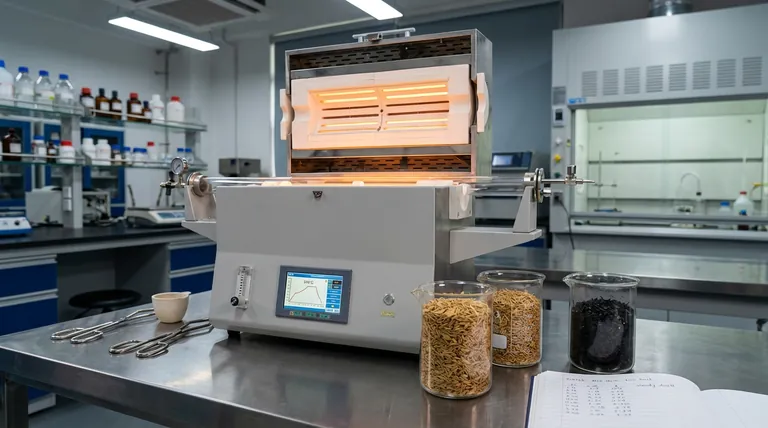
The primary technical advantage of using a tube furnace equipped with a controller for rice husk carbonization is the ability to maintain a strictly constant temperature environment while executing a programmable heating rate. This precise thermal regulation, often set to rates such as 5°C per minute, allows for the selective removal of volatiles without destroying the underlying material structure. By stabilizing the process at specific temperatures like 510°C, the equipment maximizes the preservation of the carbon skeleton and enables the formation of critical microporous structures.
Core Takeaway The value of a controller-equipped tube furnace lies in thermal discipline; by strictly controlling the heating ramp and dwell times, you transition from simple burning to precise synthesis, ensuring the rice husk retains a robust carbon skeleton with defined micropores rather than degrading into ash.
The Critical Role of Thermal Precision
Programmable Heating Rates
A controller allows you to define the exact speed at which the temperature rises, commonly around 5°C per minute for this application. This slow, controlled ramp is essential for preventing thermal shock and ensuring consistent chemical transitions within the biomass.
Selective Volatile Removal
Rice husks contain various volatile components that vaporize at different temperatures. By controlling the heating profile, the furnace allows these volatiles to escape gradually. This prevents the rapid expansion of gases that could rupture the material, ensuring the final product remains intact.
Preservation of the Carbon Skeleton
To create high-quality carbonized material, you must avoid overheating or uncontrolled combustion. Maintaining a specific temperature, such as 510°C, ensures the carbon skeleton is preserved. This "sweet spot" strikes a balance between removing impurities and retaining the structural integrity of the husk.
Formation of Microporous Structures
The ultimate goal of carbonizing rice husks is often to create a material with high surface area. The precision provided by the controller facilitates the preliminary formation of microporous structures. These pores are the defining feature that gives the carbonized husk its utility in filtration or energy storage applications.
Broader Operational Advantages
Uniform Temperature Distribution
Tube furnaces are designed to provide consistent heating along the length of the cylindrical tube. This ensures that every rice husk in the batch is subjected to the exact same thermal conditions, leading to a highly uniform product.
Atmosphere Control
While the primary focus is temperature, tube furnaces excel at operating under controlled atmospheres. This is vital for carbonization, as it allows you to introduce inert gases to prevent oxidation (burning away the carbon) during the high-temperature phase.
Scalability and Continuous Production
Supplementary data indicates that tube furnaces are capable of continuous production. While often used for batch processing in labs, the technology is mature enough that multiple units can be combined to support larger-scale manufacturing needs.
Understanding the Trade-offs
Throughput Limitations
While tube furnaces offer precision, the requirement for slow heating rates (e.g., 5°C/min) can create a bottleneck. High-quality carbonization is inherently a slower process than rapid combustion methods, potentially limiting daily throughput.
Volume Constraints
The geometry of a tube furnace limits the volume of material that can be processed at once. To achieve the uniform heating mentioned above, the tube cannot be overloaded, which requires careful batch management or investing in multiple units for volume production.
Making the Right Choice for Your Goal
To maximize the utility of a tube furnace for rice husk carbonization, align your settings with your specific objectives:
- If your primary focus is Structural Integrity: Prioritize a slow, programmable heating rate (approx. 5°C/min) to prevent thermal shock and structural collapse.
- If your primary focus is Micropore Development: Ensure the controller is calibrated to hold a strict dwell time at the optimal temperature (e.g., 510°C) to lock in the pore structure.
- If your primary focus is Production Consistency: Utilize the furnace's ability to maintain a uniform temperature zone to ensure every batch meets identical quality standards.
Precision control transforms the carbonization of rice husks from a crude disposal method into a sophisticated material synthesis process.
Summary Table:
| Feature | Technical Advantage | Impact on Carbonization |
|---|---|---|
| Programmable Controller | Precise heating rates (e.g., 5°C/min) | Prevents thermal shock; selective volatile removal. |
| Thermal Stability | Constant temperature dwell (e.g., 510°C) | Preserves carbon skeleton; ensures structural integrity. |
| Atmosphere Control | Inert gas introduction | Prevents oxidation and unintended combustion. |
| Heating Uniformity | Cylindrical zone consistency | Ensures uniform product quality across the entire batch. |
| Pore Engineering | Controlled thermal discipline | Facilitates development of high-surface-area micropores. |
Elevate Your Material Synthesis with KINTEK Precision
Transition from simple biomass burning to sophisticated carbon engineering. Backed by expert R&D and world-class manufacturing, KINTEK offers a comprehensive range of Tube, Muffle, Rotary, Vacuum, and CVD systems tailored for high-stakes research and industrial production. Whether you are carbonizing rice husks or developing advanced energy storage materials, our customizable laboratory furnaces provide the thermal discipline you need to ensure consistent, high-quality results.
Ready to optimize your carbonization process?
Contact KINTEK today for a customized solution
References
- Bakhytzhan Lesbayev, Ayazhan Zhamash. Preparation of Nanoporous Carbon from Rice Husk with Improved Textural Characteristics for Hydrogen Sorption. DOI: 10.3390/jcs8020074
This article is also based on technical information from Kintek Furnace Knowledge Base .
Related Products
- Vacuum Sealed Continuous Working Rotary Tube Furnace Rotating Tube Furnace
- 1400℃ High Temperature Laboratory Tube Furnace with Alumina Tube
- 1700℃ High Temperature Laboratory Tube Furnace with Alumina Tube
- Magnesium Extraction and Purification Condensing Tube Furnace
- High Pressure Laboratory Vacuum Tube Furnace
People Also Ask
- What is the purpose of rotary tube furnaces? Achieve Uniform Heat Treatment for Powders and Granules
- What are the key advantages of using a rotary tube furnace? Achieve Dynamic, Uniform Heating for Powders
- How does the amount of material processed vary between batch and continuous rotary tube furnaces? Scale Your Production Efficiently
- What are the advantages of rotary tube furnaces in fuel compatibility? Boost Efficiency and Cut Costs
- What is the temperature range of some rotary tube furnaces? Achieve Uniform Heating Up to 1200°C



















