
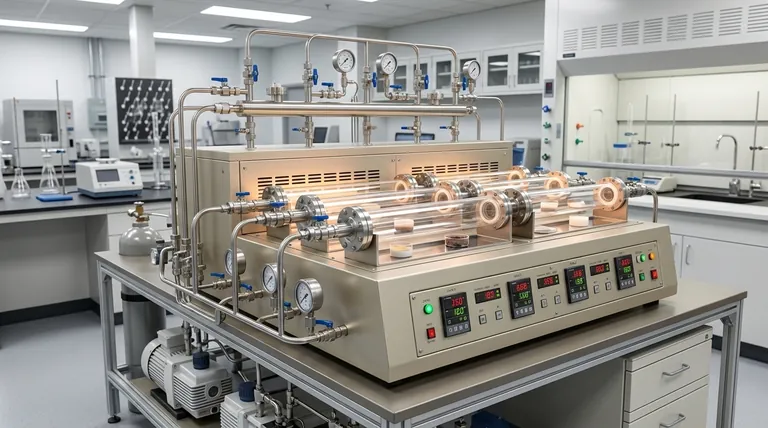
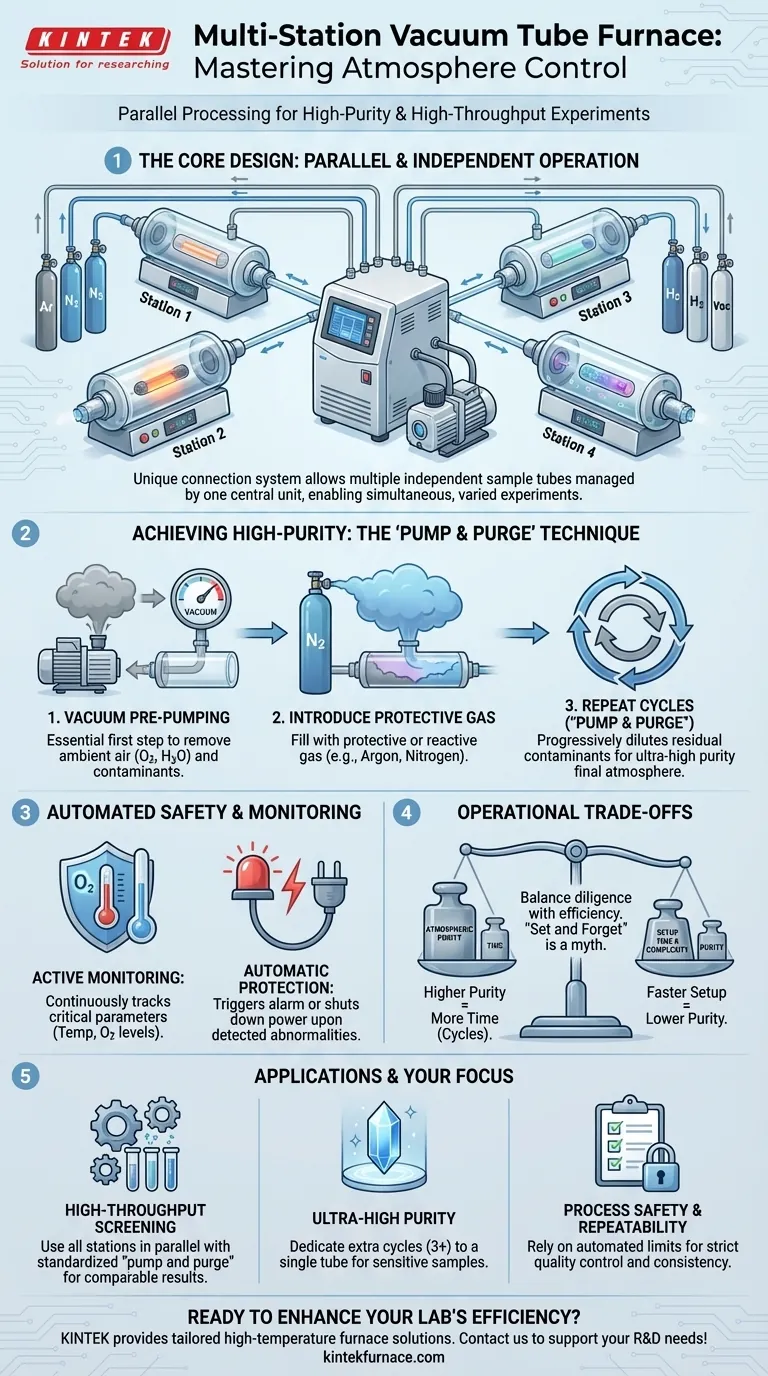
The defining feature of a multi-station vacuum tube furnace is its unique connection system, which allows multiple, independent sample tubes to be managed by a single central unit. This design enables the simultaneous execution of several high-temperature experiments, each with its own precisely controlled atmosphere, ranging from a high vacuum to various protective or reactive gases.
The true value of a multi-station furnace lies in its ability to achieve high-purity atmospheres across several parallel experiments. However, unlocking this capability is entirely dependent on following a strict operational procedure: first evacuating ambient air with a vacuum pump, and then introducing the desired protective gas.
The Core Design: Parallel and Independent Operation
A multi-station furnace is architecturally designed for efficiency and parallel processing. Understanding its structure is key to understanding its function.
How Multi-Station Connectivity Works
The system uses a specialized manifold or connection method that links several furnace tubes to a common vacuum pump and gas delivery system.
Crucially, each tube can be isolated. This allows you to run different processes with different atmospheres simultaneously without interference, maximizing laboratory throughput.
Two-Part Structure
The furnace is typically divided into two sections. The upper part contains the heating elements and the multiple furnace tubes, which can often be tilted or manipulated for easy loading and unloading of samples.
The lower part houses the electric control components. This centralized control unit manages temperature profiles, gas flow, and vacuum levels for all stations, providing a single point of programming and monitoring.
Achieving a High-Purity Atmosphere
The primary goal of atmosphere control is to protect samples from unwanted reactions, typically with oxygen, at high temperatures. The furnace's design is optimized for this purpose.
The Critical First Step: Vacuum Pre-Pumping
Before introducing any protective gas, it is essential to pre-pump a vacuum inside the furnace tube.
This initial step removes the ambient air—most importantly oxygen and moisture—which would otherwise contaminate your sample and compromise the experiment.
The "Pump and Purge" Technique
For experiments requiring the highest possible purity, a single vacuum pump-down is not enough. The recommended procedure is to repeat the process several times.
This technique, often called "pump and purge" or gas cycling, involves evacuating the tube, refilling it with the protective gas, and then evacuating it again. Each cycle progressively dilutes and removes residual contaminants, dramatically enhancing the purity of the final atmosphere.
Automated Safety and Monitoring
Modern multi-station furnaces feature program-controlled protection systems. These systems actively monitor critical parameters like furnace temperature and internal oxygen content.
If an abnormality is detected—such as a sudden temperature spike or a leak that raises oxygen levels—the system can automatically trigger an alarm or shut down power. This protects not only the valuable samples but also the furnace equipment itself.
Understanding the Operational Trade-offs
While powerful, the effectiveness of a multi-station furnace is directly tied to operational diligence. Cutting corners will compromise your results.
Purity vs. Time
The primary trade-off is between the level of atmospheric purity and the time spent on preparation. Performing multiple "pump and purge" cycles yields a much purer environment but significantly increases the setup time for each experiment.
Central Control Complexity
Managing multiple simultaneous experiments from a single interface requires careful programming and monitoring. An error in setting up the parameters for one station could potentially affect the gas flow or vacuum for another if not configured correctly, demanding user precision.
The Myth of "Set and Forget"
Achieving a truly inert atmosphere is an active process. Simply flowing a protective gas into the tube without first evacuating the ambient air is a common mistake that leads to sample oxidation and failed experiments. The vacuum step is not optional; it is fundamental to the process.
Applying This to Your Experiment
Your specific goal will determine the best way to leverage the furnace's capabilities.
- If your primary focus is high-throughput screening: Use all stations in parallel, but ensure your "pump and purge" procedure is standardized across all of them to guarantee comparable results.
- If your primary focus is ultra-high purity for one sensitive sample: Dedicate extra time to that single tube, performing three or more pump-and-purge cycles before beginning the heating process.
- If your primary focus is process safety and repeatability: Rely on the automated monitoring programs to define acceptable limits for oxygen or temperature, ensuring every run adheres to the same strict quality controls.
Ultimately, the furnace's unique design empowers you to run multiple, high-purity experiments in parallel, provided you master the essential procedure of evacuating before filling.
Summary Table:
| Feature | Description |
|---|---|
| Multi-Station Connectivity | Allows multiple independent tubes connected to a central vacuum and gas system for simultaneous experiments |
| Atmosphere Control Range | Supports high vacuum to various protective or reactive gases for precise sample protection |
| Pump and Purge Technique | Uses repeated vacuum and gas cycles to achieve ultra-high purity atmospheres |
| Automated Safety Monitoring | Program-controlled systems monitor temperature and oxygen levels, triggering alarms or shutdowns for safety |
| Operational Trade-offs | Balances purity vs. setup time and requires careful programming for multiple stations |
Ready to enhance your lab's efficiency with advanced high-temperature furnace solutions?
At KINTEK, we leverage exceptional R&D and in-house manufacturing to provide diverse laboratories with tailored high-temperature furnace solutions. Our product line includes Muffle, Tube, Rotary Furnaces, Vacuum & Atmosphere Furnaces, and CVD/PECVD Systems, complemented by strong deep customization capabilities to precisely meet your unique experimental requirements.
Whether you're focused on high-throughput screening, ultra-high purity processes, or ensuring safety and repeatability, our multi-station vacuum tube furnaces can help you achieve superior results.
Contact us today to discuss how we can support your research and development needs!
Visual Guide
Related Products
- Split Chamber CVD Tube Furnace with Vacuum Station CVD Machine
- Multi Heating Zones CVD Tube Furnace Machine for Chemical Vapor Deposition Equipment
- Multi Zone Laboratory Quartz Tube Furnace Tubular Furnace
- Vacuum Sealed Continuous Working Rotary Tube Furnace Rotating Tube Furnace
- Split Multi Heating Zone Rotary Tube Furnace Rotating Tube Furnace
People Also Ask
- What role does a Tube Furnace play in the CVD growth of carbon nanotubes? Achieve High-Purity CNT Synthesis
- How does a CVD tube furnace achieve high purity in gate media preparation? Master Precision Control for Flawless Films
- What are the operational and maintenance requirements for a CVD tube furnace? Ensure Precision for Thin Film Deposition
- What are the advantages of using a CVD tube furnace for preparing gate dielectrics? Achieve High-Quality Thin Films for Transistors
- What temperature range do standard CVD tube furnaces operate at? Unlock Precision for Your Material Deposition



















