
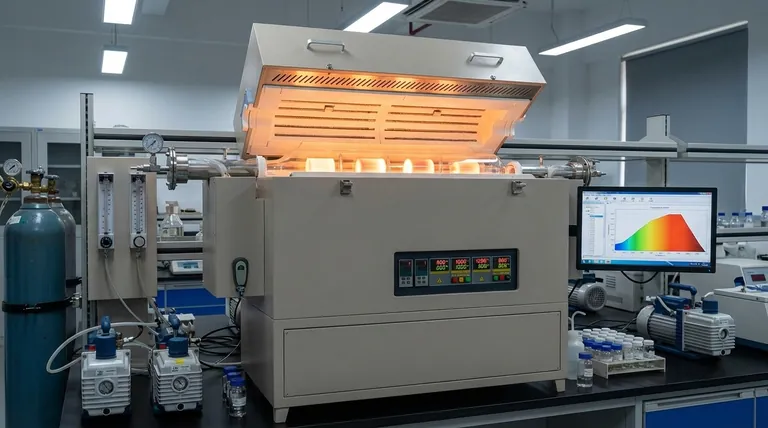
At their core, multi-zone tube furnaces offer an unparalleled level of control over the thermal environment within the reaction tube. Unlike single-zone furnaces that create a single hot spot, multi-zone systems allow you to establish and maintain distinct, stable temperature zones along the length of the tube. This capability enables you to create either an exceptionally uniform heating area or a precise, deliberate temperature gradient, which is critical for advanced chemical reaction studies.
The fundamental advantage is not just heating, but actively engineering the temperature profile along the reaction pathway. This transforms the furnace from a simple heat source into a precision instrument for controlling material synthesis and studying complex reaction mechanisms.
The Core Advantage: Engineering the Temperature Profile
A standard single-zone furnace has one setpoint and produces a temperature profile that peaks in the center and naturally drops off toward the ends. A multi-zone furnace overcomes this limitation by using multiple independent heating elements and controllers.
Independent Control Creates Flexibility
Each zone is monitored by its own thermocouple and managed by a dedicated controller. This allows you to set a different temperature for each section of the tube.
This independent control is the key that unlocks the furnace's two primary modes of operation: creating extended uniformity or establishing a specific thermal gradient.
Key Applications Unlocked by Multi-Zone Control
This precise control over the thermal landscape is not just an incremental improvement; it enables entire categories of experiments that are difficult or impossible to perform otherwise.
Achieving Superior Temperature Uniformity
For many processes, such as growing crystals or annealing materials, a long, stable, and highly uniform hot zone is required. A single-zone furnace's effective uniform zone is often quite short.
By setting all zones in a multi-zone furnace to the same temperature, the end zones can be programmed to compensate for natural heat loss. This creates a significantly longer and more stable uniform temperature profile across the furnace's central axis, ensuring reproducibility and consistent results.
Creating Precise Thermal Gradients
Many modern chemical processes, especially in nanomaterial synthesis and chemical vapor deposition (CVD), rely on a sequence of temperature-dependent steps.
A multi-zone furnace allows you to create a specific gradient. For example, you can use the first zone to vaporize a precursor material at a lower temperature, the central zone to host the high-temperature reaction or deposition, and the final zone to control the cooling rate. This control over the reaction mechanism is crucial for synthesizing materials with specific properties, like uniform nanoparticle morphology.
Increasing Experimental Throughput
The ability to create distinct thermal zones within a single furnace allows for process optimization and higher throughput.
You can perform simultaneous processes, such as sintering different samples at their unique optimal temperatures within the same run. This minimizes the need for multiple furnaces and reduces the risk of contamination or errors that can occur when transferring samples between different heating steps.
Understanding the Trade-offs
While powerful, multi-zone furnaces introduce a higher level of complexity compared to their single-zone counterparts.
Increased Cost and Complexity
Multi-zone furnaces are inherently more expensive due to the additional heating elements, thermocouples, and sophisticated controllers required. Programming and calibrating these systems also demands more technical expertise to fully leverage their capabilities.
Potential for More Failure Points
With more components comes an increase in potential points of failure. A malfunction in a single controller or thermocouple can compromise an entire experiment, requiring more diligent maintenance and calibration schedules to ensure reliable operation.
Making the Right Choice for Your Research
Choosing between a single-zone and a multi-zone furnace depends entirely on the specific demands of your experimental work.
- If your primary focus is consistent annealing or basic synthesis in a small area: A high-quality single-zone furnace may provide all the stability and control you need.
- If your primary focus is growing uniform nanoparticles or crystals over a large area: A multi-zone furnace set for maximum uniformity will deliver far superior results.
- If your primary focus is complex, multi-step synthesis like CVD: A multi-zone furnace is indispensable for creating the necessary thermal gradients.
- If your primary focus is high-throughput screening or process optimization: A multi-zone furnace can significantly accelerate your workflow by running parallel or sequential processes in one unit.
Ultimately, investing in a multi-zone tube furnace grants you precise command over the thermal landscape of your reaction.
Summary Table:
| Feature | Benefit |
|---|---|
| Independent Zone Control | Enables precise thermal gradients and uniform heating for complex reactions |
| Extended Uniformity | Improves reproducibility in crystal growth and annealing |
| Thermal Gradient Creation | Facilitates multi-step processes like CVD and nanomaterial synthesis |
| Increased Throughput | Allows simultaneous experiments, reducing time and contamination risks |
Ready to enhance your chemical reaction studies with advanced thermal control? KINTEK specializes in high-temperature furnace solutions, including multi-zone tube furnaces, backed by exceptional R&D and in-house manufacturing. Our deep customization capabilities ensure precise alignment with your unique experimental needs, whether for nanomaterials, CVD, or high-throughput applications. Contact us today to discuss how we can optimize your lab's performance!
Visual Guide

Related Products
- Split Multi Heating Zone Rotary Tube Furnace Rotating Tube Furnace
- Multi Heating Zones CVD Tube Furnace Machine for Chemical Vapor Deposition Equipment
- Multi Zone Laboratory Quartz Tube Furnace Tubular Furnace
- Magnesium Extraction and Purification Condensing Tube Furnace
- Vacuum Sealed Continuous Working Rotary Tube Furnace Rotating Tube Furnace
People Also Ask
- What are the main applications of multi zone tube furnaces in university laboratories? Unlock Precision in Material Science and Energy Research
- How are multi zone tube furnaces used in ceramics, metallurgy and glass research? Unlock Precise Thermal Control for Advanced Materials
- What role do multi zone tube furnaces play in new energy research? Unlock Precise Thermal Control for Innovation
- Why are multi zone tube furnaces particularly useful for nanomaterial research? Unlock Precise Thermal Control for Advanced Synthesis
- What temperature-related capabilities make multi zone tube furnaces valuable for research? Unlock Precision Thermal Control



















