
The fundamental advantage of individual temperature control in a multi-zone furnace is the ability to create a precise and non-uniform thermal landscape. Unlike a single-zone furnace that aims for one uniform temperature, a multi-zone design allows you to dictate different temperatures in different sections of the process chamber simultaneously. This capability transforms the furnace from a simple heater into a sophisticated tool for advanced thermal processing.
A single-zone furnace can hold a target temperature. A multi-zone furnace, however, can establish a specific temperature gradient or a sequence of thermal profiles, enabling complex processes like controlled crystal growth and advanced materials synthesis that are impossible with uniform heat.
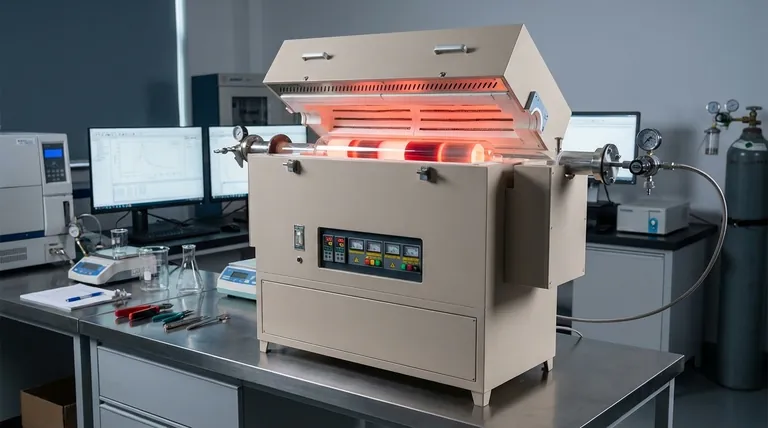
The Power of the Temperature Gradient
The true value of a multi-zone furnace lies in its ability to move beyond simple, uniform heating and create controlled temperature gradients. This opens the door to a new level of process control.
Achieving Unparalleled Process Precision
By setting different temperature setpoints for each zone, you can ensure different parts of a sample experience different thermal conditions at the same time. This is not a bug; it is a critical feature for many advanced applications.
For example, in semiconductor fabrication, this control is essential for managing dopant diffusion or for chemical vapor deposition (CVD), where different precursor gases need to react at specific temperatures along the length of a tube.
Creating Custom Thermal Profiles
A multi-zone furnace gives you granular control over the entire thermal cycle. You can precisely tune the heat-up and cool-down stages for different sections of your material.
This allows for the synthesis of intricate materials, such as nanomaterials or complex ceramics, where distinct phases of formation require unique and localized heat treatment.
Enhancing Overall Temperature Uniformity
Paradoxically, having multiple zones can also be the best way to achieve a larger area of perfect thermal uniformity. In any furnace, heat is naturally lost at the ends.
A multi-zone furnace compensates for this by allowing you to run the end zones at a slightly higher temperature. This counteracts the natural heat loss, creating a longer, more stable, and more perfectly uniform flat zone in the central processing area.
Practical and Operational Benefits
Beyond advanced material science, the ability to control distinct thermal zones provides tangible advantages in day-to-day lab and production work.
Isolating Peak Temperatures
Multi-zone control allows you to concentrate extreme heat in one section, typically the center, while keeping the end zones significantly cooler.
This design is invaluable for safety and equipment integration. It ensures the ends of a tube furnace, where gas lines or monitoring equipment may be attached, remain at a safe, manageable temperature.
Optimizing for Complex Geometries
When heating a part with varying thickness, a single heat source will cause thinner sections to overheat while thicker sections struggle to reach the target temperature.
A multi-zone furnace solves this by applying more energy to the zones heating the thicker sections and less to those heating the thinner sections, resulting in uniform heat distribution throughout the entire part.
Understanding the Trade-offs
While powerful, multi-zone furnaces introduce complexities that are not present in simpler single-zone designs. Understanding these is key to making an informed decision.
Increased Cost and Complexity
A multi-zone furnace requires separate thermocouples, power controllers, and control logic for each zone. This inherently increases the initial purchase price and the complexity of programming and operation.
The Challenge of Zone Interaction
The heating zones within a furnace are not perfectly isolated. Heat from a hotter zone will inevitably "bleed" over and influence its neighbors.
Maintaining a stable and precise temperature gradient requires sophisticated PID control algorithms that can account for this interaction between zones. Cheaper or poorly tuned controllers may struggle to hold a stable, non-uniform profile.
Making the Right Choice for Your Goal
The decision between a single-zone and a multi-zone furnace should be driven entirely by your process requirements, not just a desire for more features.
- If your primary focus is maximum thermal uniformity over a large area: A three-zone (or more) furnace is the superior choice, as it can actively compensate for heat loss at the furnace ends.
- If your primary focus is material synthesis or creating gradients: A multi-zone furnace is essential for executing the specific, non-uniform temperature profiles required for processes like crystal growth or specialized testing.
- If your primary focus is simple annealing, drying, or debinding at a single temperature: A single-zone furnace is often the most reliable, simple, and cost-effective solution for your needs.
Ultimately, choosing the right furnace means matching the equipment's capability to the specific thermal process you need to execute.
Summary Table:
| Advantage | Description |
|---|---|
| Precise Temperature Gradients | Enables non-uniform thermal landscapes for complex processes like crystal growth and CVD. |
| Custom Thermal Profiles | Allows granular control over heat-up and cool-down stages for advanced materials synthesis. |
| Enhanced Uniformity | Compensates for heat loss to create larger, more stable uniform zones in the furnace. |
| Safety and Integration | Isolates peak temperatures for safer operation and better equipment integration. |
| Optimization for Geometries | Applies tailored heating to parts with varying thickness for uniform heat distribution. |
Ready to elevate your lab's capabilities with advanced thermal processing? KINTEK leverages exceptional R&D and in-house manufacturing to provide diverse laboratories with high-temperature furnace solutions, including Muffle, Tube, Rotary Furnaces, Vacuum & Atmosphere Furnaces, and CVD/PECVD Systems. Our strong deep customization capability ensures we precisely meet your unique experimental requirements. Contact us today to discuss how our multi-zone furnaces can bring unparalleled precision and efficiency to your work!
Visual Guide

Related Products
- Multi Zone Laboratory Quartz Tube Furnace Tubular Furnace
- Multi Heating Zones CVD Tube Furnace Machine for Chemical Vapor Deposition Equipment
- Split Multi Heating Zone Rotary Tube Furnace Rotating Tube Furnace
- Magnesium Extraction and Purification Condensing Tube Furnace
- Mesh Belt Controlled Atmosphere Furnace Inert Nitrogen Atmosphere Furnace
People Also Ask
- What temperature-related capabilities make multi zone tube furnaces valuable for research? Unlock Precision Thermal Control
- What role do multi zone tube furnaces play in new energy research? Unlock Precise Thermal Control for Innovation
- What environmental protection applications utilize multi zone tube furnaces? Unlock Precision in Waste Treatment and Green Tech
- Why are multi zone tube furnaces particularly useful for nanomaterial research? Unlock Precise Thermal Control for Advanced Synthesis
- What are the main applications of multi zone tube furnaces in university laboratories? Unlock Precision in Material Science and Energy Research



















