
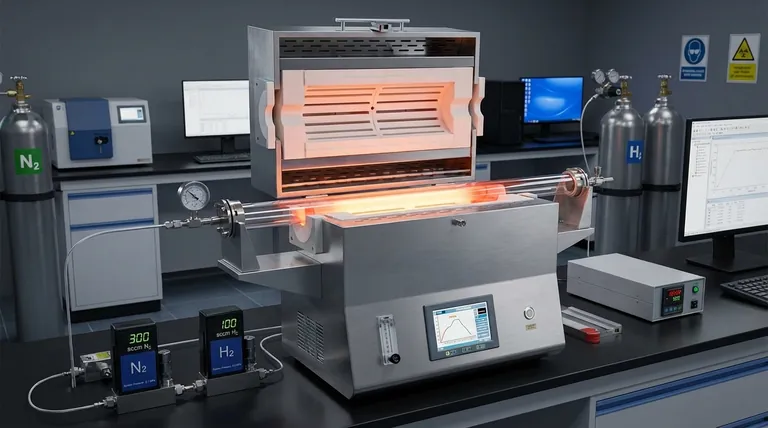
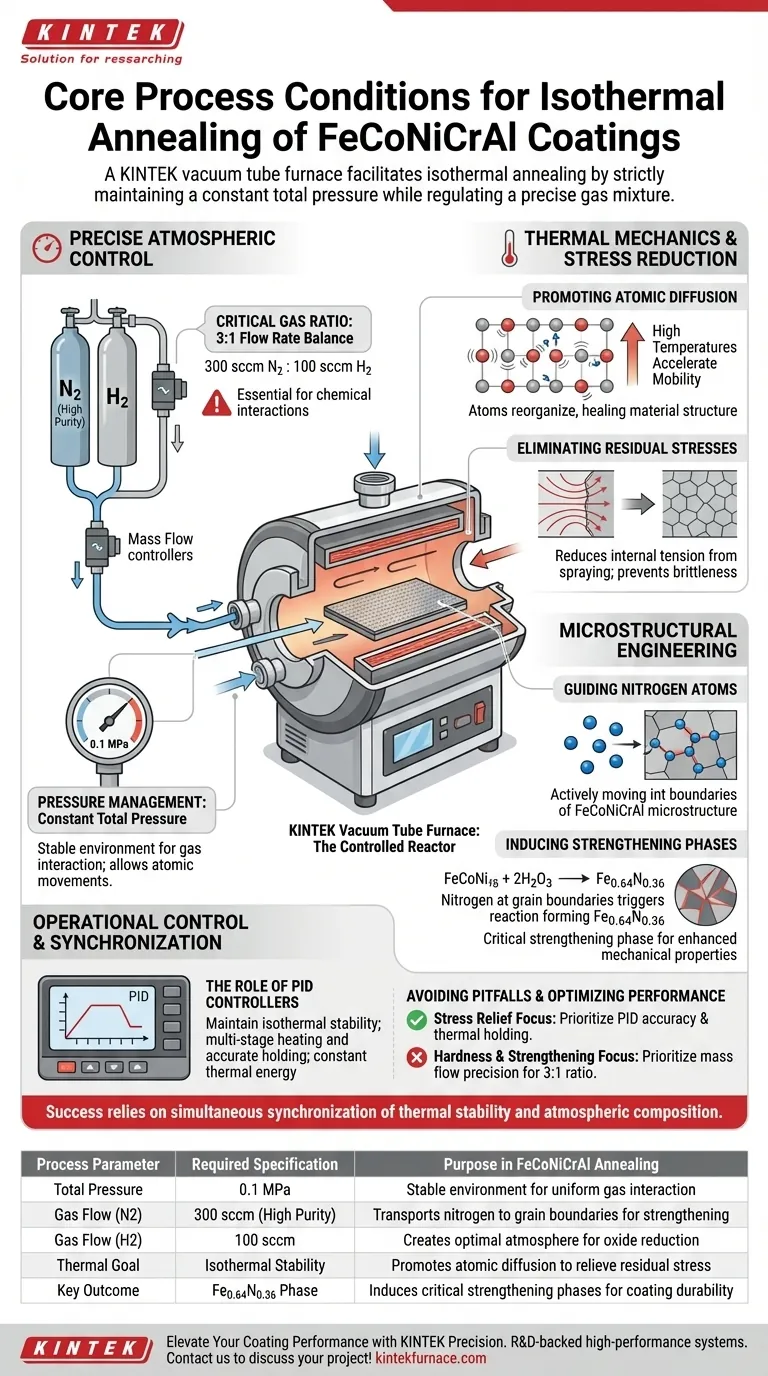
A vacuum tube furnace facilitates isothermal annealing by strictly maintaining a constant total pressure of 0.1 MPa while regulating a precise gas mixture. Specifically, it controls a flow ratio of high-purity nitrogen (300 sccm) to hydrogen (100 sccm) to create the optimal environment for treating FeCoNiCrAl coatings.
The furnace acts as more than a heating element; it functions as a controlled reactor. By combining high-temperature atomic diffusion with a specific Nitrogen-Hydrogen atmosphere, it simultaneously relieves residual spraying stresses and induces the formation of critical strengthening phases like Fe0.64N0.36.
Precise Atmospheric Control
The Critical Gas Ratio
To achieve specific microstructural changes, the furnace must maintain a strict flow rate balance.
The process requires high-purity nitrogen flowing at 300 sccm combined with hydrogen at 100 sccm. This 3:1 ratio is essential for the chemical interactions required during the anneal.
Pressure Management
Stability is key to uniform coating treatment.
The system maintains a constant total pressure of 0.1 MPa throughout the process. This pressure level ensures a stable environment for gas interaction without suppressing the necessary atomic movements.
Thermal Mechanics and Stress Reduction
Promoting Atomic Diffusion
The primary thermal function of the furnace is to utilize high temperatures to accelerate atomic mobility.
This increased mobility allows atoms within the coating to reorganize. This reorganization is fundamental to healing the material structure after deposition.
Eliminating Residual Stresses
Coatings often possess internal tension resulting from the initial spraying process.
By facilitating atomic diffusion, the vacuum tube furnace effectively reduces these residual spraying stresses. This prevents the coating from becoming brittle or failing prematurely.
Microstructural Engineering
Guiding Nitrogen Atoms
The furnace environment is designed to actively transport nitrogen atoms into the material's microstructure.
The controlled atmosphere guides these nitrogen atoms specifically into the grain boundaries of the FeCoNiCrAl coating.
Inducing Strengthening Phases
The presence of nitrogen at the grain boundaries triggers a specific chemical reaction.
This reaction leads to the formation of the Fe0.64N0.36 phase. This is a critical strengthening phase that enhances the mechanical properties of the final coating.
Operational Control and Trade-offs
The Role of PID Controllers
To maintain the "isothermal" aspect of the annealing, precise temperature regulation is required.
Integrated PID controllers are typically used to execute multi-stage heating and accurate holding programs. This ensures the thermal energy remains constant, preventing fluctuations that could alter the diffusion rate.
Potential Pitfalls
It is vital to understand that the gas ratio is not arbitrary.
An imbalance in the Nitrogen-Hydrogen ratio can fail to produce the Fe0.64N0.36 phase or fail to reduce oxides properly. Similarly, deviations in pressure from 0.1 MPa can alter the kinetics of diffusion, leading to incomplete stress relief.
Making the Right Choice for Your Goal
To optimize the performance of FeCoNiCrAl coatings, you must prioritize specific control parameters based on your desired outcome.
- If your primary focus is Stress Relief: Prioritize the accuracy of the PID controller and thermal holding times to maximize atomic diffusion and eliminate residual tension.
- If your primary focus is Hardness and Strengthening: Focus on the precision of the mass flow controllers to ensure the exact 300 sccm N2 to 100 sccm H2 ratio is maintained for phase formation.
Success in this process relies on the simultaneous synchronization of thermal stability and atmospheric composition.
Summary Table:
| Process Parameter | Required Specification | Purpose in FeCoNiCrAl Annealing |
|---|---|---|
| Total Pressure | 0.1 MPa | Stable environment for uniform gas interaction |
| Gas Flow (N2) | 300 sccm (High Purity) | Transports nitrogen to grain boundaries for strengthening |
| Gas Flow (H2) | 100 sccm | Creates optimal atmosphere for oxide reduction |
| Thermal Goal | Isothermal Stability | Promotes atomic diffusion to relieve residual stress |
| Key Outcome | Fe0.64N0.36 Phase | Induces critical strengthening phases for coating durability |
Elevate Your Coating Performance with KINTEK Precision
Achieving the perfect Fe0.64N0.36 strengthening phase requires more than just heat—it demands absolute atmospheric control. Backed by expert R&D and manufacturing, KINTEK offers high-performance Muffle, Tube, Rotary, Vacuum, and CVD systems designed to maintain the precise gas ratios and pressure stability your advanced materials require.
Whether you need a standard setup or a fully customizable system tailored to your unique FeCoNiCrAl research, our team is ready to help you eliminate residual stress and maximize material hardness.
Ready to optimize your thermal processing? Contact KINTEK today to discuss your project!
Visual Guide
References
- Miqi Wang, Shi Fang. Enhancement in Corrosion and Wear Resistance of FeCoNiCrAl High-Entropy Alloy Coating Through Dual Heat Treatment with 3:1 N2/H2 Atmosphere. DOI: 10.3390/coatings15090986
This article is also based on technical information from Kintek Furnace Knowledge Base .
Related Products
- Vacuum Sealed Continuous Working Rotary Tube Furnace Rotating Tube Furnace
- High Pressure Laboratory Vacuum Tube Furnace
- Vacuum Hot Press Furnace Machine Heated Vacuum Press Tube Furnace
- Laboratory Vacuum Tilt Rotary Tube Furnace Rotating Tube Furnace
- Controlled Inert Nitrogen Hydrogen Atmosphere Furnace
People Also Ask
- What is the purpose of rotary tube furnaces? Achieve Uniform Heat Treatment for Powders and Granules
- What are the key advantages of using a rotary tube furnace? Achieve Dynamic, Uniform Heating for Powders
- How does the amount of material processed vary between batch and continuous rotary tube furnaces? Scale Your Production Efficiently
- What are the advantages of rotary tube furnaces in fuel compatibility? Boost Efficiency and Cut Costs
- What is the temperature range of some rotary tube furnaces? Achieve Uniform Heating Up to 1200°C



















