
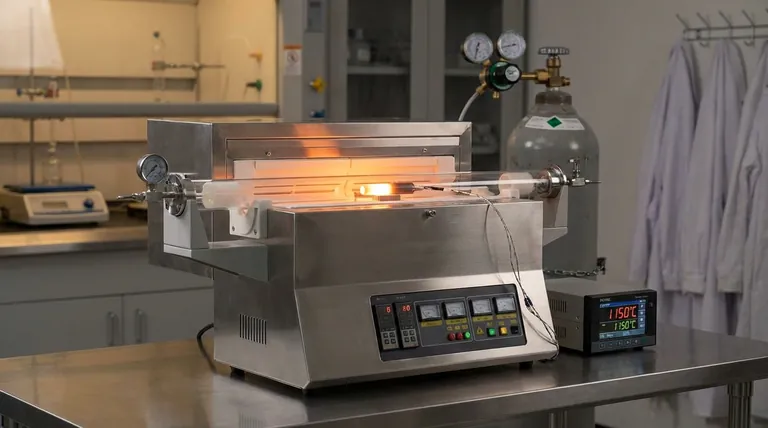
The primary function of a tube heat treatment furnace in this context is to create a precise, isothermal environment essential for phase transformation research. Specifically, it subjects Advanced High-Strength Steel (AHSS) specimens to high temperatures—typically 1100°C or 1200°C—for extended soaking periods. This controlled heating drives the microstructural changes in as-cast structures required to physically verify the complete austenitization temperatures predicted by thermodynamic calculations.
The tube furnace serves as the bridge between theoretical modeling and physical reality, validating that the equilibrium state transitions predicted for specific alloy compositions actually occur under stable high-temperature conditions.
Validating Theoretical Models
To understand the behavior of AHSS, researchers rely heavily on thermodynamic calculations to predict how materials will behave. The tube furnace provides the experimental conditions necessary to test these predictions.
Verifying Complete Austenitization
Thermodynamic calculations often provide a theoretical temperature at which steel should fully transform into austenite.
However, theory must be tested against physical samples. By maintaining the furnace at specific set points (e.g., 1100°C or 1200°C), researchers can determine if the as-cast structure successfully undergoes the complete phase transformation predicted by the data.
Examining Alloy Compositions
AHSS relies on complex alloy compositions to achieve its strength.
The tube furnace facilitates the study of equilibrium state transitions across these various compositions. It ensures that the observed changes are a result of the material chemistry and temperature, rather than external variables or inconsistencies in the heating process.
The Role of Precision and Stability
For austenitization studies, temperature fluctuations can ruin data validity. The tube furnace is selected specifically for its ability to deliver an unwavering thermal profile.
Isothermal Consistency
The definition of "austenitization behavior" requires the sample to be held at a specific temperature for a defined "soaking" period.
The tube furnace excels at providing this isothermal environment, minimizing temperature gradients that could lead to partial transformations or heterogeneous microstructures within the sample.
Uniform Thermal Distribution
As noted in broader research applications, a core advantage of the tube design is uniform thermal distribution along the length of the heating zone.
This ensures that the entire steel specimen experiences the exact same thermal history, preventing "cold spots" that would skew the results regarding the material's phase change.
Programmable Profiles
While the primary goal is often a static soak, the ability to control ramp rates and cooling allows researchers to simulate specific thermal cycles.
This precision ensures that the path to the austenitization temperature is as controlled as the soak itself.
Understanding the Trade-offs
While tube furnaces are the standard for this type of research, it is important to recognize the limitations inherent in their design when applying results to industrial scales.
Sample Size Constraints
Tube furnaces are designed for small-scale synthesis and testing.
While this allows for high precision, the results are derived from small specimens that may not fully represent the thermal mass or segregation issues found in massive industrial slabs or coils.
Static vs. Dynamic Conditions
These furnaces typically test materials in a static state.
Real-world processing of AHSS often involves mechanical deformation (rolling) occurring simultaneously with heating or cooling. The tube furnace isolates the thermal variable, which is excellent for fundamental physics but does not replicate the full thermo-mechanical processing line.
Making the Right Choice for Your Research
When utilizing a tube furnace for AHSS studies, align your methodology with your specific data requirements.
- If your primary focus is Thermodynamic Verification: Prioritize the isothermal stability of the furnace to strictly validate the complete austenitization temperatures calculated in your models.
- If your primary focus is Microstructural Evolution: Utilize the furnace's programmable ramp and cool rates to study how the heating rate affects the homogenization of the as-cast structure.
Success in characterizing AHSS relies not just on reaching high temperatures, but on the absolute certainty that those temperatures are uniform and stable throughout the transformation process.
Summary Table:
| Feature | Role in AHSS Austenitization Research |
|---|---|
| Thermal Environment | Provides a precise isothermal environment for stable soaking. |
| Temperature Range | Reaches 1100°C - 1200°C to drive microstructural changes. |
| Model Validation | Verifies theoretical equilibrium state transitions in as-cast structures. |
| Process Control | Ensures uniform thermal distribution and programmable heating rates. |
Elevate Your Material Research with KINTEK
Bridge the gap between thermodynamic theory and physical reality with KINTEK’s high-precision thermal solutions. Backed by expert R&D and manufacturing, KINTEK offers Muffle, Tube, Rotary, Vacuum, and CVD systems, all fully customizable to meet the rigorous demands of Advanced High-Strength Steel (AHSS) research.
Whether you need unwavering isothermal stability for phase transformation studies or uniform thermal distribution for small-scale synthesis, our expert-engineered lab high-temp furnaces provide the reliability your data deserves.
Ready to optimize your heat treatment process? Contact us today to discuss your unique needs!
References
- Influence of Silicon and Aluminum on the Microstructures of as-cast Advanced High-Strength Steels. DOI: 10.2355/isijinternational.isijint-2025-122
This article is also based on technical information from Kintek Furnace Knowledge Base .
Related Products
- Vacuum Hot Press Furnace Machine Heated Vacuum Press Tube Furnace
- Laboratory Quartz Tube Furnace RTP Heating Tubular Furnace
- Split Multi Heating Zone Rotary Tube Furnace Rotating Tube Furnace
- Multi Heating Zones CVD Tube Furnace Machine for Chemical Vapor Deposition Equipment
- Vacuum Heat Treat Furnace with Ceramic Fiber Liner
People Also Ask
- Why use Vacuum Hot Press (VHP) for ZnS Ceramics? Achieve Superior IR Transparency and Mechanical Strength
- What safety features are incorporated in vacuum hot press furnaces? Ensure Operator and Equipment Protection
- What are the benefits of the vacuum environment system in a vacuum hot press furnace? Unlock High-Density Sintering
- What is the primary function of the vacuum environment in a vacuum hot press furnace during titanium alloy processing? Prevent Embrittlement for Superior Ductility
- What is the significance of the vacuum environment for sintering stainless steel? Unlock High-Density Purity



















