
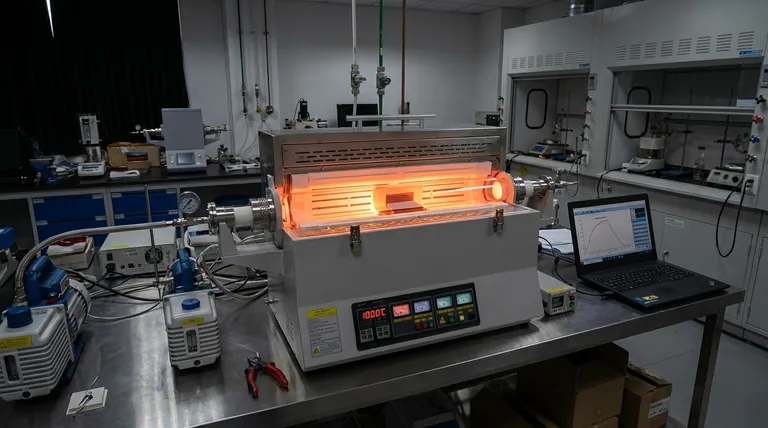
In the processing of tetragonal barium titanate (t-BTO) thin films, the vacuum tube furnace functions as a specialized reaction chamber that simultaneously controls extreme thermal energy and atmospheric pressure. It subjects spin-coated films to temperatures as high as 1000 °C while maintaining a vacuum environment. This dual-action process is the primary driver for converting raw precursor materials into functional ferroelectric layers.
The vacuum tube furnace is not merely a heating element; it is the facilitator of essential atomic restructuring. By sustaining a vacuum at 1000 °C, it drives the crystallization of barium and titanium elements to establish the material's ferroelectric polarization characteristics.
The Mechanism of Transformation
Thermal Activation at 1000 °C
The spin-coated films applied to metal substrates require significant thermal energy to transition from a precursor state to a solid crystalline phase.
The vacuum tube furnace provides a stable thermal plateau at temperatures reaching 1000 °C.
This extreme heat is necessary to overcome the kinetic barriers preventing the material from solidifying into the desired structure.
Atomic Rearrangement
Under these high-temperature conditions, the atoms within the film gain enough energy to mobilize.
This allows for the precise atomic rearrangement of barium and titanium elements on the substrate.
The furnace ensures this reorganization occurs uniformly, which is critical for film continuity.
Crystallization
The ultimate physical goal of this annealing process is crystallization.
The furnace environment guides the disordered atoms into a highly ordered tetragonal lattice structure.
This structural evolution is what defines the material as "t-BTO" rather than amorphous barium titanate.
The Role of the Environment
Establishing Ferroelectric Properties
The specific combination of vacuum and high heat determines the functional properties of the final product.
The process directly engenders ferroelectric polarization characteristics within the t-BTO films.
Without this controlled environmental processing, the films would lack the electronic properties required for advanced device applications.
Vacuum vs. Atmospheric Pressure
The primary reference highlights the use of a vacuum specifically for t-BTO thin films.
Operating in a vacuum aids in removing volatile components from the spin-coating solvents without introducing contaminants found in ambient air.
This ensures the purity of the crystalline phase formed on the metal substrate.
Understanding Environmental Nuances
Distinguishing Pure Films from Composites
It is critical to distinguish between processing pure t-BTO thin films and t-BTO composite materials, as the furnace atmosphere must change accordingly.
While pure t-BTO thin films utilize a vacuum at 1000 °C, t-BTO composites involving carbon (t-BTO@C) require a different approach.
For carbon-containing composites, an inert argon atmosphere at 800 °C is used to prevent the oxidation and loss of the carbon layer.
The Risk of Incorrect Atmospheres
Using the wrong atmospheric setting in the tube furnace can lead to material failure.
For example, annealing carbon-coated materials in a standard oxygen-rich or vacuum environment (where residual oxygen might exist) could burn off the conductive carbon layer.
Conversely, failing to use a vacuum for pure thin films may result in poor crystallization or trapped solvent defects.
Making the Right Choice for Your Goal
To ensure optimal material performance, you must align the furnace parameters with the specific composition of your barium titanate material.
- If your primary focus is pure t-BTO thin films: Utilize a vacuum environment at 1000 °C to drive atomic rearrangement and maximize ferroelectric polarization.
- If your primary focus is t-BTO/Carbon composites: Switch to an inert argon atmosphere at lower temperatures (approx. 800 °C) to carbonize the coating while preserving the t-BTO phase.
Mastering the atmosphere and temperature of the tube furnace is the decisive factor in stabilizing the crystalline phase and unlocking the electrical potential of your material.
Summary Table:
| Process Parameter | Pure t-BTO Thin Films | t-BTO@C Composites |
|---|---|---|
| Temperature | 1000 °C | 800 °C |
| Atmosphere | Vacuum | Inert Argon |
| Key Function | Ferroelectric Polarization | Carbonization & Oxidation Prevention |
| Structural Result | Tetragonal Lattice Crystallization | Core-Shell Structural Integrity |
Elevate Your Material Research with KINTEK
Precision in thermal processing is the difference between an amorphous layer and a high-performance ferroelectric film. Backed by expert R&D and manufacturing, KINTEK offers high-performance Muffle, Tube, Rotary, Vacuum, and CVD systems, all customizable to your unique research needs.
Whether you are annealing pure t-BTO thin films at 1000 °C or processing sensitive carbon composites, our furnaces provide the atmospheric control and thermal stability required for superior results. Contact us today to find your custom lab solution.
Visual Guide

References
- Rui Li, Shi Chen. Ferroelectricity enhances ion migration in hard carbon anodes for high-performance potassium ion batteries. DOI: 10.1039/d4nr04916k
This article is also based on technical information from Kintek Furnace Knowledge Base .
Related Products
- Molybdenum Vacuum Heat Treat Furnace
- 2200 ℃ Tungsten Vacuum Heat Treat and Sintering Furnace
- 1700℃ High Temperature Laboratory Tube Furnace with Alumina Tube
- Vertical Laboratory Quartz Tube Furnace Tubular Furnace
- Vacuum Heat Treat Sintering Furnace Molybdenum Wire Vacuum Sintering Furnace
People Also Ask
- How does vacuum heat treating work in terms of temperature and time control? Master Precise Material Transformations
- What is the primary application of vacuum heat treating furnaces in aerospace? Enhance Component Performance with Precision
- How does a vacuum heat treating furnace improve the condition of metal alloys? Achieve Superior Metal Performance
- Why are vacuum heat treating furnaces essential for aerospace? Ensure Superior Material Integrity for High-Stakes Applications
- What is the process of vacuum heat treating? Achieve Superior Metallurgical Properties



















