
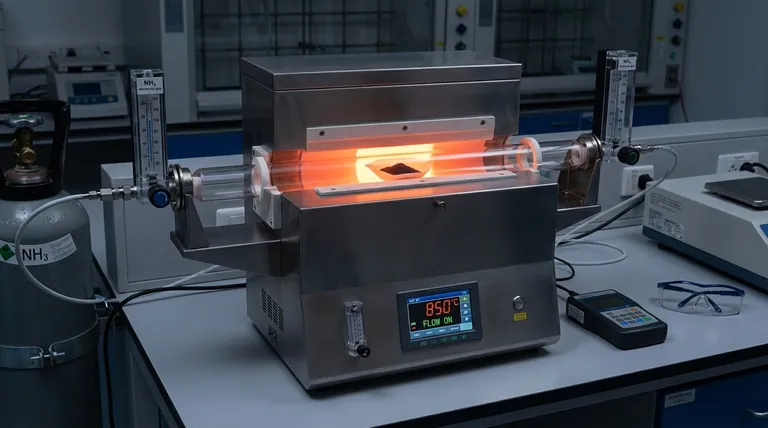
A high-temperature tube furnace facilitates the ammonolysis process by establishing a controlled thermal reactor where a continuous stream of ammonia gas can interact with a precursor material, specifically MIL-125(Ti). This setup allows for precise heating between 500 °C and 900 °C, which is necessary to drive the chemical conversion of the precursor into titanium nitride (TiNx) nanoparticles while simultaneously tuning their electronic properties.
Core Takeaway The tube furnace is not merely a heating element; it is a flow reactor that enables the complete nitridation of MIL-125(Ti). Its primary value lies in the ability to regulate nitrogen vacancy concentrations through temperature adjustments, which is the deciding factor in the sensitivity and performance of the resulting sensors.
The Role of the Tube Furnace Environment
Enabling Continuous Gas Flow
Unlike static heating chambers, a tube furnace is designed to manage a dynamic atmosphere.
It allows for the continuous introduction of ammonia gas throughout the heating cycle.
This constant flow ensures that fresh reactant (ammonia) is always available to interact with the solid precursor, driving the reaction to completion.
Precise Thermal Regulation
The furnace maintains a stable environment within a specific target range, generally 500 °C to 900 °C.
This stability is critical because the conversion from a metal-organic framework like MIL-125(Ti) to a nitride ceramic requires sustained, high-energy thermal input to break existing bonds and form new titanium-nitrogen bonds.
The Mechanism of Ammonolysis
Transforming the Precursor
The process begins with MIL-125(Ti), a titanium-based metal-organic framework.
Under the influence of heat and reactive ammonia, the organic components of the framework decompose.
Simultaneously, the titanium centers undergo nitridation, chemically bonding with nitrogen derived from the ammonia gas to form TiNx nanoparticles.
Tuning Material Properties
The tube furnace does more than simply synthesize the material; it acts as a tuning tool for the material's microstructure.
By strictly controlling the temperature, you directly influence the concentration of nitrogen vacancies (defects) in the crystal lattice.
These vacancies are essential because they alter the electronic structure of the nanoparticles, directly enhancing their activity for sensor applications.
Understanding the Trade-offs
Temperature Sensitivity
While the furnace allows for tuning, the process is highly sensitive to the selected temperature point.
Operating at the lower end (near 500 °C) may result in incomplete nitridation or insufficient crystallinity.
Conversely, operating at the higher end (approaching 900 °C) fundamentally changes the defect density.
Balancing Activity and Stability
There is often a trade-off between high catalytic activity and structural stability.
Higher temperatures typically induce higher crystallinity, which is beneficial for stability, but varying the temperature to maximize nitrogen vacancies requires precise calibration to avoid sintering (clumping) the nanoparticles, which would reduce their effective surface area.
Making the Right Choice for Your Goal
To optimize your TiNx synthesis, align your furnace parameters with your specific performance targets:
- If your primary focus is material conversion: Ensure a consistent ammonia flow and maintain temperatures above 500 °C to guarantee the complete transformation of MIL-125(Ti) into TiNx.
- If your primary focus is sensor performance: Systematically vary the temperature between 500 °C and 900 °C to find the "sweet spot" that maximizes nitrogen vacancy concentrations for your specific analyte.
Success in ammonolysis depends not just on reaching high temperatures, but on precisely controlling the thermal profile to engineer the atomic defects that drive performance.
Summary Table:
| Feature | Role in Ammonolysis | Impact on TiNx Synthesis |
|---|---|---|
| Continuous Gas Flow | Maintains ammonia saturation | Ensures complete nitridation of solid precursors |
| Precise Thermal Control | Range of 500°C to 900°C | Breaks MOF bonds and forms new Ti-N bonds |
| Atmosphere Integrity | Controlled dynamic environment | Regulates nitrogen vacancies and crystal defects |
| Thermal Stability | Prevents temperature fluctuations | Controls nanoparticle crystallinity and prevents sintering |
Elevate Your Nanomaterial Research with KINTEK
Achieving the perfect defect density in TiNx nanoparticles requires absolute thermal precision and atmosphere control. Backed by expert R&D and world-class manufacturing, KINTEK provides high-performance Tube, Muffle, Rotary, Vacuum, and CVD systems tailored for advanced chemical synthesis like ammonolysis.
Whether you are scaling up production or tuning sensitive electronic properties, our customizable lab high-temp furnaces ensure repeatable, high-purity results every time.
Contact KINTEK today to discuss your unique synthesis needs
Visual Guide

References
- Xuefei Zhao, Minghui Yang. Titanium nitride sensor for selective NO2 detection. DOI: 10.1038/s41467-024-55534-x
This article is also based on technical information from Kintek Furnace Knowledge Base .
Related Products
- 1400℃ High Temperature Laboratory Tube Furnace with Alumina Tube
- 1700℃ High Temperature Laboratory Tube Furnace with Alumina Tube
- 1200℃ Split Tube Furnace Laboratory Quartz Tube Furnace with Quartz Tube
- Vertical Laboratory Quartz Tube Furnace Tubular Furnace
- 1700℃ High Temperature Muffle Oven Furnace for Laboratory
People Also Ask
- How does zone-melting in tube furnaces synthesize bismuth micro-wires? Master Single-Crystal Thermoelectric Growth
- How are high-temp tube furnaces used to measure diffusion coefficients per Fick's law? Master Precision Annealing
- How are high-temperature laboratory tube furnaces applied in long-term vacuum homogenization heat treatments for intermetallic samples?
- How do high-temperature laboratory tube furnaces ensure environmental stability? Precision Thermal Reduction Tips
- How are high-temperature tube furnaces applied in testing ceramic-supported alloy membranes? Insights



















