A laboratory tube furnace creates three essential environmental conditions for this process: a highly stable reaction chamber maintained at 750 °C, precise regulation of Argon (Ar) gas flow, and the ability to cycle between vacuum and atmospheric pressure. These conditions are engineered to facilitate a specific heterogeneous chemical reaction between gaseous sulfur and liquid sodium molybdate.
The tube furnace is not simply a heat source; it provides a uniform thermal field that synchronizes crystal nucleation. This precision is the deciding factor in converting reactive precursors into high-quality, large-area Molybdenum Disulfide (MoS2) crystals.
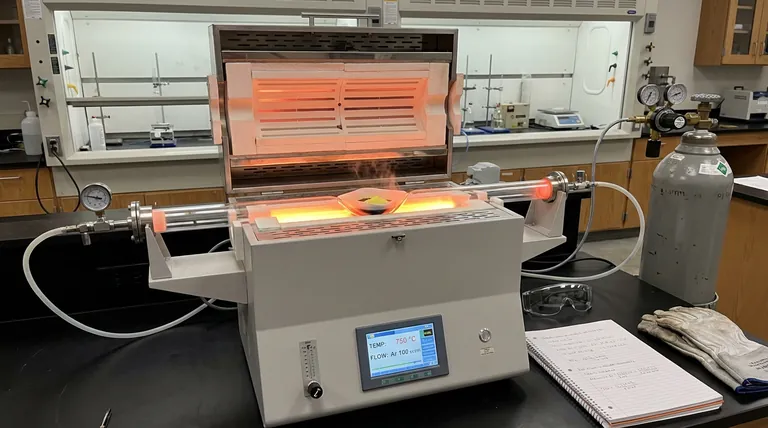
Creating the Reaction Environment
Facilitating Heterogeneous Reactions
The 750 °C sulfurization process relies on a complex interaction between materials in different states: gaseous sulfur and liquid sodium molybdate.
The tube furnace uses programmed heating to bring these precursors to the correct temperature simultaneously. This precise thermal ramp allows the heterogeneous reaction to occur efficiently at the interface of the liquid and gas phases.
Atmosphere and Pressure Management
To prevent unwanted oxidation and control reaction kinetics, the furnace provides a sealed environment capable of cycling between vacuum and atmospheric pressure.
Once the chamber is purged, the system maintains a controlled flow of Argon (Ar) gas. This inert atmosphere is critical for stabilizing the volatile sulfur vapor and protecting the developing MoS2 layers.
The Criticality of Thermal Uniformity
Synchronized Nucleation
The most significant contribution of the tube furnace to this process is thermal field uniformity.
Uniform heat distribution ensures that nucleation—the birth of the crystal—happens simultaneously across the substrate. Without this synchronization, crystal growth would be chaotic and patchy.
Promoting Large-Area Growth
The furnace design creates a constant temperature zone that minimizes longitudinal temperature gradients.
By eliminating cold spots or heat spikes, the furnace allows MoS2 crystals to grow continuously. This results in the formation of large-area crystals rather than fragmented, microscopic islands.
Understanding the Trade-offs
Sensitivity to Equilibrium
While tube furnaces offer excellent uniformity, they are highly sensitive to disturbances in thermal equilibrium.
Rapid changes in gas flow or heating rates can disrupt the stable environment required for the liquid-gas reaction. The user must strictly adhere to programmed rates to prevent thermal shock or uneven reaction fronts.
Constraint of the Constant Zone
The "constant temperature zone" where high-quality growth occurs is finite (e.g., often around 80 mm in standard models).
This limits the size of the sample you can process in a single batch. Attempting to process samples larger than this zone will result in gradient-induced defects at the sample edges.
Making the Right Choice for Your Goal
To maximize the quality of your MoS2 synthesis, you must align the furnace capabilities with your specific output requirements.
- If your primary focus is crystal uniformity and size: Prioritize a furnace with a verified, extended constant temperature zone to ensure synchronized nucleation across the entire substrate.
- If your primary focus is reaction purity: Ensure the system has high-precision vacuum and Argon flow controls to perfectly manage the heterogeneous reaction environment.
Mastering the interplay between a uniform thermal field and precise atmospheric control is the key to reproducible MoS2 synthesis.
Summary Table:
| Environmental Factor | Requirement for MoS2 Sulfurization | Benefit to Crystal Quality |
|---|---|---|
| Temperature | Stable 750 °C Constant Zone | Synchronized nucleation and large-area growth |
| Atmosphere | Inert Argon (Ar) Gas Flow | Prevents oxidation and stabilizes sulfur vapor |
| Pressure | Vacuum to Atmospheric Cycling | Purges impurities and manages reaction kinetics |
| Reaction Type | Heterogeneous (Gas-Liquid) | Facilitates interaction between S vapor and Na2MoO4 |
Elevate Your Material Synthesis with KINTEK Precision
Ready to achieve superior thermal uniformity for your MoS2 sulfurization? KINTEK provides industry-leading Tube, Muffle, Vacuum, and CVD systems designed for the most demanding laboratory environments. Backed by expert R&D and precision manufacturing, our furnaces are fully customizable to meet your unique temperature and atmospheric requirements.
Don't let thermal gradients compromise your research. Contact KINTEK today to discuss your custom furnace solution and ensure reproducible, high-quality results for your lab.
References
- Zhunda Zhu, Nagahiro Saito. Two-Dimensional Crystal Growth of MoS2 Thin Films from Sodium Dodecyl Sulfate Micellar Solutions and Wettability Between Solution and Substrate. DOI: 10.3390/coatings15010004
This article is also based on technical information from Kintek Furnace Knowledge Base .
Related Products
- Molybdenum Vacuum Heat Treat Furnace
- Vacuum Heat Treat Sintering Furnace Molybdenum Wire Vacuum Sintering Furnace
- Vertical Laboratory Quartz Tube Furnace Tubular Furnace
- Magnesium Extraction and Purification Condensing Tube Furnace
- Multi Zone Laboratory Quartz Tube Furnace Tubular Furnace
People Also Ask
- What is the primary application of vacuum heat treating furnaces in aerospace? Enhance Component Performance with Precision
- How does vacuum heat treating work in terms of temperature and time control? Master Precise Material Transformations
- Why are vacuum heat treating furnaces essential for aerospace? Ensure Superior Material Integrity for High-Stakes Applications
- What is the process of vacuum heat treating? Achieve Superior Metallurgical Properties
- How does a vacuum heat treating furnace improve the condition of metal alloys? Achieve Superior Metal Performance