
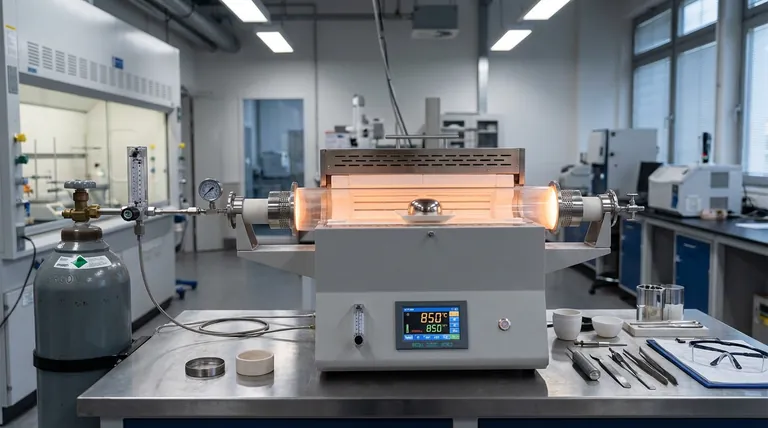
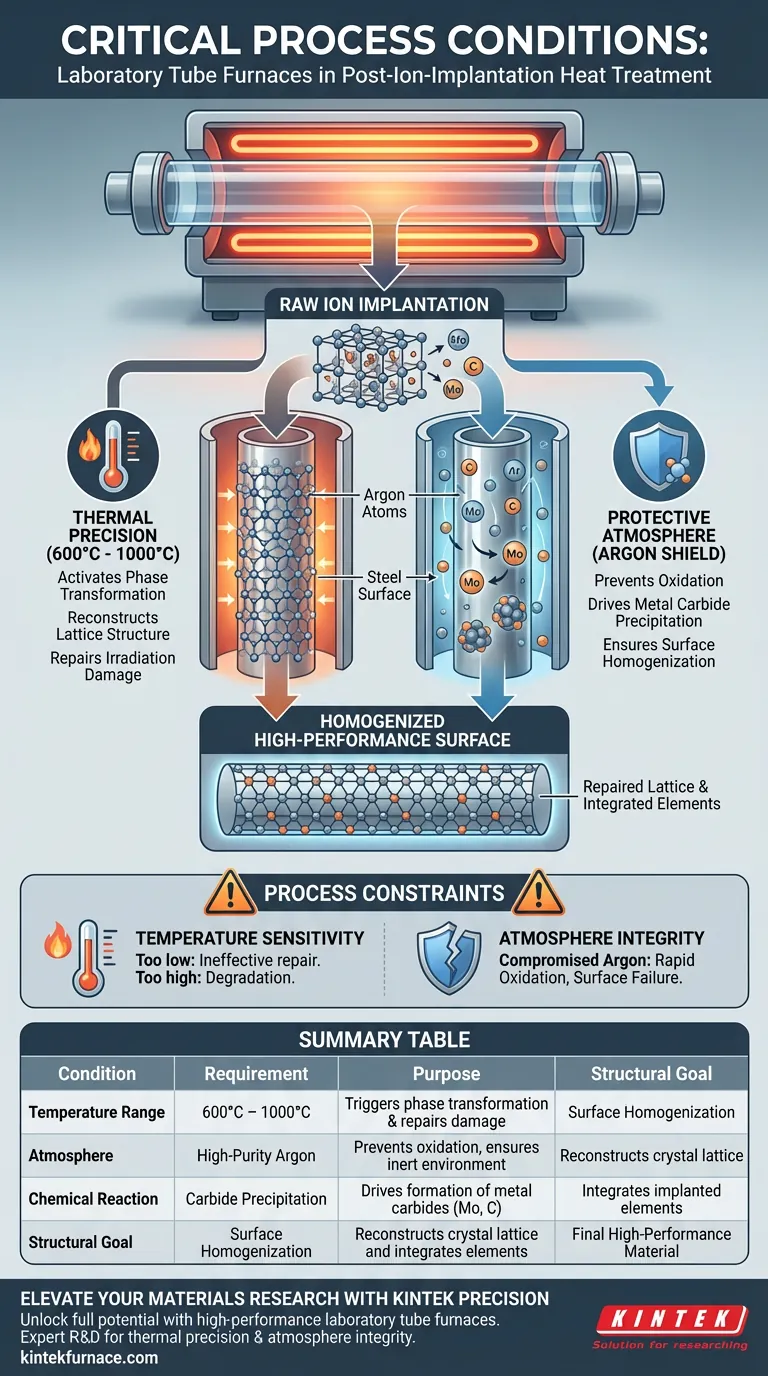
A laboratory tube furnace provides a strictly controlled, inert high-temperature environment designed to stabilize stainless steel following ion implantation. Specifically, it establishes a precise temperature regime between 600°C and 1000°C while maintaining a protective argon atmosphere to facilitate critical microstructural repairs.
The furnace is not simply a heating source; it acts as a reaction chamber that repairs irradiation damage and drives the precipitation of metal carbides. This controlled environment is the bridge between raw ion implantation and a homogenized, high-performance material surface.
The Critical Role of Thermal Precision
Activating Phase Transformation
The primary function of the tube furnace is to maintain a specific thermal window, strictly between 600°C and 1000°C. This high-temperature range is not arbitrary; it is the required energy threshold to trigger phase transformation within the steel.
Reconstructing the Lattice Structure
Ion implantation is a violent process that introduces foreign elements—specifically molybdenum and carbon in this context—into the steel, disrupting its crystal lattice. The heat treatment provided by the furnace supplies the activation energy needed for structural reconstruction.
Repairing Irradiation Damage
Beyond simple heating, this thermal environment allows the material to heal. The sustained high temperature repairs the irradiation damage caused during the initial implantation process, restoring the integrity of the stainless steel matrix.
The Necessity of a Protective Atmosphere
The Argon Shield
A defining feature of this process is the maintenance of an argon protective atmosphere. The tube furnace design allows for the exclusion of oxygen and other reactive gases during the heating cycle.
Driving Carbide Precipitation
Under this inert protection, the injected elements are free to react chemically in beneficial ways without oxidizing. The environment facilitates the specific precipitation of metal carbides, which is the ultimate goal of the doping process.
Achieving Surface Homogenization
The combination of heat and inert gas allows for diffusion without degradation. This leads to surface homogenization, ensuring that the implanted elements are evenly distributed and fully integrated into the material's surface structure.
Understanding the Process Constraints
The Temperature-Window Sensitivity
Operating outside the 600°C to 1000°C range compromises the treatment's efficacy. Temperatures too low may fail to induce the necessary phase transformations or repair lattice damage, leaving the material in a stressed state.
Atmosphere Integrity
The success of the treatment relies entirely on the purity of the environment. If the argon atmosphere is compromised, the high temperatures will lead to rapid oxidation rather than the desired carbide precipitation, potentially ruining the surface enhancement.
Optimizing Your Heat Treatment Strategy
To ensure the success of post-ion-implantation annealing, your process parameters must align with the specific material goals of the project.
- If your primary focus is Structural Repair: Prioritize maintaining the temperature strictly within the 600°C–1000°C window to ensure adequate energy for lattice reconstruction and damage healing.
- If your primary focus is Surface Hardening: Ensure the argon flow is consistent and pure to maximize the precipitation of metal carbides without introducing surface contaminants.
By rigorously controlling these thermal and atmospheric variables, you convert the potential of ion implantation into realized material performance.
Summary Table:
| Process Condition | Requirement | Purpose in Heat Treatment |
|---|---|---|
| Temperature Range | 600°C – 1000°C | Triggers phase transformation & repairs irradiation damage |
| Atmosphere | High-Purity Argon | Prevents oxidation and ensures inert protective environment |
| Chemical Reaction | Carbide Precipitation | Drives the formation of metal carbides (Mo, C) for hardening |
| Structural Goal | Surface Homogenization | Reconstructs crystal lattice and integrates implanted elements |
Elevate Your Materials Research with KINTEK Precision
Unlock the full potential of your post-ion-implantation processes with KINTEK’s high-performance laboratory tube furnaces. Backed by expert R&D and world-class manufacturing, we provide the thermal precision and atmosphere integrity required to achieve superior surface homogenization and lattice repair.
Whether you need standard or fully customizable Tube, Muffle, Rotary, Vacuum, or CVD systems, KINTEK delivers the reliability your lab demands.
Ready to optimize your heat treatment results? Contact our experts today to find the perfect high-temperature solution for your unique needs!
Visual Guide
References
- Ruijuan Wang, Chengfei Zhu. Ion Implantation Combined with Heat Treatment Enables Excellent Conductivity and Corrosion Resistance of Stainless Steel Bipolar Plates for Hydrogen Fuel Cells. DOI: 10.3390/ma17040779
This article is also based on technical information from Kintek Furnace Knowledge Base .
Related Products
- 1400℃ High Temperature Laboratory Tube Furnace with Alumina Tube
- Laboratory Quartz Tube Furnace RTP Heating Tubular Furnace
- Laboratory Vacuum Tilt Rotary Tube Furnace Rotating Tube Furnace
- 1700℃ High Temperature Laboratory Tube Furnace with Alumina Tube
- Vertical Laboratory Quartz Tube Furnace Tubular Furnace
People Also Ask
- How do high-temperature laboratory tube furnaces ensure environmental stability? Precision Thermal Reduction Tips
- How are high-temp tube furnaces used to measure diffusion coefficients per Fick's law? Master Precision Annealing
- How are high-temperature laboratory tube furnaces applied in long-term vacuum homogenization heat treatments for intermetallic samples?
- How are high-temperature tube furnaces applied in testing ceramic-supported alloy membranes? Insights
- What is the mechanism of a high-temperature furnace in Bi-2223 sintering? Achieve Precision Phase Transformation



















