
Precise temperature control in a multi-tube pyrolysis furnace results from the integration of specialized conduction materials and algorithmic regulation. Specifically, the system utilizes heating coils combined with alumina ceramic tubes inside quartz tubes to maximize heat transfer, while a PID (Proportional-Integral-Derivative) controller automatically modulates power to maintain thermal stability.
Core Takeaway: The ability to strictly control biochar quality relies on the furnace's capacity to couple rapid heating rates (up to 60°C/min) with stable holding times. This thermal precision is the primary driver for determining the pore structure, aromatization, and chemical functionality of the final product.
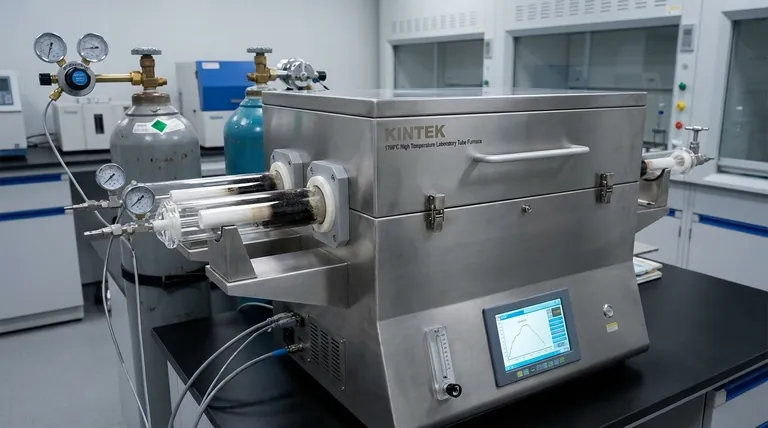
The Hardware Architecture
The physical design of the furnace is the foundation of its accuracy. It is built to minimize thermal lag and maximize uniformity.
Advanced Tube Integration
The core heating mechanism involves alumina ceramic tubes integrated within quartz tubes.
This dual-material approach ensures highly efficient heat conduction from the heating coils to the biomass (digestate).
High-Performance Insulation
Surrounding the heating elements is high-performance insulation cotton.
This material serves two roles: it prevents heat loss to the environment and creates a responsive thermal environment capable of rapid temperature changes.
Rapid Heating Capability
Due to the efficient conduction and insulation, these furnaces can achieve heating rates of approximately 60°C/min.
This speed provides the flexibility to experiment with different thermal shocks, which significantly alters biochar characteristics.
The Control Logic
Hardware alone cannot maintain precision; it requires an intelligent control system to manage the energy flow.
PID Regulation
The furnace employs a PID temperature control system.
Rather than simply turning heating elements on and off, this system continuously calculates and adjusts the power input to minimize fluctuations.
Maintaining Stability
The PID system ensures the furnace remains at a constant temperature duration at preset levels, such as 600°C.
This stability is critical for ensuring the entire batch of digestate undergoes the same chemical transformation.
Impact on Biochar Properties
The ultimate goal of this precision is not just temperature management, but the manipulation of the biochar’s physical and chemical structure.
Pore Development
Precise heating determines the pore development within the biochar.
Fluctuations in temperature can collapse pore structures or fail to clear volatiles, resulting in suboptimal surface area.
Chemical Aromatization
The aromatization degree—the formation of stable carbon rings—is strictly dictated by the holding temperature.
Exact control ensures the digestate is fully carbonized without incinerating valuable carbon structures.
Surface Functionality
The specific temperature profile controls the formation of surface chemical functional groups.
These groups determine how the biochar interacts with soil, water, and contaminants in agricultural or filtration applications.
Understanding the Trade-offs
While multi-tube furnaces offer high precision, there are operational considerations to keep in mind.
Throughput vs. Control
The multi-tube design prioritizes uniformity over volume.
Processing large quantities of digestate may require multiple batches, making this equipment better suited for high-quality production or research rather than bulk industrial throughput.
Complexity of Parameters
Achieving the perfect biochar requires managing multiple variables simultaneously.
Users must balance heating rate, holding time, and gas flow; an error in one setting can negate the precision of the PID controller.
Making the Right Choice for Your Goal
When configuring a multi-tube pyrolysis furnace for digestate, your operational parameters should match your end-product requirements.
- If your primary focus is Filtration/Adsorption: Prioritize high-temperature stability (e.g., 600°C+) to maximize pore development and surface area.
- If your primary focus is Soil Amendment: Focus on moderate temperatures and specific heating rates to preserve surface functional groups beneficial for nutrient retention.
Precision in pyrolysis is not a luxury; it is the specific variable that transforms waste digestate into a value-added carbon material.
Summary Table:
| Feature | Specification/Detail | Benefit for Biochar |
|---|---|---|
| Heating Rate | Up to 60°C/min | Allows for rapid thermal shock and flexible processing |
| Control System | PID Logic | Eliminates thermal fluctuations for consistent quality |
| Tube Material | Alumina Ceramic & Quartz | Maximizes heat conduction and thermal uniformity |
| Insulation | High-performance cotton | Reduces heat loss and improves system responsiveness |
| Primary Impact | Pore & Surface Control | Customizes biochar for filtration or soil amendment |
Elevate Your Biochar Production with KINTEK
Precise temperature control is the difference between waste and a high-value carbon product. Backed by expert R&D and world-class manufacturing, KINTEK offers high-performance Muffle, Tube, Rotary, Vacuum, and CVD systems tailored to your research or production requirements. Whether you need specialized multi-tube configurations for digestate pyrolysis or customizable high-temp lab furnaces, our team delivers the technical precision you demand.
Ready to optimize your thermal processes? Contact our experts today to find the perfect furnace solution for your unique needs.
Visual Guide

References
- Van Ngoc Duong, Hynek Roubík. A novel treatment of biogas digestate waste for biochar production and its adsorption of methylene blue and malachite green in a binary system. DOI: 10.1002/bbb.2772
This article is also based on technical information from Kintek Furnace Knowledge Base .
Related Products
- Multi Zone Laboratory Quartz Tube Furnace Tubular Furnace
- Multi Heating Zones CVD Tube Furnace Machine for Chemical Vapor Deposition Equipment
- Split Multi Heating Zone Rotary Tube Furnace Rotating Tube Furnace
- Electric Rotary Kiln Small Rotary Furnace Biomass Pyrolysis Plant Rotating Furnace
- Magnesium Extraction and Purification Condensing Tube Furnace
People Also Ask
- What temperature-related capabilities make multi zone tube furnaces valuable for research? Unlock Precision Thermal Control
- Why are multi zone tube furnaces particularly useful for nanomaterial research? Unlock Precise Thermal Control for Advanced Synthesis
- What environmental protection applications utilize multi zone tube furnaces? Unlock Precision in Waste Treatment and Green Tech
- What role do multi zone tube furnaces play in new energy research? Unlock Precise Thermal Control for Innovation
- What are the main applications of multi zone tube furnaces in university laboratories? Unlock Precision in Material Science and Energy Research



















