
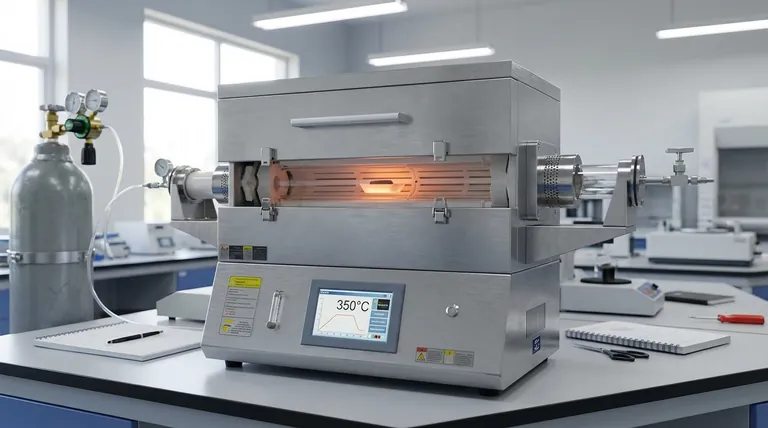
A laboratory tube annealing furnace serves as the critical reaction environment required to stabilize and unify the CNT-Al2O3-Ag-TiO2 composite. Specifically, it subjects the sample to a consistent 350°C heat treatment under a protective argon atmosphere to induce essential chemical and structural changes.
Core Takeaway The furnace does not simply dry or heat the material; it acts as a precise catalyst for phase transformation. By maintaining a specific thermal environment, it converts the sputtered titanium layer and maximizes the interfacial bonding between the carbon nanotubes, alumina, silver, and titanium oxide, resulting in a mechanically robust field emission cathode.
The Mechanics of the Annealing Process
Precise Thermal Regulation
The formation of this specific composite relies on maintaining a strict temperature of 350°C.
At this temperature, the furnace triggers a phase transformation within the sputtered titanium layer. This thermal energy is carefully calibrated to alter the material's microstructure without degrading the sensitive carbon nanotubes (CNTs) or silver components.
The Role of the Protective Atmosphere
The process is conducted under an argon atmosphere.
This inert gas displaces oxygen and other reactive elements within the tube. By eliminating these contaminants, the furnace ensures that the phase transformation and bonding occur purely between the intended components, preventing unwanted oxidation or impurities.
Enhancing Interfacial Bonding
The primary goal of this heat treatment is to fuse distinct materials—CNTs, Al2O3, Ag, and TiO2—into a cohesive unit.
The thermal energy increases the interfacial bonding strength between these layers. This transforms a collection of loose components into a unified composite structure capable of functioning as a stable field emission cathode.
Impact on Material Properties
Mechanical Stability
Without this annealing step, the composite layers would likely delaminate or fail under stress.
The furnace ensures the final material has the mechanical stability required for practical application. The improved bonding prevents structural failure during the operation of the cathode.
Chemical Durability
The phase transformation induced by the furnace also enhances chemical durability.
By settling the microstructure into a stable state, the composite becomes more resistant to chemical degradation. This extends the operational lifespan of the material in field emission applications.
Understanding the Trade-offs
Temperature Sensitivity
The specific temperature of 350°C is a critical parameter, not a suggestion.
Deviating from this temperature can have detrimental effects. Temperatures that are too low may fail to trigger the necessary phase transformation, resulting in weak bonding; temperatures that are too high could degrade the CNTs or alter the crystal structure of the silver/alumina beyond the desired state.
Atmosphere Integrity
The success of the process is entirely dependent on the purity of the argon environment.
If the tube furnace leaks or the argon flow is insufficient, the heated titanium will react with environmental oxygen rather than undergoing the intended transformation. This underscores the need for high-quality sealing and flow control in the furnace setup.
Making the Right Choice for Your Goal
To optimize the formation of CNT-Al2O3-Ag-TiO2 composites, consider your specific objective:
- If your primary focus is mechanical longevity: Ensure the furnace holds the 350°C temperature precisely to maximize the interfacial bonding strength between the distinct layers.
- If your primary focus is electronic performance: Prioritize the purity of the argon atmosphere to ensure the titanium phase transformation occurs without contamination, optimizing the field emission capabilities.
The tube furnace is the bridge that transforms raw precursor materials into a chemically durable, high-performance composite.
Summary Table:
| Process Feature | Specification/Action | Impact on Composite |
|---|---|---|
| Annealing Temp | 350°C (Precise) | Triggers phase transformation of Ti layer |
| Atmosphere | Inert Argon Gas | Prevents oxidation and ensures chemical purity |
| Primary Goal | Interfacial Bonding | Fuses CNT, Al2O3, Ag, and TiO2 into a cohesive unit |
| Key Outcome | Mechanical Stability | Prevents delamination and structural failure |
| Application | Field Emission Cathode | Ensures high performance and chemical durability |
Elevate Your Advanced Material Synthesis with KINTEK
Precise thermal processing is the difference between a loose collection of materials and a high-performance composite. Backed by expert R&D and manufacturing, KINTEK offers high-performance Tube, Muffle, Rotary, Vacuum, and CVD systems designed to meet the rigorous demands of your lab. Whether you are developing CNT composites or advanced field emission cathodes, our customizable high-temperature furnaces provide the atmosphere integrity and temperature precision your research requires.
Ready to achieve superior material stability? Contact our experts today to find your custom furnace solution!
Visual Guide

Related Products
- Laboratory Vacuum Tilt Rotary Tube Furnace Rotating Tube Furnace
- Laboratory Quartz Tube Furnace RTP Heating Tubular Furnace
- Vertical Laboratory Quartz Tube Furnace Tubular Furnace
- 1400℃ High Temperature Laboratory Tube Furnace with Alumina Tube
- 1200℃ Split Tube Furnace Laboratory Quartz Tube Furnace with Quartz Tube
People Also Ask
- What are the key advantages of using a rotary tube furnace? Achieve Dynamic, Uniform Heating for Powders
- What optional features enhance the processing capabilities of rotary tube furnaces? Boost Efficiency with Advanced Customizations
- When are rotary tube furnaces not suitable for a process? Avoid Costly Mistakes in Thermal Processing
- What other fields utilize rotary tube furnaces? Discover Versatile Heating Solutions for Multiple Industries
- What are the technical advantages of using a rotary tube furnace for hydrochar activation? Achieve Superior Porosity



















