
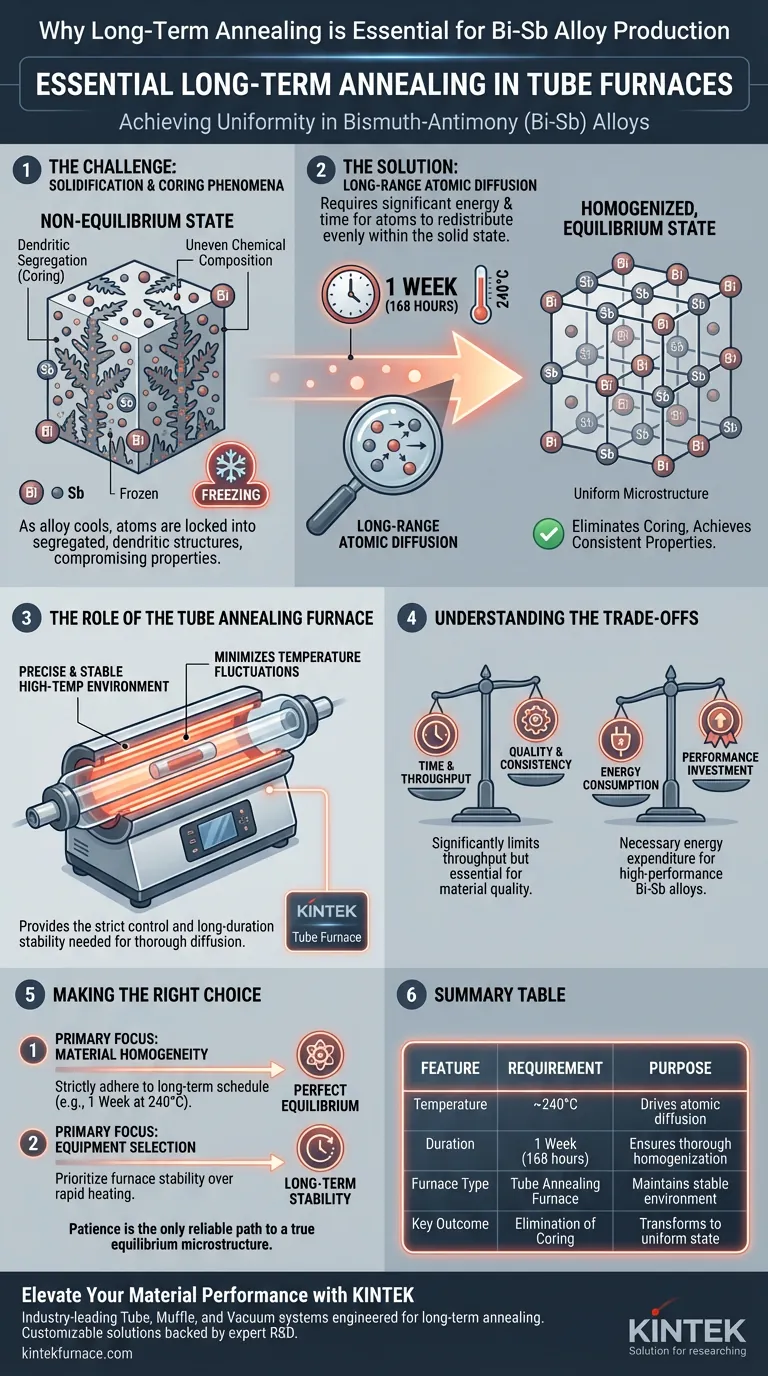
Long-term annealing acts as a critical stabilization phase for bismuth-antimony (Bi-Sb) alloys, correcting structural inconsistencies inherent to the solidification process. By maintaining a precise, elevated temperature over an extended period—often as long as one week—the process drives long-range atomic diffusion to eliminate segregation and achieve a uniform, equilibrium state.
Core Takeaway Solidification naturally results in "coring," where elements distribute unevenly across the alloy's microstructure. Long-term annealing in a stable tube furnace provides the sustained energy required to diffuse these atoms, transforming a segregated dendritic structure into a homogenized, high-performance material.
The Challenge of Solidification: Coring Phenomena
Understanding Dendritic Segregation
When Bi-Sb alloys solidify from a melt, they do not form a perfectly uniform structure immediately.
Instead, they suffer from coring phenomena, also known as dendritic segregation. This results in variations in chemical composition across the microstructure.
The Distance from Equilibrium
As the alloy cools, the resulting solid is effectively "frozen" in a non-equilibrium state.
Without intervention, this segregated structure compromises the consistency of the material's physical and electronic properties.
The Solution: Long-Range Atomic Diffusion
The Mechanism of Homogenization
To fix the segregation caused by coring, the atoms within the solid state must physically move to redistribute themselves evenly.
This process is known as long-range atomic diffusion. It requires significant energy and time to occur effectively within a solid material.
The Necessity of Extended Time
Diffusion in the solid state is a slow process compared to mixing in a liquid.
The primary reference notes that maintaining a temperature of 240 degrees Celsius for one week is a typical requirement. This duration ensures the diffusion process is thorough enough to reduce or eliminate the coring completely.
The Role of the Tube Annealing Furnace
Precision and Stability
The specific use of a tube annealing furnace is not arbitrary; it is chosen for its ability to maintain a strictly controlled environment.
This equipment provides the precise and stable high-temperature environment required for such a long duration.
Ensuring Consistent Results
Fluctuations in temperature over a week-long process could interrupt diffusion or introduce new inconsistencies.
The tube furnace minimizes these variables, ensuring the final microstructure reaches the desired equilibrium state.
Understanding the Trade-offs
Time vs. Throughput
The most significant trade-off in this process is the production bottleneck.
Dedicating a furnace to a single batch for an entire week significantly limits manufacturing throughput.
Energy Consumption
Maintaing 240 degrees Celsius for 168 hours (one week) represents a distinct energy cost.
However, skipping or shortening this step results in an inferior, segregated product, making the energy expenditure a necessary investment for quality.
Making the Right Choice for Your Goal
To optimize your Bi-Sb alloy production, align your process parameters with your quality requirements:
- If your primary focus is material homogeneity: Strictly adhere to the long-term annealing schedule (e.g., one week at 240°C) to guarantee the elimination of coring phenomena.
- If your primary focus is equipment selection: Ensure your furnace specifications prioritize long-term thermal stability over rapid heating rates, as consistency over time is the critical factor.
Patience in the annealing phase is the only reliable path to a true equilibrium microstructure in Bi-Sb alloys.
Summary Table:
| Feature | Requirement for Bi-Sb Alloys | Purpose |
|---|---|---|
| Temperature | ~240°C | Drives long-range atomic diffusion |
| Duration | 1 Week (168 hours) | Ensures thorough homogenization of structure |
| Furnace Type | Tube Annealing Furnace | Maintains precise, stable environment |
| Key Outcome | Elimination of Coring | Transforms non-equilibrium states to uniformity |
Elevate Your Material Performance with KINTEK
Precision in bismuth-antimony alloy production requires more than just heat; it requires absolute thermal stability over extended durations. KINTEK provides industry-leading Tube, Muffle, and Vacuum systems specifically engineered to handle the rigorous demands of long-term annealing processes.
Backed by expert R&D and manufacturing, our high-temp furnaces are fully customizable to meet your unique lab or production needs, ensuring your Bi-Sb alloys achieve a perfect equilibrium state every time.
Ready to optimize your heat treatment workflow? Contact us today to discuss your project requirements!
Visual Guide
References
- Dragan Manasijević, Ivana Marković. Thermal conductivity and microstructure of Bi-Sb alloys. DOI: 10.2298/hemind230829002m
This article is also based on technical information from Kintek Furnace Knowledge Base .
Related Products
- Controlled Inert Nitrogen Hydrogen Atmosphere Furnace
- 1200℃ Controlled Inert Nitrogen Atmosphere Furnace
- 1700℃ High Temperature Laboratory Tube Furnace with Alumina Tube
- Vacuum Sealed Continuous Working Rotary Tube Furnace Rotating Tube Furnace
- Vertical Laboratory Quartz Tube Furnace Tubular Furnace
People Also Ask
- How does hydrogen furnace annealing assist in preparing mechanically alloyed powders for compaction?
- How does atmospheric annealing in a controlled hydrogen furnace affect the cold compaction behavior of metal powders?
- What are the characteristics and uses of hydrogen atmosphere in furnaces? Achieve Superior Surface Purity and Bonding
- What are the characteristics and uses of hydrogen atmospheres in furnaces? Unlock Clean Metal Processing
- What controlled-atmosphere furnace conditions are required for sintering powder metallurgy copper alloy compacts? Ideal Setup



















