
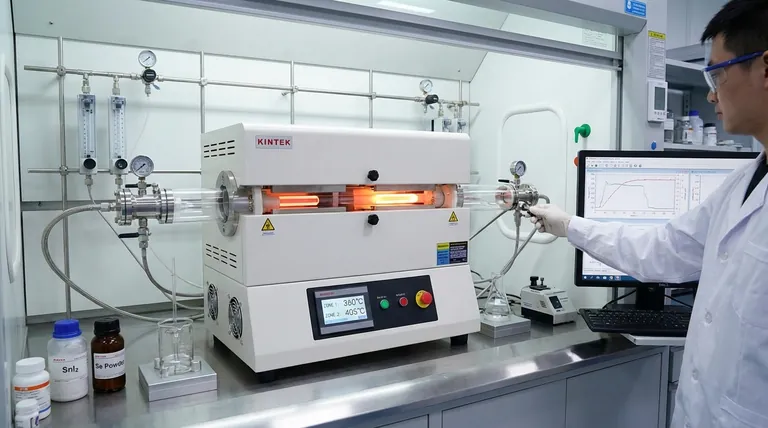
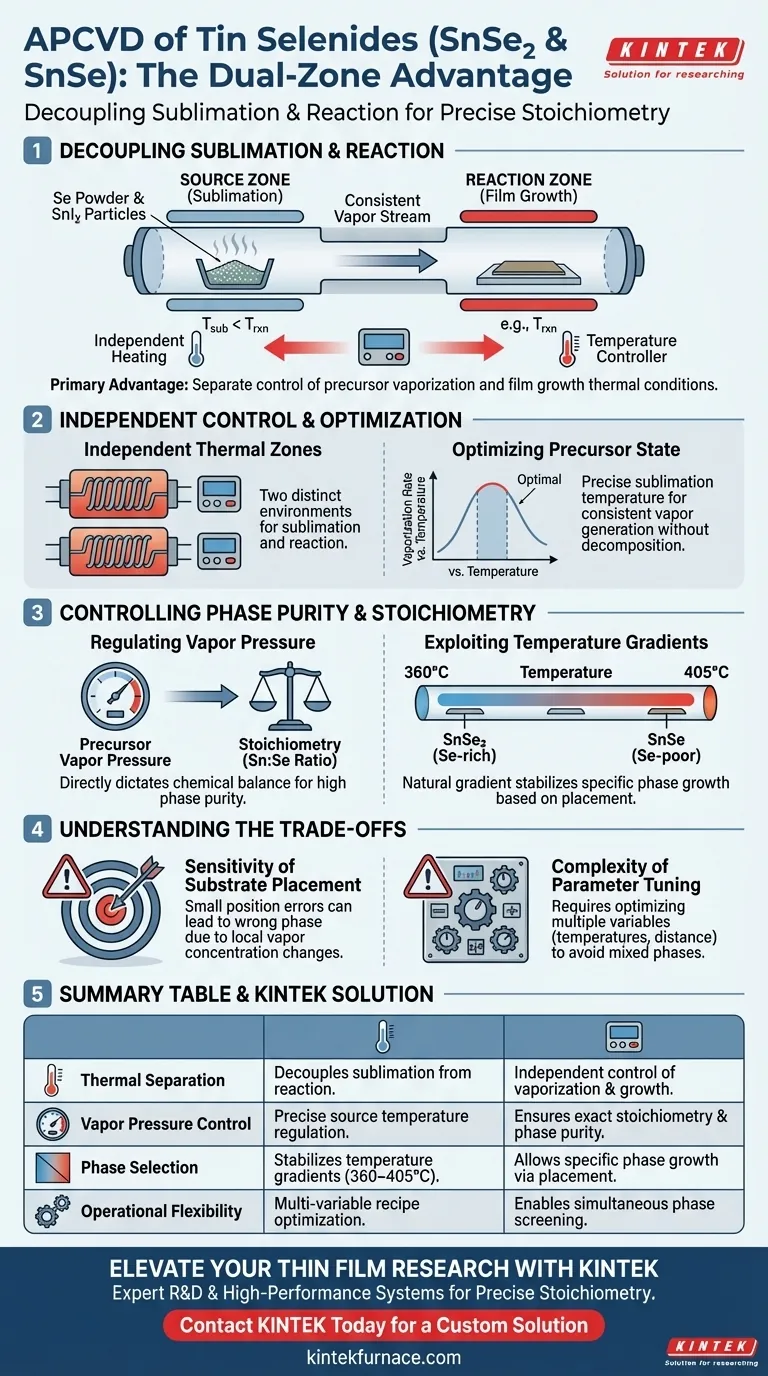
The primary advantage of a dual-zone tube furnace in Atmospheric Pressure Chemical Vapor Deposition (APCVD) is the ability to decouple the precursor sublimation temperature from the reaction zone temperature. This separation allows for precise control over the vaporization of solid precursors like Selenium (Se) powder and Tin Iodide (SnI2) without compromising the thermal conditions required for film growth.
By independently heating the source material and the substrate area, a dual-zone furnace enables exact regulation of precursor vapor pressure. This control is the deciding factor in achieving specific chemical stoichiometry and high phase purity for both Tin Diselenide (SnSe2) and Tin Selenide (SnSe).
Decoupling Sublimation and Reaction
Independent Thermal Zones
A dual-zone furnace provides two distinct heating environments that can be controlled individually.
One zone is dedicated to the sublimation of solid precursors, such as Selenium powder and Tin Iodide particles.
The second zone is dedicated to the reaction area, where the actual thin film growth occurs on the substrate.
Optimizing Precursor State
Solid precursors often require specific temperatures to vaporize at a rate that sustains the reaction without decomposing.
If the source temperature is tied to the reaction temperature (as in a single-zone furnace), you may vaporize the material too quickly or too slowly.
Dual-zone control allows you to set the sublimation temperature exactly where it needs to be to generate a consistent stream of vapor.
Controlling Phase Purity and Stoichiometry
Regulating Vapor Pressure
The quality of SnSe2 and SnSe films is heavily dependent on the ratio of reactants in the vapor phase.
By controlling the source zone temperature, you directly regulate the precursor vapor pressure.
This precise regulation dictates the chemical stoichiometry, ensuring the correct atomic balance between Tin and Selenium enters the reaction zone.
Exploiting Temperature Gradients
The reaction zone creates a natural temperature gradient, typically ranging from 360 to 405 degrees Celsius.
This gradient is essential because the thermodynamic stability of SnSe2 (Selenium-rich) and SnSe (Selenium-poor) differs by temperature.
The dual-zone setup maintains this gradient stably, allowing specific phases to grow based on the substrate's location within the tube.
Understanding the Trade-offs
Sensitivity of Substrate Placement
While the temperature gradient allows for phase selection, it introduces high sensitivity to placement.
Because the local concentration ratio of precursor vapors changes along the tube, a small error in substrate positioning can result in the wrong phase.
Complexity of Parameter Tuning
Dual-zone systems introduce more variables into the growth recipe.
You must optimize not only the growth temperature but also the source temperature and the distance between them.
Failing to balance the source vapor pressure with the reaction temperature can lead to mixed-phase films or incomplete growth.
Making the Right Choice for Your Goal
To maximize the effectiveness of a dual-zone APCVD setup, align your parameters with your specific material objectives:
- If your primary focus is Phase Purity (SnSe2 vs. SnSe): Calibrate the source zone to strictly control vapor pressure, as this dictates the stoichiometric availability of Selenium.
- If your primary focus is Phase Screening: Place multiple substrates along the natural temperature gradient (360–405°C) to grow both Selenium-rich and Selenium-poor phases in a single cycle.
Precise thermal separation between the source and the substrate is the key to mastering the stoichiometry of tin selenide thin films.
Summary Table:
| Feature | Dual-Zone Benefit | Impact on SnSe2/SnSe Growth |
|---|---|---|
| Thermal Separation | Decouples sublimation from reaction zone | Independent control of precursor vaporization and film growth. |
| Vapor Pressure Control | Precise regulation of source zone temperature | Ensures exact chemical stoichiometry and phase purity. |
| Phase Selection | Stabilizes temperature gradients (360–405°C) | Allows growth of specific phases (SnSe2 vs SnSe) via placement. |
| Operational Flexibility | Multi-variable recipe optimization | Enables simultaneous phase screening and material discovery. |
Elevate Your Thin Film Research with KINTEK
Precise stoichiometry in APCVD requires specialized thermal control. Backed by expert R&D and world-class manufacturing, KINTEK offers high-performance Tube, Muffle, Rotary, Vacuum, and CVD systems designed to meet the rigorous demands of material science.
Whether you are growing Selenium-rich SnSe2 or Selenium-poor SnSe, our dual-zone furnaces provide the thermal stability and customization necessary for high-phase purity. Don't settle for inconsistent results—let our experts help you configure the perfect system for your unique lab needs.
Contact KINTEK Today for a Custom Solution
Visual Guide
References
- Manab Mandal, K. Sethupathi. In Situ Simultaneous Growth of Layered SnSe<sub>2</sub> and SnSe: a Linear Precursor Approach. DOI: 10.1002/admi.202500239
This article is also based on technical information from Kintek Furnace Knowledge Base .
Related Products
- Magnesium Extraction and Purification Condensing Tube Furnace
- Split Multi Heating Zone Rotary Tube Furnace Rotating Tube Furnace
- Multi Zone Laboratory Quartz Tube Furnace Tubular Furnace
- Multi Heating Zones CVD Tube Furnace Machine for Chemical Vapor Deposition Equipment
- Split Chamber CVD Tube Furnace with Vacuum Station CVD Machine
People Also Ask
- What are the advantages of using a condensing tube furnace for magnesium extraction? Achieve High Purity and Efficient Metal Recovery
- Why is temperature range important when choosing a tube furnace? It Dictates Cost, Materials, and Performance
- How do tube furnaces contribute to transport reactions and crystal production? Master High-Purity Synthesis with Precision Control
- What are the key applications of tube furnaces in materials research and chemistry? Unlock Precise High-Temperature Processing
- What are the primary functions of a tube furnace in the thermal pre-treatment research of aluminum alloy powder?



















