
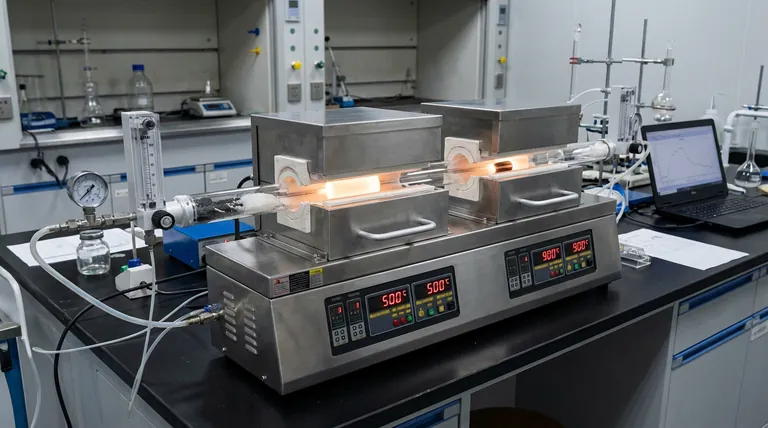
A dual-zone tube furnace provides critical spatial and temporal separation between the breakdown of raw materials and the actual formation of carbon spheres. By utilizing two independently controlled heating zones, you can pyrolyze precursors at a lower temperature in the first zone while simultaneously activating catalysts at a higher temperature in the second.
Core Takeaway In single-zone equipment, precursor breakdown and product growth happen chaotically in the same thermal environment. A dual-zone system decouples these stages, allowing you to generate a steady carbon source in one area and precisely deposit it in another, ensuring uniform morphology and preventing uncontrolled carbonization.
Decoupling the Synthesis Process
Independent Thermal Control
The primary mechanical advantage of a dual-zone furnace is the ability to maintain two distinct temperature profiles within the same reactor tube.
This allows you to treat the "source" material and the "target" substrate as separate variables.
In a single-zone setup, the optimal temperature for one reaction often compromises the other.
Spatial and Temporal Separation
Separation is not just about distance; it is about timing.
By physically separating the zones, you ensure that the chemical reactions occur in a specific sequence.
The precursor material is processed in the first zone before it interacts with the catalyst in the second zone.
The Mechanism of Carbon Sphere Synthesis
Zone 1: Controlled Pyrolysis
In the synthesis of carbon spheres, the first heating zone functions as a gas generator.
Here, solid precursors—specifically polypropylene plastic—are heated to undergo pyrolysis.
This converts the solid plastic into a gaseous carbon source without immediately forcing it to solidify or react.
Zone 2: Catalytic Activation
The gaseous carbon moves downstream into the second heating zone, which is maintained at a significantly higher temperature (e.g., 900°C).
This zone contains the Stöber silica template catalysts.
The high heat activates these templates, allowing the carbon gas to deposit onto them effectively.
Preventing Direct Carbonization
The most critical outcome of this split process is the prevention of direct carbonization.
In a single-zone furnace, the plastic might burn or carbonize unevenly before it ever reaches the silica template.
The dual-zone strategy ensures the carbon arrives as a vapor, allowing for accurate control over the final sphere morphology and particle size distribution.
Understanding the Trade-offs
The Complexity of Parameter Tuning
While a dual-zone furnace offers superior control, it introduces more variables to manage.
You must optimize not just one temperature, but the interplay between the vaporization rate in Zone 1 and the deposition rate in Zone 2.
If the first zone is too hot, the vapor concentration may be too high; if too cool, the reaction in Zone 2 becomes starved.
Equipment vs. Outcome
Single-zone furnaces are simpler to operate and generally less expensive.
However, for high-precision applications like carbon sphere synthesis, simplicity results in lower quality.
The trade-off for the superior uniformity of a dual-zone system is the requirement for stricter process monitoring and thermal calibration.
Making the Right Choice for Your Goal
- If your primary focus is Morphology Control: You must use a dual-zone system to prevent direct carbonization and ensure the carbon deposits uniformly onto the silica templates.
- If your primary focus is Precursor Efficiency: Use the dual-zone setup to fine-tune the pyrolysis temperature (Zone 1) so you generate gas at the exact rate the catalyst (Zone 2) can consume it.
Success in carbon sphere synthesis depends not just on heat, but on applying the right heat at the right stage of the reaction.
Summary Table:
| Feature | Single-Zone Tube Furnace | Dual-Zone Tube Furnace |
|---|---|---|
| Thermal Control | Single uniform profile | Two independent heating zones |
| Process Sequence | Simultaneous/Chaotic reaction | Sequential pyrolysis and deposition |
| Morphology Control | Low; high risk of uneven carbonization | High; uniform particle size distribution |
| Application Focus | Simple, cost-effective heating | Precision synthesis (e.g., carbon spheres) |
| Material Handling | Single stage processing | Source and substrate treated separately |
Elevate Your Material Synthesis with KINTEK Precision
Precise morphology control in carbon sphere synthesis requires more than just heat—it requires the specialized thermal decoupling that only a high-performance Dual-Zone Tube Furnace can provide.
Backed by expert R&D and world-class manufacturing, KINTEK offers a comprehensive range of lab high-temperature solutions, including Muffle, Tube, Rotary, Vacuum, and CVD systems. Whether you need standard equipment or a fully customized system tailored to your unique research needs, our team is ready to support your next breakthrough.
Ready to optimize your synthesis process? Contact KINTEK today to discuss your custom furnace requirements
References
- Eslam Salama, Hassan Shokry. Catalytic fabrication of graphene, carbon spheres, and carbon nanotubes from plastic waste. DOI: 10.1039/d3ra07370j
This article is also based on technical information from Kintek Furnace Knowledge Base .
Related Products
- Magnesium Extraction and Purification Condensing Tube Furnace
- Split Multi Heating Zone Rotary Tube Furnace Rotating Tube Furnace
- Multi Heating Zones CVD Tube Furnace Machine for Chemical Vapor Deposition Equipment
- Multi Zone Laboratory Quartz Tube Furnace Tubular Furnace
- Split Chamber CVD Tube Furnace with Vacuum Station CVD Machine
People Also Ask
- What are the advantages of using a condensing tube furnace for magnesium extraction? Achieve High Purity and Efficient Metal Recovery
- Can you provide an example of a material prepared using a tube furnace? Discover YBa₂Cu₃O₇ Synthesis
- Why is an argon atmosphere protection critical during the selenization of CoO/CoSe? Key to High-Purity Heterostructures
- Why is controlling the residence time within a tube furnace critical for the synthesis of amorphous NiFe2O4 catalysts?
- What is the uniform length of a tube furnace? Maximize Thermal Stability for Reliable Results



















