
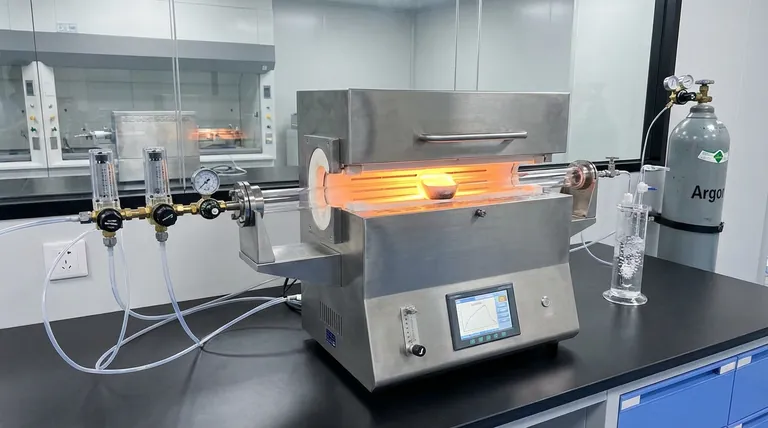
The primary technical advantage of using a tube furnace for carbon nitride heat treatment is the ability to create and maintain a dynamic, flowing inert atmosphere. Unlike ambient air environments, a tube furnace utilizing a gas flow (such as argon) actively sweeps away reaction by-products and prevents oxidation, enabling precise control over the material's structural defects.
By shifting from a static ambient environment to a controlled flowing atmosphere, you gain the ability to engineer the material at a molecular level. This process moves beyond simple heating to allow for the precise regulation of chemical groups and defect sites, which is essential for synthesizing high-performance modified carbon nitride.
The Physics of Controlled Atmosphere Synthesis
Active Exclusion of By-products
In an ambient environment, gases generated during chemical reactions often linger around the sample, potentially causing re-deposition or interfering with the synthesis.
A tube furnace solves this by utilizing a continuous gas flow (e.g., 100 sccm of argon). This flowing stream effectively flushes out volatile by-products immediately as they are generated, ensuring the reaction environment remains clean.
Prevention of Material Oxidation
Carbon nitride is sensitive to the presence of oxygen during high-temperature treatment. Ambient environments expose the material to uncontrolled oxidation, which can degrade its chemical properties.
The sealed environment of a tube furnace creates a protective inert barrier. This ensures that the material undergoes thermal modification without unwanted chemical reactions with atmospheric oxygen.
Precise Structural Engineering
The most critical advantage of the tube furnace is its ability to facilitate defect engineering.
The controlled atmosphere allows for the precise, partial removal of -NH2 groups from the carbon nitride structure. By regulating the thermal conditions and gas flow, you can accurately control the formation of defect sites, which is necessary for synthesizing modified versions of the material with tuned properties.
Understanding the Trade-offs
Process Complexity
Compared to simple muffle furnaces used in ambient air, tube furnaces introduce operational complexity.
They require external gas supplies, flow controllers (mass flow controllers), and gas-tight seals. A failure in the sealing or flow system can inadvertently introduce oxygen, negating the benefits of the equipment.
Volume Limitations
Tube furnaces generally offer a smaller "hot zone" volume compared to box furnaces.
While this geometry is ideal for ensuring uniform gas flow over a sample, it can limit the batch size of the material you can synthesize in a single run.
Making the Right Choice for Your Goal
To maximize the quality of your carbon nitride, align your equipment settings with your specific objectives:
- If your primary focus is Defect Engineering: Prioritize precise control of the gas flow rate (e.g., 100 sccm), as this directly influences the removal rate of -NH2 groups and the resulting defect density.
- If your primary focus is Material Purity: Focus on the integrity of the furnace seals and gas purity to strictly prevent oxidation and exclude reaction by-products.
The tube furnace is not just a heating element; it is a chemical reactor that dictates the final purity and electronic structure of your carbon nitride.
Summary Table:
| Feature | Ambient Environment | Tube Furnace (Flowing Inert Gas) |
|---|---|---|
| Atmosphere Control | Static / Reactive (Oxygen present) | Dynamic / Inert (Argon/Nitrogen) |
| By-product Removal | Poor (Gases linger/re-deposit) | High (Active sweeping via gas flow) |
| Oxidation Risk | High | Near Zero (Sealed system) |
| Structural Precision | Limited | High (Defect engineering of -NH2 groups) |
| Ideal Application | Simple calcination | High-performance modified carbon nitride |
Elevate Your Materials Research with KINTEK Precision
Unlock the full potential of your carbon nitride synthesis with KINTEK’s advanced thermal solutions. Backed by expert R&D and world-class manufacturing, we provide high-performance Tube, Muffle, Rotary, Vacuum, and CVD systems tailored to your exact research parameters.
Whether you need to master defect engineering or ensure absolute material purity, our customizable high-temperature furnaces deliver the stability and atmosphere control your lab requires. Contact KINTEK today to discuss your unique needs with our technical team and discover how our equipment can accelerate your innovation.
References
- Debin Zeng, Yuzheng Guo. CO<sub>2</sub> chemisorption and activation on carbon nitride with less amino groups boost CO<sub>2</sub> photoreduction. DOI: 10.1039/d3cy01585h
This article is also based on technical information from Kintek Furnace Knowledge Base .
Related Products
- Vacuum Sealed Continuous Working Rotary Tube Furnace Rotating Tube Furnace
- 1400℃ High Temperature Laboratory Tube Furnace with Alumina Tube
- 1700℃ High Temperature Laboratory Tube Furnace with Alumina Tube
- 1200℃ Split Tube Furnace Laboratory Quartz Tube Furnace with Quartz Tube
- Vertical Laboratory Quartz Tube Furnace Tubular Furnace
People Also Ask
- What is the purpose of rotary tube furnaces? Achieve Uniform Heat Treatment for Powders and Granules
- What are the key advantages of using a rotary tube furnace? Achieve Dynamic, Uniform Heating for Powders
- How does the amount of material processed vary between batch and continuous rotary tube furnaces? Scale Your Production Efficiently
- What are the advantages of rotary tube furnaces in fuel compatibility? Boost Efficiency and Cut Costs
- What is the temperature range of some rotary tube furnaces? Achieve Uniform Heating Up to 1200°C



















