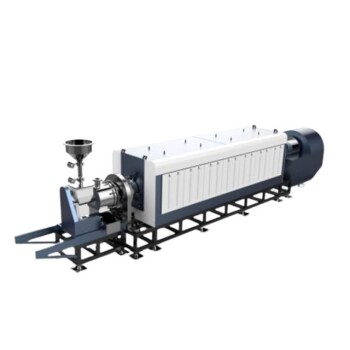
A stainless steel tubular horizontal reactor functions as a robust, high-temperature vessel designed to facilitate the catalytic decomposition of plastic waste. It provides a controlled environment where plastic samples, often held in a specific basket structure, undergo molecular breakdown under thermal stress up to 500°C while maintaining precise contact with the catalyst.
Core Takeaway: This reactor configuration is essential for experimental precision. It combines durability with a specific geometric orientation to ensure uniform heat transfer and effective catalyst-plastic interaction, enabling the accurate conversion of polymers into targeted hydrocarbon products like oil and gas.
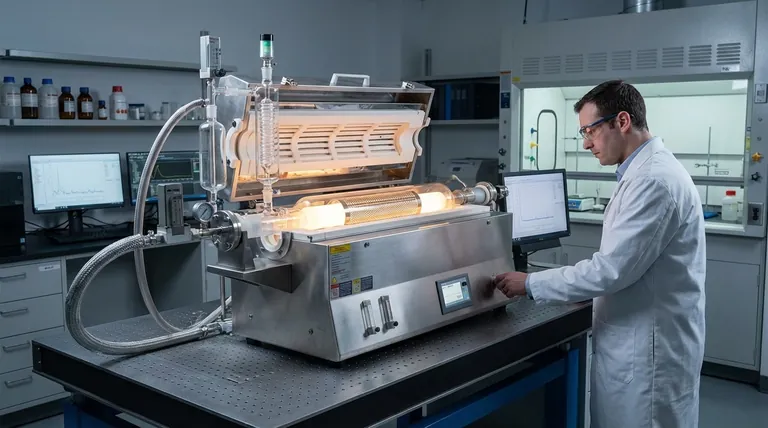
The Role of Material and Structure
Withstanding Thermal Stress
The reactor is constructed from stainless steel, chosen specifically for its durability.
In the context of catalytic pyrolysis, the vessel must withstand significant thermal stress without deforming or reacting with the contents. It operates reliably at high temperatures, typically up to 500°C, which is necessary to trigger the thermal decomposition of polymers.
The Advantage of Horizontal Orientation
The horizontal design is not arbitrary; it serves a functional purpose in product collection.
This orientation facilitates the natural flow of pyrolysis-generated oil and gas mixtures out of the heating zone. By working in tandem with a carrier gas, the horizontal path ensures these volatile products move efficiently into the condensation system, preventing them from lingering too long in the hot zone and undergoing unwanted secondary reactions.
Facilitating the Reaction Mechanism
Precise Catalyst Contact
According to the primary technical guidelines, this reactor type is often paired with a specialized basket structure.
This internal configuration is critical. It dictates the specific contact mode between the solid plastic sample and the catalyst. By fixing the position of the reactants, the system ensures consistent interaction, which is vital for reproducible results.
Molecular Chain Shearing
The ultimate function of the reactor is to act as the site for molecular chain shearing.
Within this heated, stainless steel tube, long-chain hydrocarbons found in plastics are broken down. The environment allows the catalyst to efficiently convert solid waste into shorter-chain gaseous or liquid fuel precursors, resulting in targeted product outputs rather than random decomposition.
Operational Control and Analysis
Maintaining an Inert Atmosphere
The reactor operates as a sealed reaction tube, often within a high-temperature furnace.
This seal is crucial for maintaining an inert atmosphere (oxygen-free), which prevents combustion. Instead of burning the plastic, the heat causes pyrolysis—breaking the chemical bonds in the absence of oxygen to produce fuel rather than ash and smoke.
Enabling Quantitative Analysis
Because the system allows for the classified collection of products, it acts as a tool for data integrity.
The design permits the separate capture of pyrolysis oil, pyrolysis gas, and solid residues. This capability is essential for researchers needing to perform quantitative analysis on product distribution, helping to determine the efficiency of different catalysts or temperature settings.
Understanding the Trade-offs
Batch vs. Continuous Limitations
While highly effective for analysis and specific conversion targets, this setup typically operates as a batch or semi-batch system (implied by the "basket" and "sample" terminology).
This makes it ideal for studying specific waste conversion rates and ensuring complete heating cycles. However, it may have lower throughput compared to continuous industrial fluidized bed reactors. It is a tool designed for precision and experimental validation rather than high-volume commercial processing.
Making the Right Choice for Your Goal
To determine if a stainless steel tubular horizontal reactor is the right tool for your pyrolysis project, consider your primary objectives:
- If your primary focus is Experimental Precision: Use this reactor to isolate variables and obtain accurate data on how specific catalysts affect product yield (oil vs. gas).
- If your primary focus is Material Testing: Rely on the basket structure to test small batches of homogenous plastic waste to understand their specific decomposition behaviors.
This reactor configuration is the bridge between raw plastic waste and usable fuel data, offering the stability required to understand and optimize the pyrolysis process.
Summary Table:
| Feature | Function in Pyrolysis |
|---|---|
| Material (Stainless Steel) | Withstands thermal stress up to 500°C and prevents vessel deformation. |
| Horizontal Orientation | Facilitates efficient flow of oil/gas mixtures toward the condensation system. |
| Sealed Reaction Tube | Maintains an inert, oxygen-free atmosphere to prevent sample combustion. |
| Internal Basket Structure | Ensures precise, reproducible contact between plastic samples and catalysts. |
| Molecular Chain Shearing | Serves as the primary site for converting polymers into liquid and gas fuels. |
Advance Your Pyrolysis Research with KINTEK Precision
Maximize your experimental accuracy with high-performance reactor systems designed for the most demanding lab environments. Backed by expert R&D and manufacturing, KINTEK offers high-quality Muffle, Tube, Rotary, Vacuum, and CVD systems, along with customizable lab high-temp furnaces tailored to your specific plastic waste conversion needs.
Whether you are refining catalyst efficiency or analyzing hydrocarbon yields, our engineering team provides the durability and thermal precision required for groundbreaking results.
Ready to optimize your thermal processing? Contact KINTEK today to discuss your custom furnace solution!
References
- Marco F. Paucar-Sánchez, M.A. Martín‐Lara. Impact of Metal Impregnation of Commercial Zeolites in the Catalytic Pyrolysis of Real Mixture of Post-Consumer Plastic Waste. DOI: 10.3390/catal14030168
This article is also based on technical information from Kintek Furnace Knowledge Base .
Related Products
- Laboratory Quartz Tube Furnace RTP Heating Tubular Furnace
- Electric Rotary Kiln Small Rotary Furnace Biomass Pyrolysis Plant Rotating Furnace
- Custom Made Versatile CVD Tube Furnace Chemical Vapor Deposition CVD Equipment Machine
- Slide PECVD Tube Furnace with Liquid Gasifier PECVD Machine
- Electric Rotary Kiln Pyrolysis Furnace Plant Machine Small Rotary Kiln Calciner
People Also Ask
- What physical conditions does a laboratory Tube Furnace provide for SOEC? Precision Heat for Solid Oxide Characterization
- What are the main features and functions of a laboratory tube furnace? Unlock Precise High-Temp Control for Your Lab
- What role does a laboratory tube furnace play in geological and mineralogical research? Unlock Earth's Secrets with Precision
- Why is control of heating rate and gas flow in a lab tube furnace critical for EM wave absorption materials?
- What conditions does a tube furnace provide for post-ion-implantation? Achieve Precise Microstructural Repair