
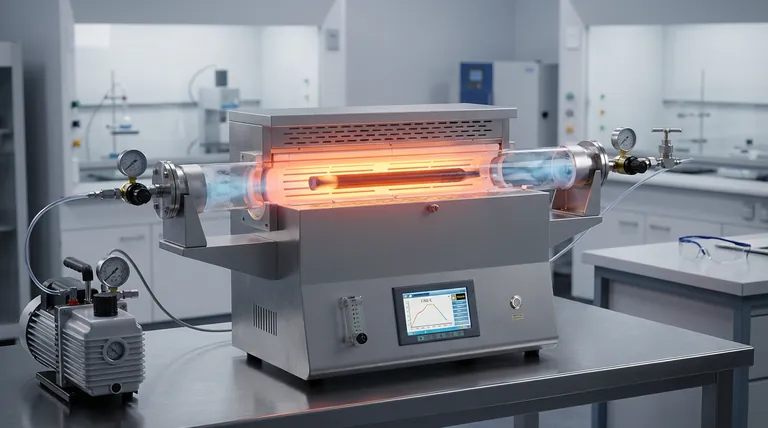
High-temperature tube furnaces using an argon atmosphere are essential for the controlled thermal decomposition of composite materials. They provide a strictly regulated, oxygen-free environment that allows organic precursors to transform into stable carbon structures through pyrolysis. By displacing oxygen, the argon prevents the material from burning away, ensuring that the final product retains its intended chemical composition and microscopic architecture.
The core purpose of this setup is to enable "protected pyrolysis," where precise heating triggers chemical transformations like coking and crystallization while the inert argon gas prevents the carbon matrix from undergoing oxidative destruction.
The Critical Role of the Inert Atmosphere
Preventing Oxidative Ablation
At the high temperatures required for carbonization, carbon and many organic polymers will react with oxygen to form carbon dioxide, effectively disappearing. High-purity argon creates a protective barrier that prevents this "oxidative ablation," ensuring the carbon skeleton remains intact throughout the process.
Protecting Sensitive Composite Elements
Many composites contain metallic or rare-earth elements, such as aluminum, samarium, or gadolinium, which are highly susceptible to oxidation. The argon atmosphere prevents the formation of unwanted interfacial oxide layers, which is critical for maintaining strong atomic bonding and ideal physical properties within the composite.
Enabling Chemical Transformations
The inert environment allows for specific chemical reactions that would be impossible in the presence of air, such as dehydrogenation and cyclization. These reactions are what successfully convert organic precursors like polyaniline or PVP into a robust, nitrogen-doped carbon skeleton or carbon-encapsulated structure.
Precision Thermal Control and Structural Integrity
Facilitating Controlled Coking
A tube furnace allows for a precise heating program—for example, a ramp of 5 °C/min up to 600 °C—which is necessary for binder pitch to undergo coking. This controlled transformation turns the binder into an amorphous carbon matrix, which is the "glue" that holds the composite together.
Promoting Localized Crystallization
Beyond simple heating, the furnace provides the stable environment needed for localized crystallization of the carbon structure. This increase in crystallinity is vital for enhancing the electrochemical stability of the material, making it suitable for high-performance applications like batteries or supercapacitors.
Preserving Microscopic Pore Structures
The combination of uniform heat and an inert gas flow prevents the "collapse" of delicate internal features. This ensures that the microscopic pore structure of the original material is preserved, which is essential for subsequent processes like active component loading or gas adsorption.
Understanding the Trade-offs and Limitations
Gas Consumption and Operational Cost
Argon is an expensive inert gas compared to nitrogen, though it is more effective at preventing oxidation in high-temperature environments. Continuous flow requirements can significantly increase the operational cost of the carbonization process, making gas recovery systems a common consideration for industrial scales.
Management of Volatile Byproducts
During carbonization, organic precursors release volatile components as they decompose into carbon. If the furnace does not have an adequate exhaust or "trap" system, these volatiles can condense on the cooler ends of the tube, potentially contaminating future batches or damaging the equipment.
Seal Integrity Risks
The effectiveness of the argon atmosphere is entirely dependent on the vacuum-tight seals of the tube furnace. Even a minor leak can allow trace amounts of oxygen to enter, leading to "pitting" or partial oxidation of the composite, which can compromise the material's mechanical strength.
How to Optimize Your Carbonization Process
Recommendations for Success
To achieve the best results with a high-temperature tube furnace, you should tailor your approach based on your specific material goals:
- If your primary focus is electrochemical stability: Prioritize a precise heating ramp and a steady argon flow to promote localized crystallization and an amorphous carbon matrix.
- If your primary focus is preserving delicate structures: Utilize multi-stage gradient heating (e.g., 1°C/min to 2°C/min) to allow for orderly dehydrogenation and deoxygenation without destroying the micropore framework.
- If your primary focus is preventing metallic oxidation: Ensure a high-vacuum purge is performed before introducing argon to achieve an environment with extremely low residual oxygen content.
By mastering the balance between thermal precision and atmospheric purity, you can transform simple organic precursors into high-performance carbon composites with predictable and repeatable properties.
Summary Table:
| Feature | Function in Carbonization | Impact on Composite Quality |
|---|---|---|
| Argon Atmosphere | Prevents oxidative ablation | Preserves carbon skeleton & structural integrity |
| Precise Thermal Control | Manages heating ramps (e.g., 5°C/min) | Facilitates controlled coking & amorphous matrix formation |
| Oxygen-Free Environment | Enables dehydrogenation & cyclization | Converts organic precursors into stable carbon structures |
| Inert Gas Flow | Protects sensitive metallic elements | Maintains strong atomic bonding & prevents oxide layers |
| Vacuum-Tight Seals | Ensures atmospheric purity | Prevents material pitting & mechanical strength loss |
Elevate Your Materials Research with KINTEK
Unlock the full potential of your carbonization processes with high-performance thermal technology. Backed by expert R&D and world-class manufacturing, KINTEK offers a comprehensive range of Tube, Muffle, Rotary, Vacuum, and CVD systems. Our lab high-temp furnaces are fully customizable to meet your unique atmosphere and thermal profile requirements.
Whether you are refining battery materials or engineering advanced composites, our team is ready to provide the precision you need. Contact KINTEK experts today to find the perfect solution for your high-temperature laboratory applications.
References
- Sungwon Hwang. SiOx/C Composite Anode for Lithium-Ion Battery with Improved Performance Using Graphene Quantum Dots and Carbon Nanoparticles. DOI: 10.3390/molecules29112578
This article is also based on technical information from Kintek Furnace Knowledge Base .
Related Products
- 1700℃ High Temperature Laboratory Tube Furnace with Alumina Tube
- Vertical Laboratory Quartz Tube Furnace Tubular Furnace
- 1400℃ High Temperature Laboratory Tube Furnace with Alumina Tube
- 1700℃ Controlled Inert Nitrogen Atmosphere Furnace
- 1200℃ Split Tube Furnace Laboratory Quartz Tube Furnace with Quartz Tube
People Also Ask
- How does zone-melting in tube furnaces synthesize bismuth micro-wires? Master Single-Crystal Thermoelectric Growth
- How do high-temperature laboratory tube furnaces ensure environmental stability? Precision Thermal Reduction Tips
- How are high-temp tube furnaces used to measure diffusion coefficients per Fick's law? Master Precision Annealing
- How are high-temperature laboratory tube furnaces applied in long-term vacuum homogenization heat treatments for intermetallic samples?
- How are high-temperature tube furnaces applied in testing ceramic-supported alloy membranes? Insights



















