
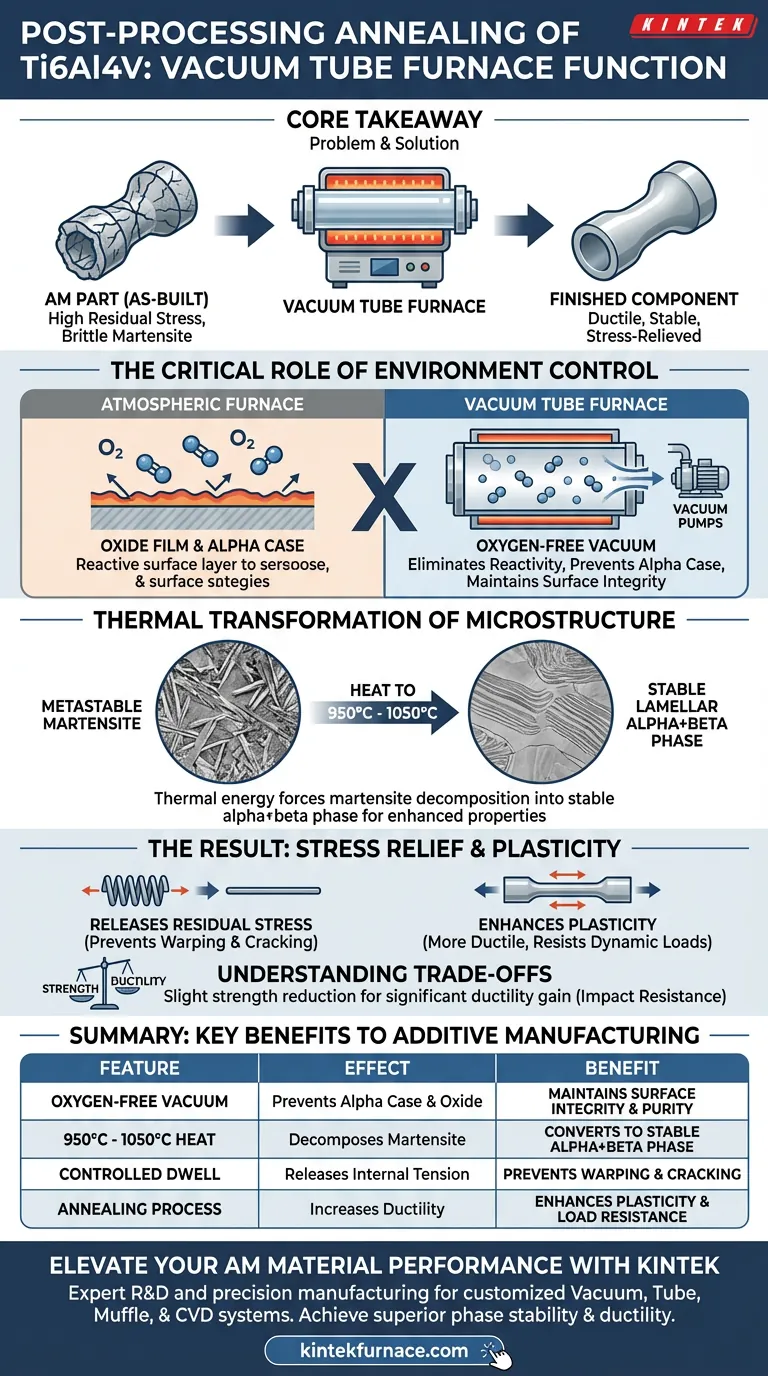
A vacuum tube furnace functions as a precision thermal environment specifically engineered to alter the microstructure of Additively Manufactured (AM) Ti6Al4V parts without compromising surface integrity.
It achieves this by maintaining a strict oxygen-free vacuum while heating components to temperatures between 950°C and 1050°C. This thermal cycle decomposes the brittle, metastable martensitic structures typical of AM printing, converting them into stable lamellar alpha+beta phases to relieve residual stress and significantly enhance plasticity.
Core Takeaway
Additive manufacturing leaves Ti6Al4V with high residual stresses and a brittle microstructure. The vacuum tube furnace solves this by providing the inert, high-temperature environment required to decompose these unstable phases, transforming the part into a ductile, structurally stable component ready for use.
The Critical Role of Environment Control
Eliminating Reactivity
Titanium alloys, particularly Ti6Al4V, are highly reactive at elevated temperatures. If exposed to oxygen while hot, they rapidly form oxide films that degrade mechanical properties.
The Vacuum Advantage
A vacuum tube furnace creates an oxygen-free atmosphere. This is distinct from standard atmospheric furnaces.
By removing air and impurities, the furnace prevents the formation of a brittle "alpha case" (an oxygen-enriched surface layer). This ensures the surface integrity remains intact during the heating process.
Thermal Transformation of the Microstructure
Addressing the "As-Built" State
Parts produced via additive manufacturing undergo rapid cooling during the printing process.
This rapid cooling freezes the microstructure into a metastable martensitic phase. While hard, this structure is full of residual internal stresses and lacks the ductility required for many structural applications.
The Decomposition Process
The furnace heats the parts to a specific annealing window, typically 950°C or 1050°C.
At these temperatures, the thermal energy forces the metastable martensite to decompose. The material relaxes, and the atoms rearrange themselves into a more natural equilibrium.
Achieving Phase Stability
The end result of this heat treatment is a stable lamellar alpha+beta phase.
This transformation is not merely cosmetic; it fundamentally changes how the material behaves under load. The shift to a lamellar structure provides the internal "slip systems" necessary for the material to stretch rather than snap.
The Result: Stress Relief and Plasticity
Releasing Residual Stress
AM parts often contain significant internal tension from the layer-by-layer melting process.
The high-temperature dwell in the vacuum furnace releases these residual stresses. If left untreated, these stresses could cause the part to warp or crack prematurely during service.
Enhancing Plasticity
The primary output of this specific annealing process is enhanced plasticity.
By converting the brittle martensite into the alpha+beta phase, the material becomes more ductile. This ensures the part can withstand dynamic loads and deformation without catastrophic failure.
Understanding the Trade-offs
While vacuum annealing is essential for Ti6Al4V, it is important to understand the balance of properties.
Strength vs. Ductility
The "as-built" martensitic structure is often extremely strong but brittle. By annealing to specific temperatures like 1050°C to gain plasticity, you may see a slight reduction in ultimate tensile strength compared to the raw printed state. This is a necessary trade-off to ensure the part does not shatter under impact.
Process Sensitivity
The vacuum level must be maintained rigorously. Even a small leak or insufficient vacuum level can lead to surface oxidation, rendering the high-precision part unusable due to surface embrittlement.
Making the Right Choice for Your Goal
To maximize the performance of your Ti6Al4V components, align your heat treatment with your mechanical requirements:
- If your primary focus is Ductility and Reliability: Prioritize annealing at 950°C–1050°C to fully decompose martensite into the stable alpha+beta phase.
- If your primary focus is Geometric Stability: Ensure the vacuum cycle includes a sufficient dwell time to fully relieve residual stresses, preventing warping after the part is removed from the build plate.
Summary: The vacuum tube furnace is not just a heater; it is a phase-transformation tool that converts a printed shape into a structurally sound, ductile engineering component.
Summary Table:
| Feature | Effect on Ti6Al4V Parts | Benefit to Additive Manufacturing |
|---|---|---|
| Oxygen-Free Vacuum | Prevents "alpha case" & oxide films | Maintains surface integrity & purity |
| 950°C - 1050°C Heat | Decomposes brittle martensite | Converts to stable alpha+beta phase |
| Controlled Dwell | Releases internal tension | Prevents warping and cracking |
| Annealing Process | Increases material ductility | Enhances plasticity and load resistance |
Elevate Your AM Material Performance with KINTEK
Don't let residual stress or surface oxidation compromise your titanium components. KINTEK provides industry-leading thermal solutions backed by expert R&D and precision manufacturing. Whether you need Vacuum, Tube, Muffle, or CVD systems, our laboratory high-temp furnaces are fully customizable to meet your specific additive manufacturing post-processing requirements.
Ready to achieve superior phase stability and ductility?
Contact our specialists today to find your perfect furnace solution!
Visual Guide
References
- Anna Antolak‐Dudka, Justyna Łukasiewicz. Comparison of the Microstructural, Mechanical and Corrosion Resistance Properties of Ti6Al4V Samples Manufactured by LENS and Subjected to Various Heat Treatments. DOI: 10.3390/ma17051166
This article is also based on technical information from Kintek Furnace Knowledge Base .
Related Products
- Vacuum Hot Press Furnace Machine Heated Vacuum Press Tube Furnace
- Vacuum Sealed Continuous Working Rotary Tube Furnace Rotating Tube Furnace
- High Pressure Laboratory Vacuum Tube Furnace
- Laboratory Vacuum Tilt Rotary Tube Furnace Rotating Tube Furnace
- Magnesium Extraction and Purification Condensing Tube Furnace
People Also Ask
- Why use Vacuum Hot Press (VHP) for ZnS Ceramics? Achieve Superior IR Transparency and Mechanical Strength
- What safety features are incorporated in vacuum hot press furnaces? Ensure Operator and Equipment Protection
- What are the benefits of the vacuum environment system in a vacuum hot press furnace? Unlock High-Density Sintering
- What considerations guide the selection of heating elements and pressurization methods for a vacuum hot press furnace?
- How have vacuum hot press furnaces transformed material processing? Achieve Superior Density and Purity



















