
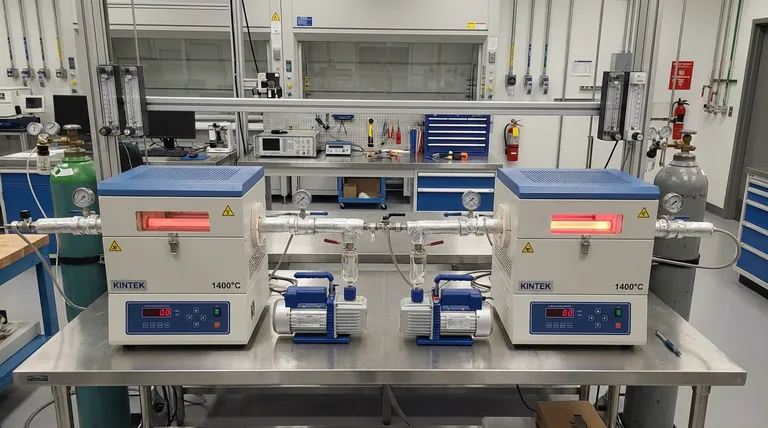
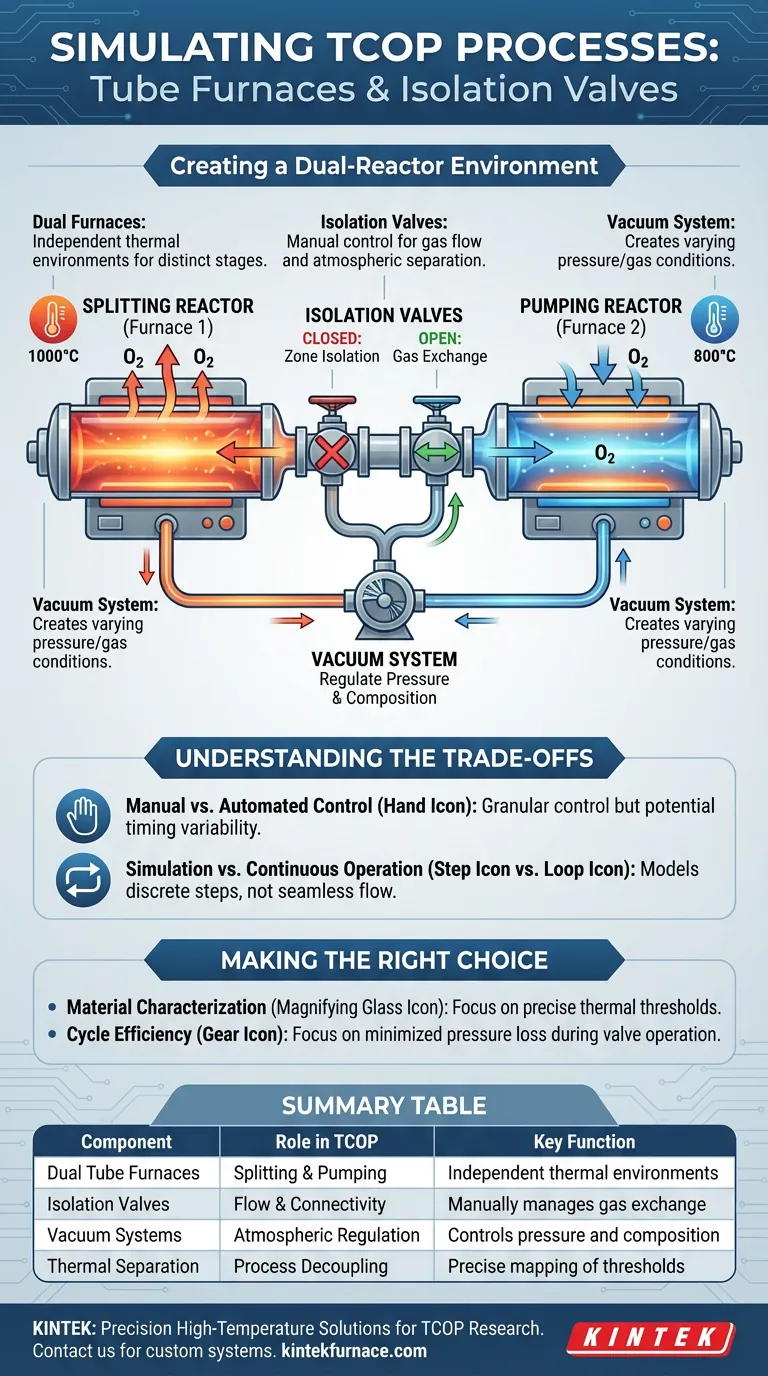
In Thermochemical Oxygen Pump (TCOP) experiments, tube furnaces and isolation valves are arranged to create a dual-reactor simulation that mimics the distinct stages of a thermochemical cycle. Two independent tube furnaces are used to represent the splitting reactor and the pumping reactor separately, while precision manual valves allow researchers to physically connect or isolate these high-temperature zones to control gas flow and pressure.
By decoupling the thermal zones and utilizing manual isolation, this setup enables precise manipulation of pressure and gas composition, allowing for the accurate assessment of oxygen absorption and release performance.
Simulating the Dual-Reactor Environment
The Role of Independent Tube Furnaces
The core of the TCOP experimental setup relies on two independent tube furnaces.
Rather than using a single heating source, this dual-furnace configuration physically separates the process into two distinct thermal environments.
Replicating Specific Reactor Functions
One furnace is designated to simulate the splitting reactor, while the other simulates the pumping reactor.
This separation allows researchers to maintain different thermal conditions simultaneously, mimicking the real-world operational disparity between the two stages of the cycle.
Controlling the Cycle with Isolation Valves
Managing Zone Connectivity
Precision manual valves are placed between the two furnace zones.
These valves serve as the control mechanism, allowing the operator to instantly connect or isolate the atmospheres of the two furnaces.
Simulating Gas Exchange
By opening and closing these valves, researchers can simulate the gas exchange processes that occur during a full thermochemical cycle.
This manual control enables the transfer of gases between the simulated reactors, replicating the flow that would occur in a continuous system.
Regulating Pressure and Composition
The valves work in tandem with vacuum systems to alter the environment within the tubes.
This allows the experiment to run under varying pressures and gas compositions, which is critical for testing how materials behave under stress or changing atmospheric conditions.
Understanding the Trade-offs
Manual vs. Automated Control
The primary reference notes the use of precision manual valves.
While this offers granular control for small-scale experiments, manual operation can introduce variability in timing that might not exist in a fully automated industrial pump.
Simulation vs. Continuous Operation
This setup creates a discontinuous simulation of a continuous process.
While effective for assessing material performance (oxygen absorption and release), the reliance on isolating zones means the setup is modeling discrete steps rather than a seamless, continuous flow.
Making the Right Choice for Your Experiment
To maximize the effectiveness of a TCOP simulation using this setup, consider your specific testing goals:
- If your primary focus is material characterization: Utilize the independent temperature controls of the two furnaces to pinpoint the exact thermal thresholds for oxygen absorption.
- If your primary focus is cycle efficiency: Focus on the precision of your valve operation to minimize pressure loss during the transition between the connected and isolated states.
This configuration provides a robust framework for isolating variables and validating the fundamental chemical performance of your materials.
Summary Table:
| Component | Role in TCOP Simulation | Key Function |
|---|---|---|
| Dual Tube Furnaces | Splitting & Pumping Reactors | Creates independent thermal environments for separate cycle stages. |
| Isolation Valves | Flow & Connectivity Control | Manually manages gas exchange and atmospheric separation between reactors. |
| Vacuum Systems | Atmospheric Regulation | Controls pressure and gas composition to mimic real-world stress conditions. |
| Thermal Separation | Process Decoupling | Allows precise mapping of oxygen absorption and release thresholds. |
Precision High-Temperature Solutions for TCOP Research
Maximize the accuracy of your thermochemical cycles with KINTEK’s industry-leading thermal technology. Backed by expert R&D and manufacturing, KINTEK offers a comprehensive range of Muffle, Tube, Rotary, Vacuum, and CVD systems, all of which are fully customizable to meet your unique experimental needs.
Whether you are characterizing advanced materials or optimizing oxygen pump efficiency, our high-performance furnaces provide the thermal stability and precision control required for groundbreaking research. Empower your laboratory with KINTEK today—Contact our experts to discuss your custom solution.
Visual Guide
References
- Mathias Pein, Christian Sattler. Thermochemical Oxygen Pumping with Perovskite Reticulated Porous Ceramics for Enhanced Reduction of Ceria in Thermochemical Fuel Production. DOI: 10.1002/aenm.202304454
This article is also based on technical information from Kintek Furnace Knowledge Base .
Related Products
- Vacuum Sealed Continuous Working Rotary Tube Furnace Rotating Tube Furnace
- 1400℃ High Temperature Laboratory Tube Furnace with Alumina Tube
- 1700℃ High Temperature Laboratory Tube Furnace with Alumina Tube
- Magnesium Extraction and Purification Condensing Tube Furnace
- High Pressure Laboratory Vacuum Tube Furnace
People Also Ask
- What is the purpose of rotary tube furnaces? Achieve Uniform Heat Treatment for Powders and Granules
- What are the key advantages of using a rotary tube furnace? Achieve Dynamic, Uniform Heating for Powders
- How does the amount of material processed vary between batch and continuous rotary tube furnaces? Scale Your Production Efficiently
- What are the advantages of rotary tube furnaces in fuel compatibility? Boost Efficiency and Cut Costs
- What is the temperature range of some rotary tube furnaces? Achieve Uniform Heating Up to 1200°C



















