
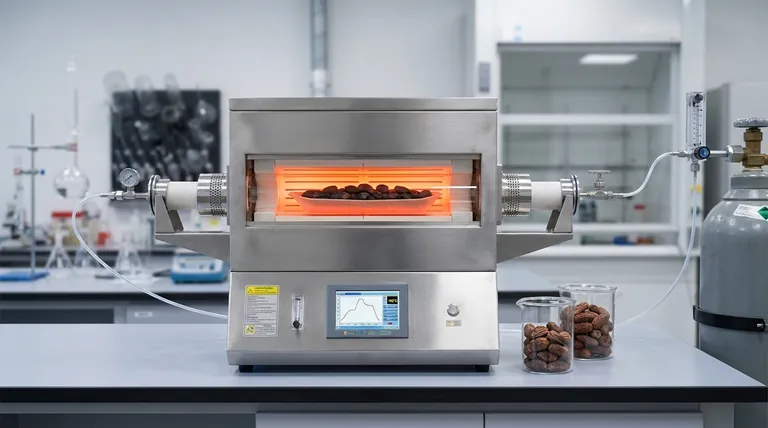
The laboratory tube furnace functions as the primary reactor for slow pyrolysis, the specific thermal process required to convert date stones into biochar. By maintaining a stable temperature between 400-500 °C under a continuous flow of nitrogen, the furnace creates a strictly controlled, oxygen-free environment. This prevents the biomass from burning, instead forcing thermal decomposition that transforms the organic date stone material into a carbon-rich solid with a developed pore structure.
Core Takeaway The tube furnace is not merely a heater; it is a precision instrument for environment control. Its ability to regulate atmosphere and heating rates simultaneously is what distinguishes high-quality biochar production from simple combustion, ensuring the specific yield and porosity required for advanced applications.
The Mechanism of Transformation
Creating an Oxygen-Free Atmosphere
The most critical role of the tube furnace is to facilitate an anaerobic (oxygen-free) reaction. By sealing the reaction zone and flushing it with nitrogen, the furnace prevents the date stones from combusting into ash.
This "protective atmosphere" ensures that the chemical changes are driven purely by heat (pyrolysis) rather than oxidation.
Facilitating Thermal Decomposition
Once the oxygen is removed, the furnace creates the conditions for thermal decomposition. As the temperature rises, the lignocellulosic components of the date stones break down.
This process, known as devolatilization, drives off volatile organic compounds, leaving behind the stable carbon skeleton that constitutes biochar.
Critical Operational Parameters
Precise Temperature Regulation
For date stones, the primary reference indicates an optimal operating window of 400-500 °C. The tube furnace maintains this temperature with high precision, ensuring the entire sample is treated uniformly.
Uniform heating is essential; fluctuations can lead to incomplete carbonization or inconsistent biochar quality within the same batch.
Controlled Heating Rates
Beyond the final temperature, the furnace controls how fast the heat increases (e.g., 10 °C/min). Programmable heating rates allow for the gradual release of volatiles.
This gradual release is vital for preventing structural collapse, ensuring the biochar retains a robust physical form.
Development of Pore Structure
The regulated heat and airflow directly influence the physical architecture of the biochar. As volatiles escape the date stone matrix, they leave behind voids.
These voids become the "primary channels" or pores. This initial pore structure is fundamental, as it defines the surface area and potential adsorption capacity of the final material.
Understanding the Trade-offs
Batch Size Limitations
Laboratory tube furnaces are designed for precision, not volume. They are ideal for experimental optimization and characterizing date stone biochar, but they are generally limited to small sample sizes compared to industrial rotary kilns.
Sensitivity to Gas Flow
The quality of the output is entirely dependent on the integrity of the inert atmosphere. Any fluctuation or interruption in the nitrogen flow during the high-temperature phase can instantly oxidize the sample, ruining the pore structure and reducing the yield to ash.
Making the Right Choice for Your Goal
The settings you choose for the tube furnace should depend on what you intend to do with the date stone biochar.
- If your primary focus is Adsorption Capacity: Prioritize higher temperatures (within the 500 °C range) and slower heating rates to maximize the release of volatiles and the formation of complex pore networks.
- If your primary focus is Biochar Yield: Operate at the lower end of the temperature spectrum (closer to 400 °C) to minimize mass loss while still achieving carbonization.
The tube furnace turns raw biomass into a tunable material, giving you control over the microscopic architecture of the final product.
Summary Table:
| Parameter | Role in Date Stone Pyrolysis | Impact on Final Biochar |
|---|---|---|
| Atmosphere Control | Provides anaerobic (N2) environment | Prevents combustion; ensures carbonization over ash formation |
| Temp Range (400-500°C) | Facilitates thermal decomposition | Determines the balance between biochar yield and pore development |
| Heating Rate | Controls devolatilization speed | Prevents structural collapse; maintains robust physical form |
| Reaction Zone | Sealed quartz/ceramic tube | Ensures uniform heat distribution and high-purity output |
Elevate Your Biochar Research with KINTEK
Ready to transform date stones and biomass into high-performance carbon materials? KINTEK’s precision laboratory tube furnaces provide the exact atmosphere and temperature control needed to optimize your pyrolysis yields. Backed by expert R&D and manufacturing, we offer customizable Tube, Muffle, Rotary, Vacuum, and CVD systems tailored for advanced lab research.
Don't settle for inconsistent results. Partner with KINTEK for superior thermal processing solutions—Contact us today to find your perfect furnace!
Visual Guide

References
- Salem S. Bamerdhah, Mohammad Asif. Optimized synthesis of activated carbon from date palm seeds for efficient crude oil adsorption in wastewater treatment. DOI: 10.1038/s41598-025-16831-7
This article is also based on technical information from Kintek Furnace Knowledge Base .
Related Products
- 1400℃ High Temperature Laboratory Tube Furnace with Alumina Tube
- Laboratory Quartz Tube Furnace RTP Heating Tubular Furnace
- Laboratory Vacuum Tilt Rotary Tube Furnace Rotating Tube Furnace
- 1700℃ High Temperature Laboratory Tube Furnace with Alumina Tube
- Vertical Laboratory Quartz Tube Furnace Tubular Furnace
People Also Ask
- How does zone-melting in tube furnaces synthesize bismuth micro-wires? Master Single-Crystal Thermoelectric Growth
- How do high-temperature laboratory tube furnaces ensure environmental stability? Precision Thermal Reduction Tips
- How are high-temp tube furnaces used to measure diffusion coefficients per Fick's law? Master Precision Annealing
- How are high-temperature laboratory tube furnaces applied in long-term vacuum homogenization heat treatments for intermetallic samples?
- How are high-temperature tube furnaces applied in testing ceramic-supported alloy membranes? Insights



















