
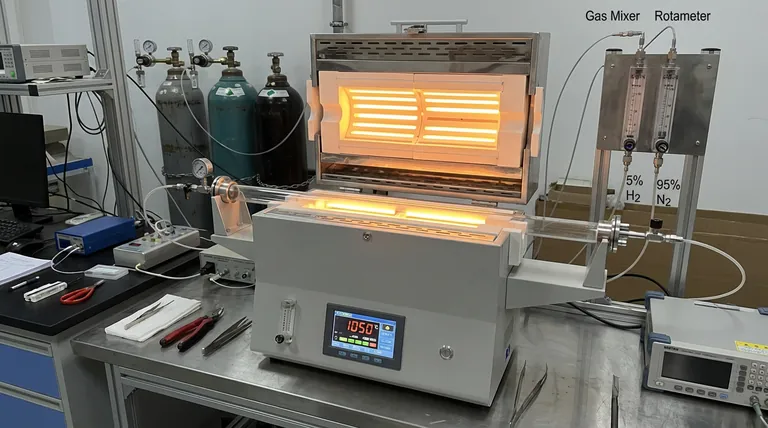
An industrial-grade tube furnace is essential because it provides the precise combination of high thermal energy and a specific reducing atmosphere required for chemical conversion. Specifically, it maintains a stable 1050 °C environment while managing a controlled gas flow of 5% H2 and 95% N2. This dual control is the only reliable method to drive the reduction process necessary to activate the material.
The tube furnace acts as the catalyst for a fundamental structural shift, forcing the material from a tetragonal to a cubic phase. By strictly controlling the reduction of molybdenum ions, this equipment ensures the creation of high-performance anode materials for Solid Oxide Fuel Cells (SOFCs).
Driving the Structural Transformation
To understand why this equipment is non-negotiable, you must look at the physical changes occurring within the material lattice.
From Tetragonal to Cubic Phase
The primary function of the furnace is to facilitate a complete phase transition. The precursor material, SrMo1−xMnxO4, exists in a tetragonal phase.
To become active SrMo1−xMnxO3−δ, the crystal structure must rearrange into a cubic perovskite phase. This transformation is energy-intensive and requires sustained, uniform heat that standard ovens cannot provide.
Modifying Molybdenum Valence States
Beyond simple heating, the furnace alters the chemical state of the elements. The process targets the molybdenum ions, specifically changing their valence states.
Accurate reduction of these ions is critical. It determines the electronic conductivity and catalytic activity of the final perovskite, directly impacting its efficiency as an SOFC anode.
The Necessity of Environmental Control
The "industrial-grade" designation is significant because it implies a level of precision that laboratory-grade or makeshift setups often lack.
Maintaining the 1050 °C Threshold
The reduction process requires a high-temperature environment of exactly 1050 °C. Variations in temperature can lead to incomplete phase transformation or material degradation.
An industrial furnace ensures the thermal profile remains consistent across the entire heating zone, preventing "cold spots" that result in heterogeneous samples.
Managing the Reducing Atmosphere
Heat alone is insufficient; the reaction requires a chemical reducing agent. The furnace circulates a specific mixture of 5% Hydrogen (H2) and 95% Nitrogen (N2).
This gas management is the core mechanism that removes oxygen from the lattice (creating the "−δ" in the formula). Precise flow control prevents over-reduction or oxidation, locking the material into the desired active state.
Understanding the Trade-offs
While an industrial tube furnace is the standard solution, it is important to understand the variables at play to avoid common processing errors.
Precision vs. Throughput
The strict requirement for a controlled atmosphere limits the batch size of the material. Attempting to overload the tube can disrupt gas flow, leading to uneven reduction.
Gas Mixture Sensitivity
The 5% H2 concentration is a critical variable. Deviating from this specific ratio—either too high or too low—can result in a failure to achieve the correct molybdenum valence state, rendering the anode material ineffective.
Making the Right Choice for Your Goal
When configuring your synthesis process, your equipment settings should align with your specific material performance targets.
- If your primary focus is Phase Purity: Prioritize temperature stability at 1050 °C to ensure the complete transition from tetragonal to cubic structures.
- If your primary focus is Electrochemical Performance: Focus on the precision of the gas flow management to guarantee the optimal reduction of molybdenum ions.
The industrial-grade tube furnace is not just a heat source; it is the precision instrument that defines the structural and chemical integrity of your final SOFC anode material.
Summary Table:
| Feature | Requirement | Impact on SrMo1−xMnxO3−δ |
|---|---|---|
| Temperature | Stable 1050 °C | Ensures complete Tetragonal to Cubic phase transition |
| Atmosphere | 5% H2 / 95% N2 | Creates oxygen vacancies (δ) and reduces Mo valence |
| Equipment | Industrial Tube Furnace | Uniform thermal profile and precise gas flow management |
| End Result | Active Perovskite | High electronic conductivity and catalytic activity for SOFCs |
Elevate Your Material Research with KINTEK Precision
Achieving the perfect cubic perovskite phase for SOFC anodes demands uncompromising thermal and atmospheric control. KINTEK provides industry-leading Tube, Muffle, Vacuum, and CVD systems—all backed by expert R&D and fully customizable to your specific reduction protocols.
Don't let temperature fluctuations or gas impurities compromise your research. Contact our technical experts today to discover how our specialized high-temperature lab furnaces can streamline your synthesis process and ensure material purity.
References
- Lucía Sánchez de Bustamante, J. A. Alonso. Valence Variability Induced in SrMoO₃ Perovskite by Mn Doping: Evaluation of a New Family of Anodes for Solid-Oxide Fuel Cells. DOI: 10.3390/ma18030542
This article is also based on technical information from Kintek Furnace Knowledge Base .
Related Products
- Vacuum Sealed Continuous Working Rotary Tube Furnace Rotating Tube Furnace
- 1400℃ High Temperature Laboratory Tube Furnace with Alumina Tube
- 1700℃ High Temperature Laboratory Tube Furnace with Alumina Tube
- Magnesium Extraction and Purification Condensing Tube Furnace
- High Pressure Laboratory Vacuum Tube Furnace
People Also Ask
- What is the purpose of rotary tube furnaces? Achieve Uniform Heat Treatment for Powders and Granules
- What are the key advantages of using a rotary tube furnace? Achieve Dynamic, Uniform Heating for Powders
- How does the amount of material processed vary between batch and continuous rotary tube furnaces? Scale Your Production Efficiently
- What are the advantages of rotary tube furnaces in fuel compatibility? Boost Efficiency and Cut Costs
- What is the temperature range of some rotary tube furnaces? Achieve Uniform Heating Up to 1200°C



















