
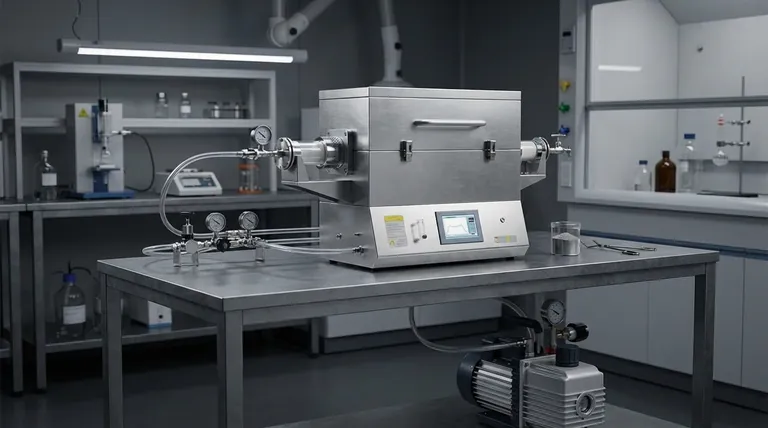
The vacuum tube furnace is the critical enabler for transforming disordered iron-aluminum mixtures into high-performance magnetic materials. It serves a dual purpose: providing a high-vacuum environment ($10^{-3}$ Pa) to prevent oxidation and maintaining a precise temperature of 500 °C. This specific combination allows the synthesized powder to undergo a necessary phase transition, evolving from a metastable solid solution into a chemically ordered state.
Core Takeaway The significance of the furnace lies in its ability to facilitate long-range atomic ordering. It converts the initial Fe(Al) solid solution into the highly structured Fe3Al phase (DO3 superlattice), which is the specific requirement for maximizing the material's magnetic loss capabilities.
The Mechanism of Phase Transformation
From Metastable to Ordered
Synthesized Fe3Al powder often begins as a metastable Fe(Al) solid solution.
In this initial state, the iron and aluminum atoms are randomly distributed. The vacuum tube furnace provides the thermal energy required to reorganize these atoms without chemically altering the material through oxidation.
Creating the DO3 Superlattice
The specific goal of this post-treatment is the formation of a DO3 superlattice structure.
By annealing at 500 °C for two hours, the furnace allows the atoms to settle into a long-range ordered configuration. This structural arrangement is distinct from the random solid solution and is the defining characteristic of high-quality Fe3Al.
Enhancing Magnetic Properties
The physical structure of the material directly dictates its performance.
The transition to the ordered Fe3Al phase is not merely cosmetic; it is essential for enhancing the magnetic loss capabilities of the powder. Without this specific vacuum treatment, the material would fail to exhibit the magnetic characteristics required for its end application.
The Critical Role of the Vacuum Environment
Prevention of Oxidation
Iron and Aluminum are highly reactive metals that oxidize rapidly at high temperatures.
A standard furnace would degrade the powder by forming unwanted oxides on the particle surfaces. The vacuum tube furnace, operating at a high vacuum of $10^{-3}$ Pa, ensures the environment remains oxygen-free, preserving the purity of the metallic elements.
Precise Thermal Control
The transformation to the Fe3Al phase requires a specific thermal profile.
The furnace maintains a steady 500 °C for a duration of two hours. This precise control ensures the phase transformation is complete throughout the powder batch, resulting in a uniform material.
Understanding the Trade-offs
Batch Processing Limitations
Vacuum tube furnaces typically operate as batch processing units rather than continuous flow systems.
This can limit production throughput compared to atmospheric furnaces. You must account for the time required to pump down the chamber to $10^{-3}$ Pa before the heating cycle can even begin.
Equipment Complexity
Achieving and maintaining a high vacuum requires sophisticated pumping systems and strict seal integrity.
Unlike simple inert gas furnaces, a vacuum system is more sensitive to leaks and requires higher maintenance. However, for Fe3Al, this complexity is the cost of entry for achieving the required DO3 superlattice structure.
Making the Right Choice for Your Goal
When integrating a vacuum tube furnace into your material synthesis workflow, consider your specific performance targets:
- If your primary focus is Magnetic Performance: Prioritize the vacuum level ($10^{-3}$ Pa or better) above all else, as even trace oxygen can disrupt the formation of the pure DO3 phase and degrade magnetic loss properties.
- If your primary focus is Process Efficiency: Acknowledge that the 2-hour annealing time is a fixed chemical requirement for atomic ordering; attempting to shorten this via higher temperatures may result in incorrect phase formation.
Ultimately, the vacuum tube furnace is not just a heating element; it is a reaction chamber that dictates the fundamental atomic architecture of your final product.
Summary Table:
| Parameter | Specification | Purpose in Fe3Al Treatment |
|---|---|---|
| Vacuum Level | 10⁻³ Pa | Prevents oxidation of reactive Fe and Al atoms |
| Temperature | 500 °C | Provides thermal energy for phase transition |
| Duration | 2 Hours | Ensures completion of long-range atomic ordering |
| Target Phase | DO3 Superlattice | Maximizes material magnetic loss capabilities |
| Initial State | Fe(Al) Solid Solution | Transforms metastable atoms into ordered structures |
Elevate Your Material Synthesis with KINTEK
Precise atomic ordering requires more than just heat; it requires an uncompromising environment. KINTEK provides industry-leading vacuum tube systems designed to meet the rigorous demands of Fe3Al post-treatment.
Backed by expert R&D and manufacturing, we offer Muffle, Tube, Rotary, Vacuum, and CVD systems—all customizable to your unique research or production needs. Whether you require high-vacuum integrity ($10^{-3}$ Pa) or precise thermal profiles for superlattice formation, our team ensures your lab is equipped for success.
Ready to transform your powders into high-performance materials?
Contact KINTEK Today to Discuss Your Custom Solution
References
- Xixi Luo, Ziyan Liu. Enhanced microwave absorption performance of Fe<sub>3</sub>Al flakes by optimizing the carbon nanotube coatings. DOI: 10.1039/d4ra00955j
This article is also based on technical information from Kintek Furnace Knowledge Base .
Related Products
- Vacuum Hot Press Furnace Machine Heated Vacuum Press Tube Furnace
- Vacuum Sealed Continuous Working Rotary Tube Furnace Rotating Tube Furnace
- High Pressure Laboratory Vacuum Tube Furnace
- Laboratory Vacuum Tilt Rotary Tube Furnace Rotating Tube Furnace
- Magnesium Extraction and Purification Condensing Tube Furnace
People Also Ask
- Why use Vacuum Hot Press (VHP) for ZnS Ceramics? Achieve Superior IR Transparency and Mechanical Strength
- What are the benefits of the vacuum environment system in a vacuum hot press furnace? Unlock High-Density Sintering
- What safety features are incorporated in vacuum hot press furnaces? Ensure Operator and Equipment Protection
- What is the primary function of the vacuum environment in a vacuum hot press furnace during titanium alloy processing? Prevent Embrittlement for Superior Ductility
- What considerations guide the selection of heating elements and pressurization methods for a vacuum hot press furnace?



















