
The horizontal tube furnace serves as the precise thermal reactor required to convert raw biomass into 25%-ASHC porous carbon without combustion. Specifically, it maintains a protective nitrogen atmosphere while executing a steady heating ramp of 10°C per minute up to 750°C, facilitating the chemical activation necessary to develop the material's pore structure.
The horizontal tube furnace does not merely heat the material; it orchestrates the critical chemical interaction between the biomass and Potassium ferrate (K2FeO4) to engineer a specific porous architecture in an inert environment.
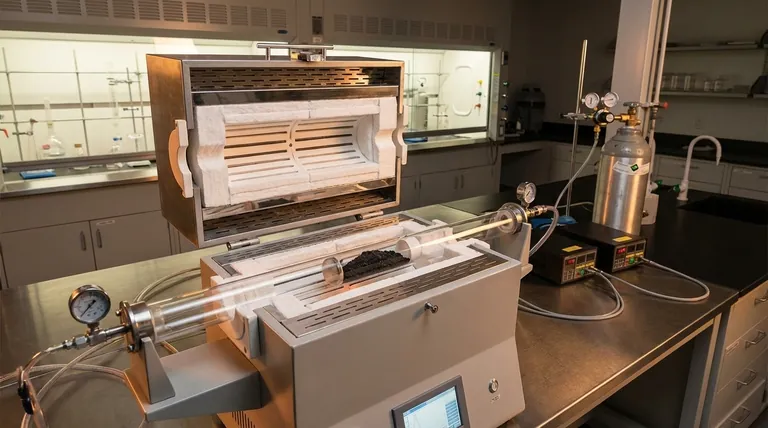
The Critical Functions in 25%-ASHC Synthesis
Controlling the Reaction Atmosphere
The most immediate function of the horizontal tube furnace is to isolate the reactants from the external environment.
By maintaining a continuous flow of nitrogen gas, the furnace creates a strictly anaerobic (oxygen-free) setting.
This is essential to prevent the oxidative combustion of the biomass, ensuring it undergoes pyrolysis—decomposition caused by high temperatures—rather than simply burning into ash.
Facilitating Chemical Activation
The furnace provides the necessary reaction space for the interaction between the carbon matrix and the chemical activator.
For 25%-ASHC materials, the activator is Potassium ferrate (K2FeO4).
Under the controlled heat of the furnace, K2FeO4 decomposes and reacts with the carbon, effectively "etching" the material to create a developed pore structure.
Precise Thermal Regulation
Achieving the specific 25%-ASHC structure requires exact adherence to a temperature profile, not just general heating.
The furnace is programmed to increase temperature at a stable rate of 10°C per minute.
It holds this ramp until reaching a target temperature of 750°C, the specific thermal point required for optimal activation of this material composition.
Understanding the Trade-offs
Sensitivity to Heating Rates
The heating rate of 10°C/min is not arbitrary; it balances reaction kinetics with thermal stability.
Deviating from this rate can alter how the K2FeO4 interacts with the biomass.
A rate that is too fast may lead to uneven activation or thermal shock, while a rate that is too slow may result in inefficient processing times without improving pore quality.
Atmosphere Integrity
The effectiveness of the pyrolysis is entirely dependent on the integrity of the nitrogen seal.
Any leakage of oxygen into the tube during the 750°C hold will compromise the purity of the carbon.
This results in the loss of material mass through oxidation and the destruction of the desired pore architecture.
Making the Right Choice for Your Goal
To ensure the successful preparation of 25%-ASHC porous carbon, consider these focus areas:
- If your primary focus is Pore Structure Development: Prioritize the stability of the heating rate (10°C/min) and the accuracy of the target temperature (750°C) to ensure the Potassium ferrate activates the carbon matrix correctly.
- If your primary focus is Material Purity: Focus on the quality of the nitrogen flow and the sealing of the tube furnace to strictly prevent oxidation during pyrolysis.
Precision in thermal control and atmospheric isolation is the difference between simple charcoal and high-performance porous carbon.
Summary Table:
| Process Feature | Specification | Role in 25%-ASHC Synthesis |
|---|---|---|
| Atmosphere Control | Nitrogen Gas Flow | Prevents combustion; ensures anaerobic pyrolysis |
| Heating Rate | 10°C / minute | Balances reaction kinetics for even pore activation |
| Target Temperature | 750°C | Optimal point for K2FeO4 chemical etching |
| Reaction Type | Chemical Activation | Orchestrates interaction between biomass and activator |
Elevate Your Materials Research with KINTEK
Achieving the perfect pore structure in 25%-ASHC porous carbon requires uncompromising thermal precision. Backed by expert R&D and world-class manufacturing, KINTEK provides high-performance Tube, Muffle, Rotary, and Vacuum systems specifically engineered for complex CVD and pyrolysis applications.
Whether you need stable heating ramps or superior atmospheric sealing, our furnaces are fully customizable to meet your unique laboratory needs. Contact us today to find your precision solution and see how KINTEK can enhance your synthesis outcomes.
References
- Huijuan Ying, Ning Ai. Turn Waste Golden Tide into Treasure: Bio-Adsorbent Synthesis for CO2 Capture with K2FeO4 as Catalytic Oxidative Activator. DOI: 10.3390/molecules29061345
This article is also based on technical information from Kintek Furnace Knowledge Base .
Related Products
- Vertical Laboratory Quartz Tube Furnace Tubular Furnace
- 1700℃ High Temperature Laboratory Tube Furnace with Alumina Tube
- Vacuum Sealed Continuous Working Rotary Tube Furnace Rotating Tube Furnace
- Split Multi Heating Zone Rotary Tube Furnace Rotating Tube Furnace
- Laboratory Vacuum Tilt Rotary Tube Furnace Rotating Tube Furnace
People Also Ask
- What are the key differences between single-zone and multi-zone vertical tube furnaces? Choose the Right Furnace for Your Lab
- How does a vertical single-temperature zone tube furnace facilitate the growth of high-quality PdSe2 single crystals?
- Why is a vertical tube furnace preferred for quenching tests? Achieve Rapid, Repeatable Cooling for Accurate Results
- What is the purpose of using an industrial-grade vertical tube furnace in phosphorus recovery? High-Fidelity Simulation
- What are the main characteristics of vertical tube furnaces? Optimize Your Lab with Space-Saving, Uniform Heating



















