
A tube furnace establishes the rigorous control required for accurate microplastic decomposition by isolating the sample in a stable, uniform thermal environment. By combining high-precision temperature regulation with strict atmospheric management, it ensures that the breakdown of molecular chains is driven solely by intended thermal parameters, rather than environmental fluctuations or oxygen contamination.
Success in microplastic pyrolysis relies on separating thermal effects from environmental interference. A tube furnace achieves this by maintaining an oxygen-free atmosphere and precise thermal gradients, ensuring that molecular chains break in a predictable, reproducible manner to yield high-quality bio-oil and syngas.
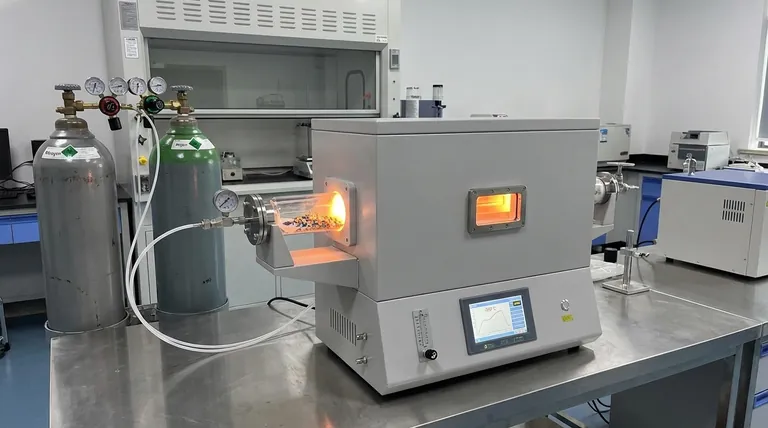
Achieving Thermal Precision
High-Precision Temperature Control
Accuracy in decomposition experiments depends on maintaining exact temperatures, typically between 300°C and 600°C. Tube furnaces utilize digital control systems to monitor and adjust heat output with minimal deviation. This prevents temperature spikes that could alter the chemical composition of the resulting bio-oil or syngas.
Uniform Heat Distribution
Inconsistent heating leads to incomplete decomposition or varied reaction rates within a single sample. Because the heating elements surround the cylindrical work tube, the furnace provides uniform heat along the tube’s entire length. This geometry ensures every particle of the microplastic sample is exposed to the same thermal energy simultaneously.
Predictable Molecular Breakdown
The primary goal of these experiments is to break microplastic molecular chains in a specific way. The stable thermal environment ensures these chains fracture in a predictable pattern. This reproducibility is essential for validating experimental data and comparing results across different studies.
Controlling the Reaction Atmosphere
Isolation from Oxygen
To achieve true pyrolysis (decomposition without combustion), oxygen must be excluded from the reaction. The design of the tube furnace allows for a sealed environment using stable quartz or ceramic tubes. This isolation is critical for preventing the sample from simply burning, which would ruin the experiment.
Specific Gas Environments
Beyond simple isolation, the furnace allows researchers to introduce specific gases to influence the reaction. Systems can flow Nitrogen (N2) or Argon (Ar) to create an inert atmosphere, or steam for specific gasification processes. This capability allows researchers to test how different environments affect the decomposition process without changing other variables.
Understanding the Trade-offs
Sample Volume Limitations
While tube furnaces offer exceptional control, they are generally limited by the diameter of the work tube. This restricts the sample size you can process in a single run, making them ideal for laboratory-scale research but less suited for high-volume throughput without scaling up significantly.
Thermal Lag
There is a physical barrier between the heating elements (outside the tube) and the sample (inside the tube). Users must account for a slight thermal lag, ensuring the internal sample temperature has actually reached the setpoint displayed on the controller before assuming the reaction has started.
Making the Right Choice for Your Goal
- If your primary focus is Chemical Purity: Prioritize the seal integrity of the quartz or ceramic tube to ensure a strictly oxygen-free environment using Nitrogen or Argon.
- If your primary focus is Product Yield (Bio-oil/Syngas): Focus on the precision of the temperature ramp rate within the 300°C to 600°C range to optimize the molecular breakdown.
Control the environment, and you control the chemistry.
Summary Table:
| Feature | Benefit for Microplastic Research | Experimental Impact |
|---|---|---|
| High-Precision Control | Maintains exact 300°C - 600°C range | Prevents chemical spikes; ensures data reproducibility |
| Uniform Heat Distribution | Cylindrical heating around the work tube | Ensures consistent reaction rates across all particles |
| Atmospheric Isolation | Sealed quartz/ceramic tube environment | Eliminates oxygen to prevent combustion (true pyrolysis) |
| Gas Flexibility | Supports Nitrogen, Argon, or Steam flow | Allows testing of specific chemical environments |
Elevate Your Research with Precision Thermal Solutions
Ready to achieve unmatched accuracy in your microplastic decomposition experiments? Backed by expert R&D and manufacturing, KINTEK offers a comprehensive range of high-performance Muffle, Tube, Rotary, Vacuum, and CVD systems. Our lab high-temp furnaces are fully customizable to meet your unique research parameters, ensuring you get the exact thermal environment required for high-quality bio-oil and syngas production.
Don't settle for inconsistent results. Contact KINTEK today to discuss your project requirements with our technical experts and find the perfect furnace solution for your laboratory.
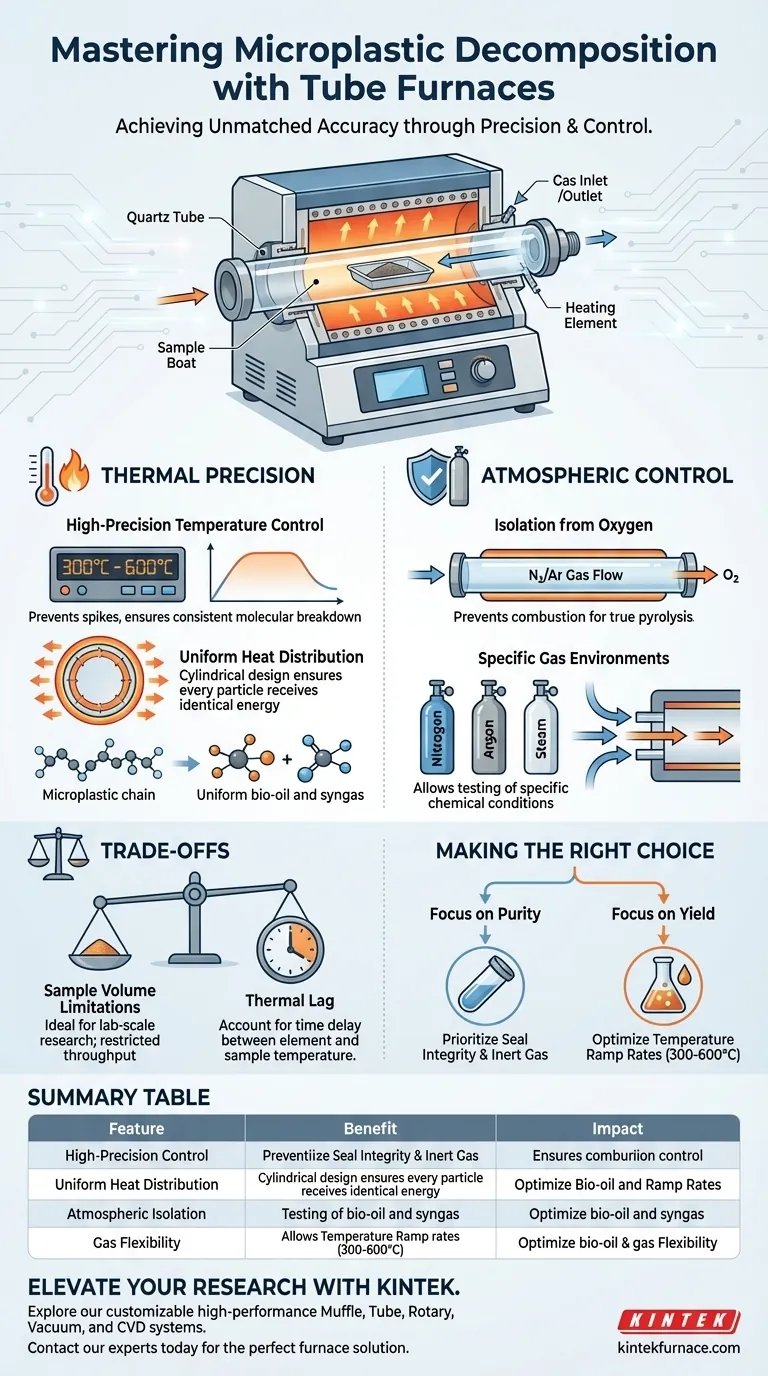
Visual Guide
References
- Dorota Wieczorek, Katarzyna Ławińska. Microplastic Recovery and Conversion Pathways: The Most Recent Advancements in Technologies for the Generation of Renewable Energy. DOI: 10.3390/en18184949
This article is also based on technical information from Kintek Furnace Knowledge Base .
Related Products
- Vacuum Sealed Continuous Working Rotary Tube Furnace Rotating Tube Furnace
- 1400℃ High Temperature Laboratory Tube Furnace with Alumina Tube
- 1700℃ High Temperature Laboratory Tube Furnace with Alumina Tube
- 1200℃ Split Tube Furnace Laboratory Quartz Tube Furnace with Quartz Tube
- Vertical Laboratory Quartz Tube Furnace Tubular Furnace
People Also Ask
- What is the purpose of rotary tube furnaces? Achieve Uniform Heat Treatment for Powders and Granules
- What are the key advantages of using a rotary tube furnace? Achieve Dynamic, Uniform Heating for Powders
- How does the amount of material processed vary between batch and continuous rotary tube furnaces? Scale Your Production Efficiently
- What are the advantages of rotary tube furnaces in fuel compatibility? Boost Efficiency and Cut Costs
- What is the temperature range of some rotary tube furnaces? Achieve Uniform Heating Up to 1200°C



















