
The repair process requires a specific chemical atmosphere, not just heat. High-energy dry etching damages thin films by physically knocking atoms out of the crystal lattice, creating "cation vacancies." A high-temperature tube furnace containing specific powders (such as Barium Oxide) is essential to create a vapor-rich environment that actively forces these missing elements back into the material to restore its structure.
The Core Mechanism: Atmospheric Compensation
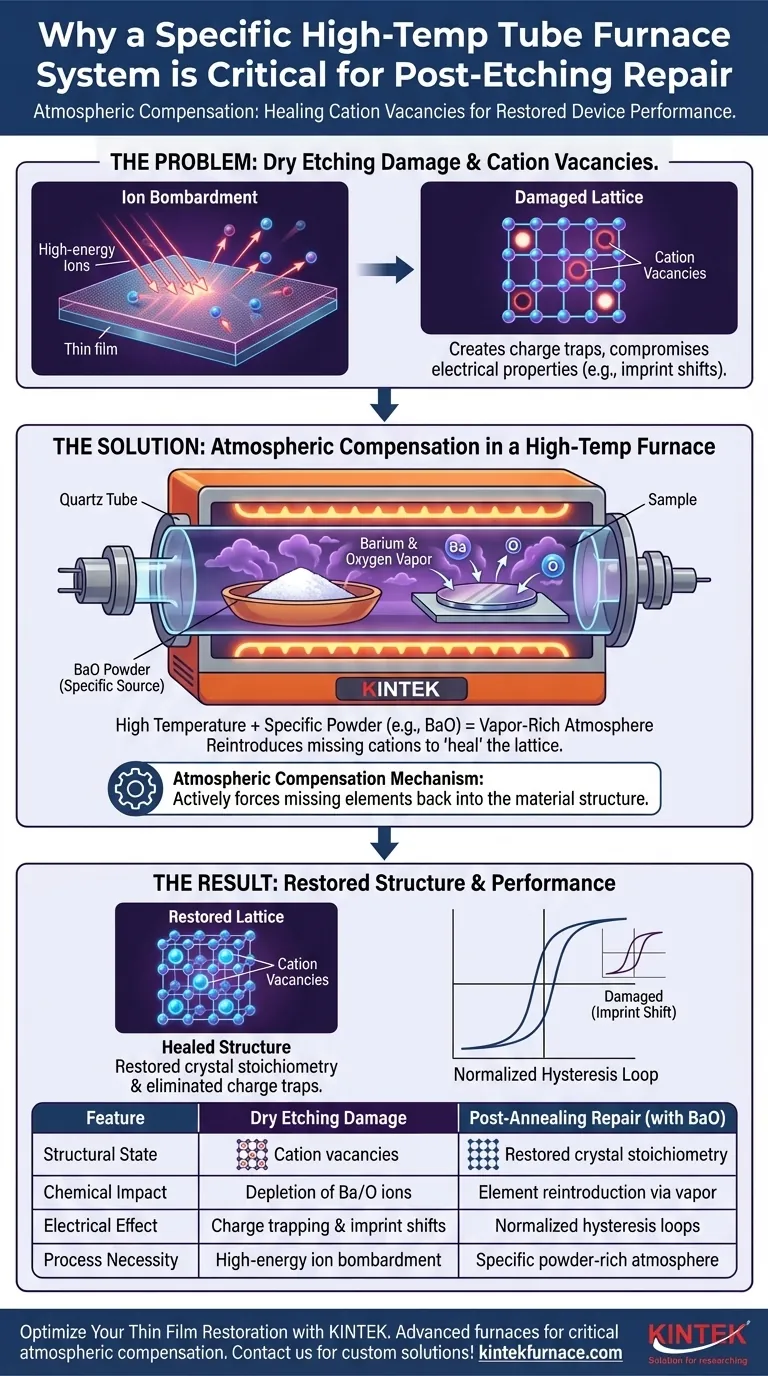
Standard annealing cannot fix chemical depletion caused by ion bombardment. By using Barium Oxide powder to generate a Barium- and Oxygen-rich atmosphere, this process utilizes atmospheric compensation to reintroduce missing cations into the lattice, thereby eliminating charge traps and restoring electrical performance.
The Root Problem: Etching-Induced Damage
The Impact of Ion Bombardment
Dry etching processes, particularly ion milling, rely on high-energy bombardment to remove material. While effective for shaping, this physical impact damages the remaining crystal structure.
Formation of Cation Vacancies
The collision energy is often sufficient to strip away essential atoms from the film's surface and subsurface. This leaves behind cation vacancies—holes in the atomic lattice where positive ions should be.
Degradation of Electrical Properties
These vacancies act as defects that severely compromise the material's performance. Specifically, they create charge trapping states that interfere with electron movement and polarization.
In ferroelectric materials, these trapped charges cause "imprint shifts" in hysteresis loops, essentially biasing the material and preventing it from switching states cleanly.
The Solution: High-Temperature Atmospheric Repair
Creating the Compensation Environment
To repair this specific type of damage, simple thermal energy is insufficient. You must restore the chemical stoichiometry (balance) of the film.
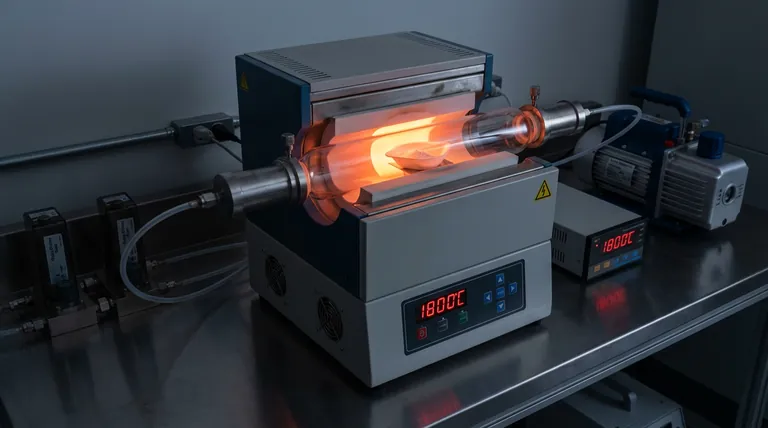
This is achieved by placing a ceramic boat filled with Barium Oxide (BaO) powder alongside the sample inside a high-temperature tube furnace.
Reintroducing Missing Atoms
At high temperatures, the BaO powder sublimates or creates a vapor pressure, filling the tube environment with Barium and Oxygen.
This creates an atmosphere rich in the exact elements that were lost during etching. Driven by the high temperature, these atoms diffuse back into the film, filling the vacancies and "healing" the crystal lattice.
Restoring Device Reliability
Once the lattice is repaired, the charge trapping states are significantly reduced or eliminated. Consequently, the imprint shifts disappear, and the material's hysteresis loop returns to its expected, symmetrical behavior.
Understanding the Trade-offs
The Necessity of Specific Powders
You cannot substitute the specific powder source with inert gas or vacuum annealing. Without the BaO source, the atmosphere will lack the necessary cations to fill the vacancies, and the etching damage will remain permanent.
Thermal Budget Considerations
This process requires high temperatures to effectively volatilize the powder and drive diffusion. This imposes a strict thermal budget, meaning the underlying substrate and other device layers must be able to withstand this heat without degrading.
Making the Right Choice for Your Goal
To ensure the success of your post-etching recovery, align your process parameters with your specific repair needs:
- If your primary focus is eliminating imprint shifts: You must include the BaO powder source to correct the chemical stoichiometry of the lattice.
- If your primary focus is reducing charge traps: Ensure the furnace temperature is high enough to activate the atmospheric compensation mechanism fully.
By matching the annealing atmosphere to the chemical loss caused by etching, you convert a damaged film back into a high-performance device.
Summary Table:
| Feature | Dry Etching Damage | Post-Annealing Repair (with BaO) |
|---|---|---|
| Structural State | Cation vacancies & lattice damage | Restored crystal stoichiometry |
| Chemical Impact | Depletion of Barium/Oxygen ions | Element reintroduction via vapor |
| Electrical Effect | Charge trapping & imprint shifts | Normalized hysteresis loops |
| Process Necessity | High-energy ion bombardment | Specific powder-rich atmosphere |
Optimize Your Thin Film Restoration with KINTEK
Don't let dry etching damage compromise your material's performance. KINTEK provides the advanced high-temperature tube furnaces and precision heating solutions required for critical atmospheric compensation processes.
Backed by expert R&D and manufacturing, KINTEK offers Muffle, Tube, Rotary, Vacuum, and CVD systems, all customizable to meet your unique thermal budget and chemical repair needs. Whether you are addressing cation vacancies or complex lattice healing, our systems ensure the uniform atmosphere required for device reliability.
Ready to enhance your lab's efficiency? Contact us today to discuss your custom furnace needs!
Visual Guide
References
- Yizhe Jiang, Lane W. Martin. Effect of fabrication processes on BaTiO3 capacitor properties. DOI: 10.1063/5.0203014
This article is also based on technical information from Kintek Furnace Knowledge Base .
Related Products
- 1400℃ High Temperature Laboratory Tube Furnace with Alumina Tube
- 1700℃ High Temperature Laboratory Tube Furnace with Alumina Tube
- 1200℃ Split Tube Furnace Laboratory Quartz Tube Furnace with Quartz Tube
- Vertical Laboratory Quartz Tube Furnace Tubular Furnace
- 1700℃ High Temperature Muffle Oven Furnace for Laboratory
People Also Ask
- How does zone-melting in tube furnaces synthesize bismuth micro-wires? Master Single-Crystal Thermoelectric Growth
- How do high-temperature laboratory tube furnaces ensure environmental stability? Precision Thermal Reduction Tips
- How are high-temperature laboratory tube furnaces applied in long-term vacuum homogenization heat treatments for intermetallic samples?
- How are high-temp tube furnaces used to measure diffusion coefficients per Fick's law? Master Precision Annealing
- How are high-temperature tube furnaces applied in testing ceramic-supported alloy membranes? Insights



















