
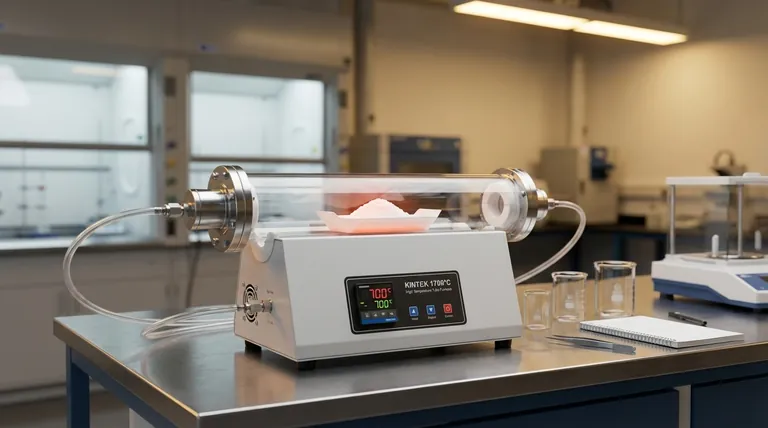
Calcination is the critical bridge between raw chemical synthesis and high-performance ceramic fabrication. Specifically, treating ZnS nanopowders in a tube furnace—typically between 600-800°C under vacuum or controlled atmosphere—is necessary to remove volatile impurities and stabilize the crystal phase, ensuring the final hot-pressed material retains high light transmittance.
Core Takeaway: Calcination transforms volatile, unstable nanopowders into a robust feedstock for sintering. It serves a dual purpose: chemically purifying the surface to prevent optical defects and physically modifying particle shape to prevent the formation of permanent, intragranular pores during hot pressing.
Achieving Optical Purity and Phase Stability
Removing Surface Contaminants
Raw nanopowders often retain adsorbed impurities from the synthesis process. Calcination effectively desorbs these contaminants from the powder surface.
Eliminating Organic Residues
In many synthesis routes, organic surfactants and solvents—such as oleylamine and diphenyl ether—are used to control particle growth. A high-temperature environment facilitates the thermal oxidation of these precursors, ensuring the final oxide powder is chemically pure.
Controlling the Crystal Phase
For optical applications, the crystalline structure is paramount. Calcination reduces the alpha-ZnS phase content. This stabilization is vital because phase transitions during the subsequent hot press sintering can drastically decrease the light transmittance of the final ceramic.
Optimizing Powder Mechanics for Hot Pressing
Transforming Particle Morphology
Raw powders often exhibit irregular, flake-like shapes that resist efficient packing. Low-temperature calcination transforms these particles into spherical shapes. This morphological change significantly improves both flowability and dispersibility, allowing for more uniform density during the pressing stage.
Regulating Sintering Activity
Nanopowders are highly reactive; without treatment, they may sinter too aggressively. Calcination promotes appropriate grain growth, which reduces excessive sintering activity.
Preventing Intragranular Pores
If sintering activity is unchecked, the material densifies too rapidly. This rapid densification can trap pores inside the grains (intragranular pores), which are nearly impossible to eliminate later. Pre-treatment ensures a controlled densification rate, keeping pores on the grain boundaries where they can be removed.
Understanding the Trade-offs: The Risks of Rapid Densification
The Danger of Excessive Reactivity
It is a common misconception that higher reactivity is always better for sintering. In reality, excessive sintering activity is a liability for optical ceramics.
The Consequence of Skipping Calcination
If you bypass this step, the powder will densify unevenly and too quickly. This results in a microstructure riddled with defects and trapped gases. While the material may appear solid, its optical performance—specifically transparency—will be compromised due to scattering centers caused by these residual defects.
Making the Right Choice for Your Goal
To maximize the performance of your ZnS ceramics, align your calcination parameters with your specific defect constraints:
- If your primary focus is Optical Transmittance: Prioritize the removal of the alpha-ZnS phase and organic residues to prevent scattering and absorption.
- If your primary focus is Structural Density: Focus on transforming particle shape to spheres to prevent intragranular pores and ensure uniform packing.
Successful hot pressing begins with a powder that is chemically pure, phase-stable, and physically uniform.
Summary Table:
| Feature | Impact of Calcination on ZnS Nanopowder |
|---|---|
| Chemical Purity | Removes organic residues (oleylamine) and surface contaminants. |
| Phase Control | Reduces alpha-ZnS phase to prevent light scattering defects. |
| Morphology | Transforms irregular flakes into spherical shapes for better packing. |
| Sintering Activity | Regulates densification rate to prevent trapped intragranular pores. |
| Final Quality | Essential for achieving high optical transmittance and structural density. |
Elevate Your Ceramic Fabrication with KINTEK
Precise pre-treatment is the foundation of high-performance optical materials. KINTEK provides industry-leading thermal solutions, including Tube, Vacuum, CVD, and Muffle furnaces, specifically designed to handle delicate ZnS calcination and sintering processes.
Backed by expert R&D and precision manufacturing, our systems are fully customizable to meet your unique laboratory or production needs. Ensure your nanopowders achieve perfect phase stability and purity—contact us today to find your custom furnace solution!
Visual Guide

Related Products
- Magnesium Extraction and Purification Condensing Tube Furnace
- Multi Zone Laboratory Quartz Tube Furnace Tubular Furnace
- 1400℃ High Temperature Laboratory Tube Furnace with Alumina Tube
- 1200℃ Controlled Inert Nitrogen Atmosphere Furnace
- 1700℃ High Temperature Laboratory Tube Furnace with Alumina Tube
People Also Ask
- What are the advantages of using a condensing tube furnace for magnesium extraction? Achieve High Purity and Efficient Metal Recovery
- Can you provide an example of a material prepared using a tube furnace? Discover YBa₂Cu₃O₇ Synthesis
- How does a tube furnace contribute to the carbonization of biomass? Master Precise Pyrolysis for Superior Materials
- Why are high-temperature laboratory furnaces necessary for Cu/In2O3 catalysts? Achieve Superior Catalyst Performance
- What role does a tube furnace play in evaluating modified birnessite catalysts? Optimize VOC Degradation Activity
















