
In the synthesis of Edge Nitrogen-enriched Lignin-derived Carbon Nanosheet Frameworks (EN-LCNF), the tube furnace serves as a precision reactor that executes a specific two-stage calcination strategy. Its primary function is to maintain a controlled nitrogen atmosphere while delivering exact thermal energy to drive both physical exfoliation and chemical doping simultaneously.
By synchronizing thermal decomposition with solid-phase reactions, the tube furnace transforms raw lignin into a structured, nitrogen-doped framework. It converts a standard heating process into a complex synthesis tool that dictates the material's final porosity and chemical composition.
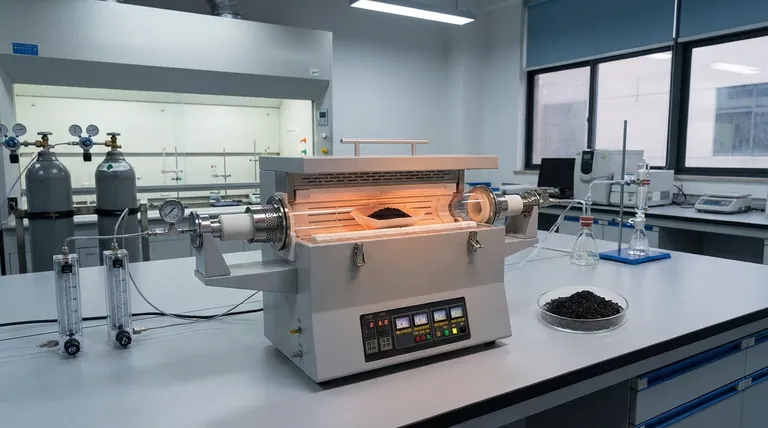
The Two-Stage Calcination Strategy
The synthesis of EN-LCNF relies on a sophisticated thermal process. The tube furnace enables this by distinctively managing two simultaneous mechanisms within the reaction chamber.
Stage 1: Physical Exfoliation via Gas Generation
The first critical function of the furnace is to heat the mixture to 700°C. At this precise temperature, the tube furnace triggers the decomposition of calcium oxalate.
This decomposition releases streams of carbon monoxide (CO) and carbon dioxide ($\text{CO}_2$). These gas streams act as physical agents that "puff" or exfoliate the dense lignin matrix, expanding it into thin, layered nanosheets.
Stage 2: Chemical Doping via Solid-Phase Reaction
Simultaneously, the furnace facilitates a solid-phase reaction required for chemical functionalization.
Inside the heated zone, pyrolysis products from melamine react with calcium oxide (CaO). This reaction is what enables the in-situ integration of edge nitrogen atoms directly into the carbon skeleton, giving the material its electrochemical properties.
Environmental Control Mechanisms
Beyond simple heating, the tube furnace provides the stabilizing environment necessary for these delicate chemical transformations to occur.
Nitrogen Protection Atmosphere
The furnace maintains a continuous flow of nitrogen gas throughout the process.
This creates an inert shield that prevents the lignin and carbon precursors from oxidizing or burning away at high temperatures. It ensures that the carbon nanosheets form properly rather than degrading into ash.
Precise Thermal Regulation
The success of EN-LCNF synthesis depends on hitting specific thermal targets.
The furnace must maintain the temperature accurately to ensure calcium oxalate decomposes exactly when needed to exfoliate the lignin. Without this thermal precision, the gas release might not align with the carbonization phase, leading to a collapsed or non-porous structure.
Understanding the Process Criticality
While the tube furnace is a robust tool, the EN-LCNF synthesis is highly sensitive to the processing parameters.
The Dependency on Precursor Interaction
The furnace is not merely "baking" the material; it is orchestrating a chemical chain reaction.
The process relies entirely on the specific interaction between the decomposition products of calcium oxalate and the lignin matrix. If the furnace temperature fluctuates significantly from 700°C, the gas generation may fail to exfoliate the nanosheets effectively, compromising the specific surface area.
Balancing Exfoliation and Doping
The furnace must balance two competing needs: expanding the physical structure and embedding nitrogen chemically.
An inability to maintain the correct heating environment could result in distinct failures: either a material with poor porosity (failed exfoliation) or a material with low conductivity (failed nitrogen integration).
Making the Right Choice for Your Goal
When utilizing a tube furnace for this type of advanced carbon synthesis, focus on the specific outcome you are trying to influence.
- If your primary focus is Structural Porosity: Ensure the furnace is calibrated to hold 700°C precisely, as this is the trigger point for calcium oxalate to generate the exfoliating gas streams.
- If your primary focus is Chemical Activity: Verify the stability of the nitrogen atmosphere, as oxygen leakage will degrade the melamine pyrolysis products and prevent successful nitrogen doping.
The tube furnace is the architectural tool that forces the physical expansion of lignin while simultaneously locking nitrogen into its atomic edges.
Summary Table:
| Synthesis Phase | Temperature | Key Reaction | Functional Outcome |
|---|---|---|---|
| Physical Exfoliation | 700°C | Calcium Oxalate Decomposition | Gas release (CO/CO2) creates layered nanosheets |
| Chemical Doping | High Temp | Melamine + CaO Reaction | In-situ edge nitrogen integration for conductivity |
| Atmosphere Control | Continuous | Nitrogen Flow | Prevents oxidation and ensures carbon framework stability |
Elevate Your Material Synthesis with KINTEK
Precision is the difference between a collapsed structure and a high-performance framework. Backed by expert R&D and manufacturing, KINTEK offers high-performance Muffle, Tube, Rotary, Vacuum, and CVD systems—all fully customizable to meet your specific research needs. Whether you are optimizing exfoliation at 700°C or perfecting nitrogen doping, our furnaces provide the thermal stability and atmospheric control required for advanced EN-LCNF synthesis.
Ready to achieve superior carbon nanosheet frameworks? Contact KINTEK today to discuss your custom furnace solution!
References
- Caiwei Wang, Zhili Li. Engineering of edge nitrogen dopant in carbon nanosheet framework for fast and stable potassium-ion storage. DOI: 10.1007/s44246-024-00101-8
This article is also based on technical information from Kintek Furnace Knowledge Base .
Related Products
- Vacuum Sealed Continuous Working Rotary Tube Furnace Rotating Tube Furnace
- 1400℃ High Temperature Laboratory Tube Furnace with Alumina Tube
- 1700℃ High Temperature Laboratory Tube Furnace with Alumina Tube
- Magnesium Extraction and Purification Condensing Tube Furnace
- High Pressure Laboratory Vacuum Tube Furnace
People Also Ask
- What is the purpose of rotary tube furnaces? Achieve Uniform Heat Treatment for Powders and Granules
- What are the key advantages of using a rotary tube furnace? Achieve Dynamic, Uniform Heating for Powders
- How does the amount of material processed vary between batch and continuous rotary tube furnaces? Scale Your Production Efficiently
- What are the advantages of rotary tube furnaces in fuel compatibility? Boost Efficiency and Cut Costs
- What is the temperature range of some rotary tube furnaces? Achieve Uniform Heating Up to 1200°C



















