
In the diffusion process within a tube furnace, nitrogen and oxygen serve distinct but complementary roles: nitrogen acts as a stable transport medium and protective shield, while oxygen is a reactive agent used to facilitate specific chemical transformations. Nitrogen maintains the furnace's environmental integrity, whereas oxygen is critical for creating the necessary conditions for dopant transfer.
Nitrogen ensures a clean, pressurized environment by preventing contamination and unwanted oxidation, while oxygen is strategically introduced to form a Phosphosilicate Glass (PSG) layer, acting as a controlled source for dopant atoms.
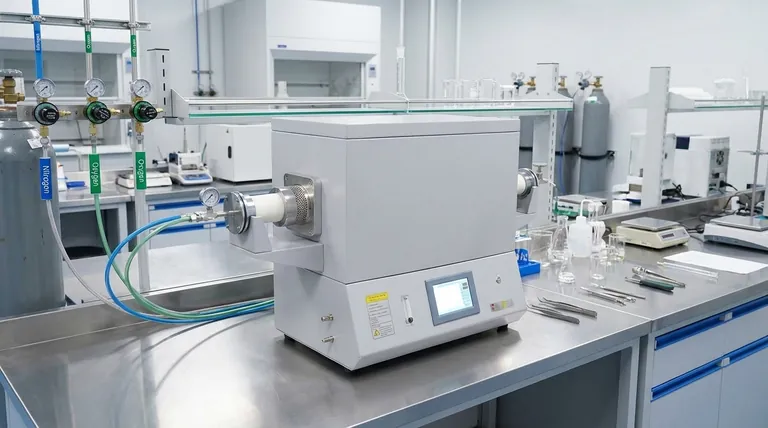
The Protective Role of Nitrogen
Nitrogen acts as the foundational atmosphere within the furnace. Its primary function is to stabilize the environment rather than participate in the chemical reaction itself.
Acting as a Carrier Gas
Nitrogen serves as a vehicle for transporting process gases through the tube. It ensures a consistent flow of chemicals across the wafer surface without reacting with them prematurely.
Maintaining Pressure Balance
A critical function of nitrogen is to maintain a positive pressure balance within the tube. By filling the volume of the furnace, it ensures that the internal pressure remains higher than the external ambient pressure.
Shielding Against Impurities
This positive pressure acts as a shield. It prevents external atmospheric impurities or contaminants from leaking into the process chamber and compromising the wafers.
Preventing Unintended Oxidation
Nitrogen is relatively inert in this context. It is used to displace oxygen when oxidation is not desired, preventing uncontrolled oxidation of the silicon surface outside of specific process steps.
The Reactive Role of Oxygen
Unlike nitrogen, oxygen is introduced as an active participant. It is used in specific ratios during the pre-deposition stages to engineer the surface chemistry of the silicon wafer.
Forming the PSG Layer
The primary purpose of introducing oxygen is to initiate a reaction that forms a Phosphosilicate Glass (PSG) layer on the silicon wafer surface. This is a deliberate oxidation process.
Serving as a Solid-State Source
The PSG layer created by the oxygen flow is not merely a byproduct; it is a functional component of the diffusion process. It acts as a solid-state source that holds the dopant material.
Ensuring Stable Dopant Supply
By creating this PSG layer, oxygen ensures that dopant atoms are supplied to the silicon in a continuous and stable manner. Without the oxygen-induced formation of PSG, the diffusion of dopants would be inconsistent.
Understanding Process Variables
Controlling the interplay between these two gases is essential for a successful diffusion run.
The Importance of Ratio Precision
Oxygen must be introduced in specific ratios relative to other gases. Deviating from these ratios can result in a PSG layer that is either too thick or too thin to act as an effective dopant source.
Balancing Flow for Purity
While oxygen is necessary for reaction, nitrogen flow must remain constant and sufficient. If nitrogen flow drops, the "shielding" effect is lost, leading to contamination or pressure imbalances.
Optimizing Flow for Process Control
To achieve high-quality diffusion results, you must view these gases as tools for two different goals: environmental control and chemical reaction.
- If your primary focus is process purity and safety: Prioritize the stability and volume of your nitrogen flow to maintain positive pressure and exclude external contaminants.
- If your primary focus is doping uniformity and concentration: Focus on the precise timing and ratio of your oxygen flow to control the formation and quality of the PSG layer.
Mastering the diffusion process requires balancing the protective inertia of nitrogen with the calculated reactivity of oxygen.
Summary Table:
| Gas Type | Primary Function | Role in Diffusion Process | Key Benefit |
|---|---|---|---|
| Nitrogen (N2) | Inert Carrier & Shield | Maintains positive pressure & transports gases | Prevents contamination & unintended oxidation |
| Oxygen (O2) | Reactive Agent | Forms Phosphosilicate Glass (PSG) layer | Ensures stable, uniform dopant supply |
Elevate Your Semiconductor Research with KINTEK
Precision gas control is the backbone of successful diffusion. KINTEK provides industry-leading Tube, Vacuum, CVD, and high-temperature furnace systems designed for the rigorous demands of material science. Backed by expert R&D and manufacturing, our systems are fully customizable to your specific gas flow and thermal requirements.
Ready to achieve superior doping uniformity and process purity? Contact our technical experts today to find the perfect furnace solution for your laboratory.
Visual Guide

References
- Jyotirmoy Sarker. Investigating Diffusion in Silicon Wafers: A Study of Doping and Sheet Resistance Measurement.. DOI: 10.21203/rs.3.rs-7884440/v1
This article is also based on technical information from Kintek Furnace Knowledge Base .
Related Products
- 1200℃ Controlled Inert Nitrogen Atmosphere Furnace
- 1400℃ Controlled Inert Nitrogen Atmosphere Furnace
- 1700℃ Controlled Inert Nitrogen Atmosphere Furnace
- Mesh Belt Controlled Atmosphere Furnace Inert Nitrogen Atmosphere Furnace
- Controlled Inert Nitrogen Hydrogen Atmosphere Furnace
People Also Ask
- What controlled-atmosphere furnace conditions are required for sintering powder metallurgy copper alloy compacts? Ideal Setup
- How do surface oxide layers on ceramic powders like silicon nitride affect sintering? Master Atmosphere Control
- How does a controlled atmosphere furnace prevent oxidation and decarburization? Master Precision Heat Treatment
- What are the operational advantages of using a controlled atmosphere furnace? Boost Quality and Efficiency in Heat Treatment
- What factors should be considered when choosing a controlled atmosphere furnace? Ensure Optimal Performance for Your Materials



















