
The definitive advantage of using an induction heated quartz tube furnace for annealing beta-gallium oxide ($\beta$-Ga$_2$O$_3$) is the ability to achieve superior surface quality while drastically reducing the thermal budget. By utilizing an argon atmosphere, this method completes the annealing process in just one minute at temperatures below 600°C, a stark contrast to traditional oxygen-based methods that require hour-long cycles.
By shifting from high-temperature prolonged soaking to rapid, low-temperature induction, this process eliminates the bottleneck of traditional annealing. It solves the critical problem of surface decomposition while simultaneously enhancing production speed and energy efficiency.
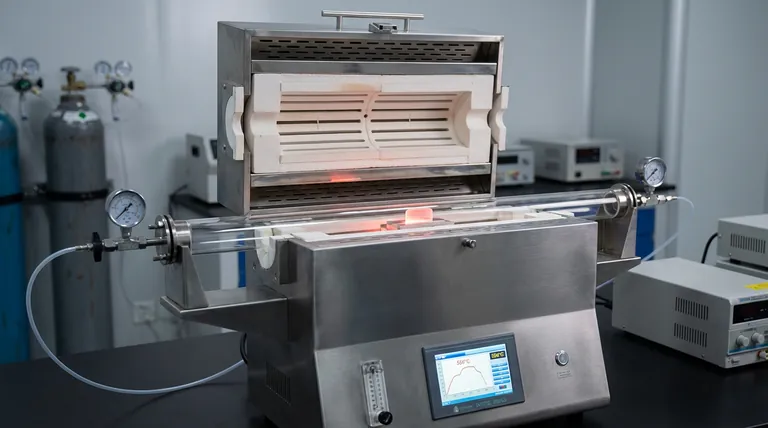
Accelerating Production Throughput
Drastic Reduction in Cycle Time
Traditional annealing processes are often the rate-limiting step in semiconductor manufacturing, typically requiring a full hour to complete.
The induction heated quartz tube method compresses this timeframe significantly. It achieves the necessary surface modification in only one minute. This allows for a continuous, high-velocity workflow rather than a slow, batch-based bottleneck.
Streamlined Manufacturing
The reduction in time does not require a trade-off in quality.
Because the desired surface characteristics are achieved so quickly, manufacturers can cycle substrates through the furnace much faster. This directly translates to higher overall production efficiency and throughput for the facility.
Preserving Material Integrity
Mitigating Surface Decomposition
One of the primary risks in annealing $\beta$-Ga$_2$O$_3$ is material degradation caused by excessive heat.
High-temperature cycles, common in traditional processing, often lead to severe surface decomposition. This damages the crystal lattice and compromises the electronic properties of the substrate.
The Benefit of Lower Operating Temperatures
The induction heating method operates effectively at temperatures below 600°C.
By keeping the substrate below this critical thermal threshold, the process preserves the structural integrity of the material. It achieves the necessary annealing effects without subjecting the gallium oxide to the harsh conditions that trigger decomposition.
Operational Efficiency and Costs
Reduced Energy Consumption
Traditional furnaces must maintain high temperatures for extended periods, consuming vast amounts of power.
Induction heating is inherently more energy-efficient because it targets the material (or susceptibility coupler) directly and operates for a fraction of the time. The combination of a lower temperature setpoint (<600°C) and a shorter duration (1 minute) results in significant energy savings.
The Role of the Argon Atmosphere
While traditional methods rely on oxygen-containing atmospheres, this specific induction process utilizes argon.
This inert environment works in tandem with the rapid heating cycle. It facilitates the necessary surface changes without the oxidation risks or chemical interactions associated with prolonged exposure to reactive gases at high heat.
Understanding the Operational Considerations
Precision Over Duration
In traditional annealing, a long "soak" time helps ensure temperature uniformity across the batch.
With induction heating, the cycle is extremely brief (one minute). This requires precise calibration of the induction equipment. The system must achieve target temperatures instantly and uniformly, as there is no long soak period to correct for uneven heating.
Making the Right Choice for Your Process
To determine if this method aligns with your manufacturing goals, consider your primary constraints:
- If your primary focus is increasing throughput: This method is superior, reducing cycle times from one hour to one minute to remove production bottlenecks.
- If your primary focus is material quality: The lower temperature (<600°C) is critical for preventing the severe surface decomposition common in high-heat processes.
- If your primary focus is cost reduction: The substantial drop in energy consumption due to shorter run-times and lower temperatures offers immediate operational savings.
Switching to induction heating in an argon atmosphere offers a rare "triple win" in semiconductor processing: it is faster, cooler, and gentler on the substrate.
Summary Table:
| Feature | Traditional Annealing | Induction Quartz Tube Furnace |
|---|---|---|
| Cycle Duration | ~60 Minutes | ~1 Minute |
| Process Temperature | High Heat (>600°C) | Low Temperature (<600°C) |
| Atmosphere | Oxygen-based | Inert Argon |
| Surface Quality | Risk of Decomposition | Superior Structural Integrity |
| Energy Efficiency | High Consumption | Significantly Reduced |
Optimize Your Semiconductor Production with KINTEK
Don’t let traditional annealing bottlenecks slow down your innovation. Backed by expert R&D and manufacturing, KINTEK offers high-performance Tube, Muffle, Rotary, Vacuum, and CVD systems—all customizable for your unique material requirements.
Our advanced induction heated quartz tube furnaces are designed to help you achieve superior surface quality for $\beta$-Ga$_2$O$_3$ substrates while slashing energy costs and cycle times.
Ready to elevate your lab's efficiency?
Contact our technical specialists today to discuss your custom high-temp furnace solution!
References
- D. Gogova, Vanya Darakchieva. High crystalline quality homoepitaxial Si-doped <i>β</i>-Ga2O3(010) layers with reduced structural anisotropy grown by hot-wall MOCVD. DOI: 10.1116/6.0003424
This article is also based on technical information from Kintek Furnace Knowledge Base .
Related Products
- Laboratory Quartz Tube Furnace RTP Heating Tubular Furnace
- Vertical Laboratory Quartz Tube Furnace Tubular Furnace
- 1200℃ Split Tube Furnace Laboratory Quartz Tube Furnace with Quartz Tube
- High Pressure Laboratory Vacuum Tube Furnace
- 600T Vacuum Induction Hot Press Vacuum Heat Treat and Sintering Furnace
People Also Ask
- What physical conditions does a laboratory Tube Furnace provide for SOEC? Precision Heat for Solid Oxide Characterization
- What are the main features and functions of a laboratory tube furnace? Unlock Precise High-Temp Control for Your Lab
- Why is control of heating rate and gas flow in a lab tube furnace critical for EM wave absorption materials?
- Why is a laboratory tube furnace necessary for BiVO4/RGO synthesis? Achieve Precise Nano-Structure Control
- What parameters must be controlled when calcining freeze-dried oxide precursors in a laboratory tube furnace? A Guide



















