
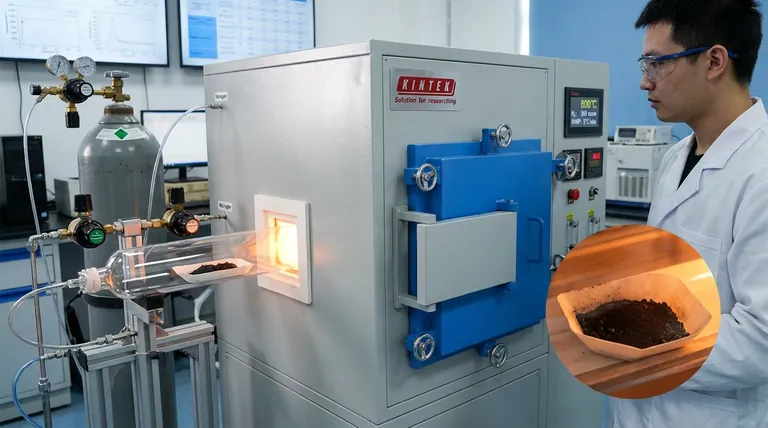
The technical function of an industrial tube furnace in this context is to provide a strictly regulated thermal reactor that decouples high temperatures from oxidation. By maintaining a continuous flow of inert nitrogen gas, the system allows for the pyrolysis of ZIF-8 precursors, enabling the precise conversion of organic ligands into conductive carbon skeletons and the transformation of metal salts into active species without combustion.
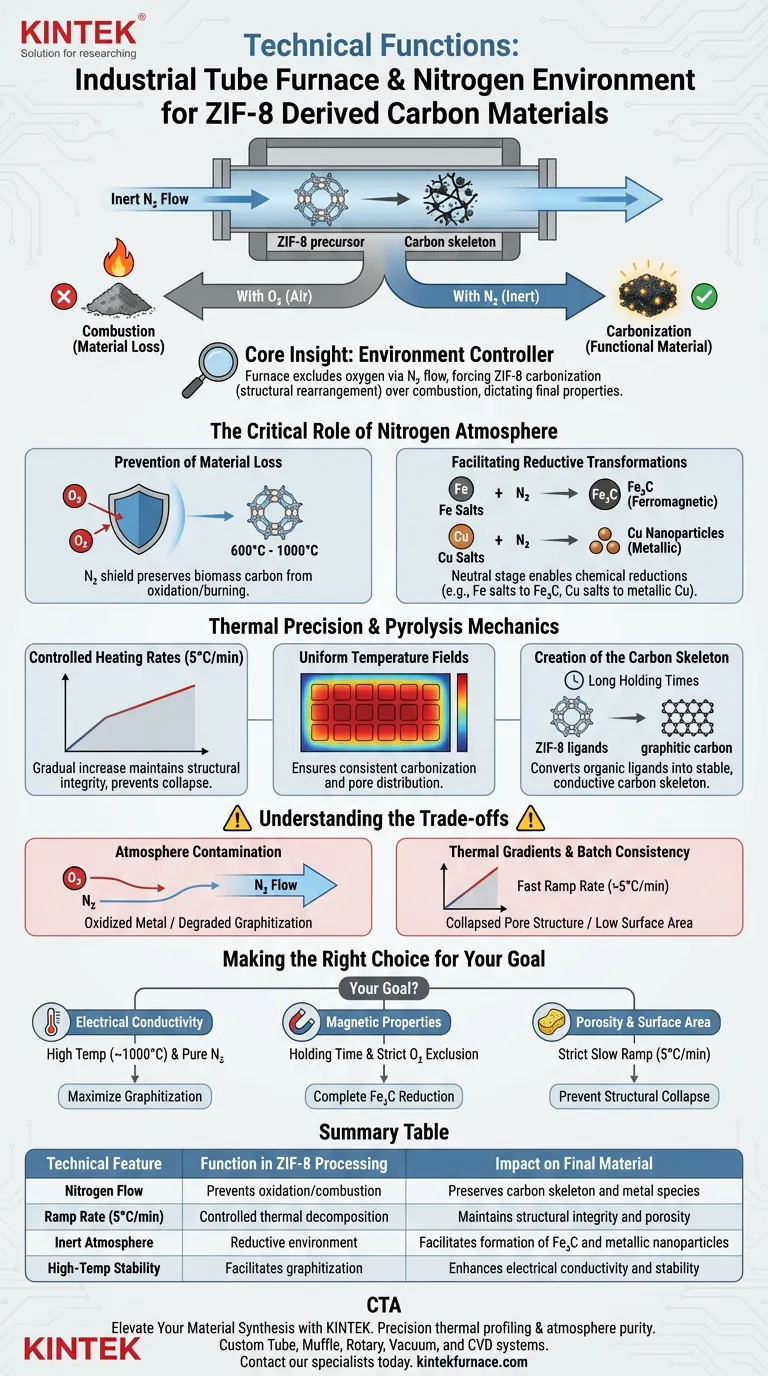
Core Insight: The tube furnace is not simply a heating element; it is an environment controller. By excluding oxygen via nitrogen flow, it forces the ZIF-8 material to undergo carbonization (structural rearrangement) rather than combustion (burning), directly dictating the final material's conductivity, porosity, and magnetic properties.
The Critical Role of the Nitrogen Atmosphere
Prevention of Material Loss
At the elevated temperatures required for this process (often between 600°C and 1000°C), carbon-based materials are highly susceptible to oxidation.
Without a nitrogen shield, the organic components of ZIF-8 would react with oxygen and burn away completely. The inert nitrogen atmosphere ensures that the biomass carbon is preserved and restructured rather than consumed.
Facilitating Reductive Transformations
The nitrogen environment creates a neutral stage that allows specific chemical reductions to occur.
As referenced in your primary data, this atmosphere enables impregnated iron salts to transform into ferromagnetic iron carbide (Fe3C) species. Similarly, it allows for the reduction of other metals, such as converting copper salts into metallic copper nanoparticles, which would otherwise form oxides in standard air.
Thermal Precision and Pyrolysis Mechanics
Controlled Heating Rates
The tube furnace allows for programmable ramp rates, such as the specific 5 °C per minute rate mentioned in technical specifications.
This gradual increase is critical for maintaining the structural integrity of the material. A controlled rate prevents the rapid collapse of the framework, allowing organic ligands to decompose systematically into a nitrogen-doped carbon substrate.
Uniform Temperature Fields
For industrial applications, consistency across the material batch is paramount.
The tube furnace provides a uniform temperature field that ensures consistent carbonization throughout the sample. This uniformity directly impacts the final adsorbent's porosity and the even distribution of chemical active sites.
Creation of the Carbon Skeleton
The defining function of the furnace is to facilitate long-duration thermal treatment, known as holding times.
During this phase, the ZIF-8 organic ligands are converted into a chemically stable and electrically conductive carbon skeleton. This process, often involving graphitization at higher temperatures (e.g., 1000°C), locks in the specific pore structures derived from the original ZIF framework.
Understanding the Trade-offs
The Risk of Atmosphere Contamination
The process relies entirely on the purity of the nitrogen flow.
Even trace amounts of oxygen entering the tube can degrade the graphitization process or oxidize the metal active sites (e.g., turning Fe3C into iron oxide), rendering the material less conductive or non-magnetic.
Thermal Gradients and Batch Consistency
While tube furnaces offer precise control, ramping temperatures too quickly to save time is a common pitfall.
Accelerating the heating rate beyond the recommended 5 °C/min can lead to the collapse of the pore structure before the carbon skeleton hardens, resulting in a material with low surface area and poor catalytic performance.
Making the Right Choice for Your Goal
To optimize your ZIF-8 derived materials, align your furnace settings with your specific end-goal:
- If your primary focus is Electrical Conductivity: Prioritize higher temperatures (around 1000°C) and ensure absolute nitrogen purity to maximize graphitization of the carbon skeleton.
- If your primary focus is Magnetic Properties: Focus on the holding time and the strict exclusion of oxygen to ensure the complete reduction of iron salts into ferromagnetic iron carbide (Fe3C).
- If your primary focus is Porosity and Surface Area: Adhere strictly to slow heating rates (e.g., 5 °C/min) to prevent structural collapse during ligand decomposition.
Precision in the thermal profile and atmosphere purity is the difference between creating high-performance functional carbon and creating simple ash.
Summary Table:
| Technical Feature | Function in ZIF-8 Processing | Impact on Final Material |
|---|---|---|
| Nitrogen Flow | Prevents oxidation/combustion | Preserves carbon skeleton and metal species |
| Ramp Rate (5°C/min) | Controlled thermal decomposition | Maintains structural integrity and porosity |
| Inert Atmosphere | Reductive environment | Facilitates formation of Fe3C and metallic nanoparticles |
| High-Temp Stability | Facilitates graphitization | Enhances electrical conductivity and stability |
Elevate Your Material Synthesis with KINTEK
Precision in thermal profiling and atmosphere purity is the difference between high-performance functional carbon and simple ash. Backed by expert R&D and manufacturing, KINTEK offers specialized Tube, Muffle, Rotary, Vacuum, and CVD systems—all fully customizable to meet the rigorous demands of ZIF-8 derivation and advanced carbonization.
Our lab high-temp furnaces provide the uniform temperature fields and airtight nitrogen control required to ensure your materials achieve peak conductivity, porosity, and magnetic properties.
Ready to optimize your research or production? Contact our specialists today to find your custom furnace solution.
Visual Guide
References
- Yongheng Shi, Wei Du. Preparation of Ordered Macroporous ZIF-8-Derived Magnetic Carbon Materials and Its Application for Lipase Immobilization. DOI: 10.3390/catal14010055
This article is also based on technical information from Kintek Furnace Knowledge Base .
Related Products
- High Pressure Laboratory Vacuum Tube Furnace
- Vacuum Sealed Continuous Working Rotary Tube Furnace Rotating Tube Furnace
- Vertical Laboratory Quartz Tube Furnace Tubular Furnace
- 1400℃ High Temperature Laboratory Tube Furnace with Alumina Tube
- 1700℃ High Temperature Laboratory Tube Furnace with Alumina Tube
People Also Ask
- What role does a high vacuum tube furnace play in Co-Al sintering? Master High-Purity Porous Material Synthesis
- What are the different types of tube furnaces available? Find the Perfect Fit for Your Lab's Needs
- What is the role of a vacuum tube furnace during the final thermal treatment stage of Fe3O4@CSAC catalysts?
- What are the main advantages of vacuum tube furnaces in the market? Achieve Purity and Precision in Material Processing
- What role does a laboratory tube furnace play in geological and mineralogical research? Unlock Earth's Secrets with Precision



















