
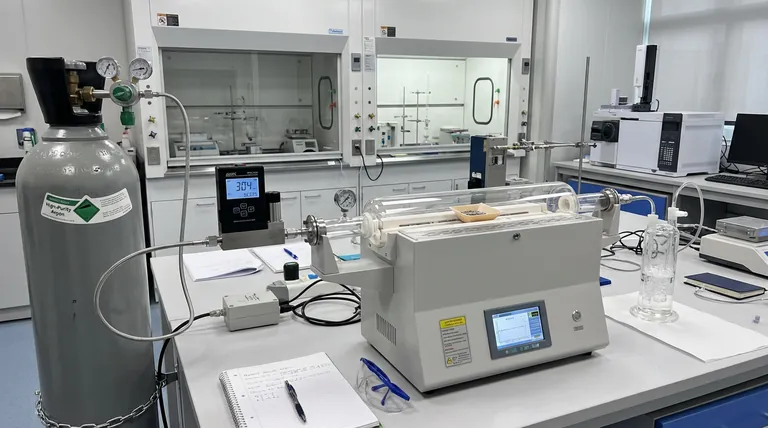
High-purity argon purging is strictly required to completely eliminate reactive atmospheric components, specifically oxygen and water vapor, from the quartz tube furnace. Before heating begins, this process replaces the air inside the chamber with a non-invasive inert gas, creating the necessary environment to prevent the chemical oxidation of Antimony Selenide (Sb2Se3).
Core Insight: Successful nanowire synthesis depends on environmental control as much as temperature control. Without a thorough inert gas purge, high temperatures will accelerate oxidation, causing you to grow degraded oxide byproducts rather than pure semiconductor nanowires.
The Physics of Atmospheric Control
Eliminating Reactive Impurities
The air naturally present inside a quartz tube contains significant amounts of oxygen and water vapor. These elements are chemically aggressive, particularly when energy is added to the system.
You must flush the system to remove these contaminants before the synthesis process begins. Failure to do so leaves the precursor materials vulnerable to immediate reaction with the atmosphere.
Establishing a Non-Invasive Environment
Argon is selected because it creates a non-invasive inert environment. Unlike reactive gases, argon does not participate in the chemical reaction.
It acts as a protective blanket, occupying the volume of the tube without altering the composition of the Antimony Selenide. This isolation is critical for ensuring the chemical reaction is driven solely by the precursor materials.
Protecting Material Integrity
Preventing Oxidation at High Temperatures
As the furnace ramps up to growth temperatures, the reactivity of oxygen increases exponentially. If the tube has not been purged, the Antimony Selenide (Sb2Se3) will rapidly oxidize.
This oxidation degrades the material, altering its stoichiometry and electronic properties. Instead of forming high-quality nanowires, the sample may turn into unwanted antimony oxides or selenium oxides.
Adhering to Critical Process Parameters
Effective purging is not instantaneous; it requires sufficient volume and time. A high flow rate, such as 304 sccm, combined with a substantial duration (e.g., 30 minutes), is necessary to ensure a complete gas exchange.
Shortcutting this step allows pockets of air to remain trapped in the system, compromising the entire batch.
Common Pitfalls to Avoid
Insufficient Purge Duration
A common error is terminating the purge cycle too early. Even if the pressure gauge indicates a stable flow, residual oxygen can linger in the "dead zones" of the tube connections.
You must adhere to a duration (like the recommended 30 minutes) that flushes the tube volume multiple times over to guarantee purity.
Ignoring Gas Purity Levels
Using industrial-grade argon instead of high-purity argon defeats the purpose of the purge. Low-grade inert gases often contain trace moisture or oxygen impurities.
In sensitive nanowire synthesis, these trace impurities are sufficient to introduce defects or nucleate unwanted oxide layers on the crystal surface.
Making the Right Choice for Your Goal
To ensure the successful growth of Sb2Se3 nanowires, consider these specific operational focuses:
- If your primary focus is Material Purity: Use certified high-purity argon and strictly adhere to a high flow rate (e.g., 304 sccm) to dilute and remove all atmospheric contaminants.
- If your primary focus is Process Reproducibility: Standardize your purge duration to a minimum of 30 minutes for every run to eliminate environmental variables between batches.
A rigorous purging protocol is the invisible foundation upon which high-quality semiconductor growth is built.
Summary Table:
| Parameter | Recommended Requirement | Purpose |
|---|---|---|
| Gas Type | High-purity Argon (Inert) | Create a non-invasive environment & prevent oxidation |
| Flow Rate | ~304 sccm | Ensure complete displacement of atmospheric air |
| Purge Duration | Minimum 30 Minutes | Eliminate residual oxygen/moisture in dead zones |
| Atmospheric Targets | Oxygen & Water Vapor | Remove reactive elements that degrade semiconductor quality |
Maximize Your Synthesis Precision with KINTEK
Don't let atmospheric impurities compromise your research. KINTEK provides high-performance Tube, Vacuum, and CVD systems engineered for rigorous environmental control. Backed by expert R&D and manufacturing, our high-temperature furnaces are fully customizable to meet the specific purging and thermal requirements of advanced semiconductor synthesis like Sb2Se3 nanowires.
Ready to elevate your material purity? Contact our laboratory specialists today to find the perfect thermal solution for your unique needs.
References
- Atmospheric Pressure Vapor Transport Deposition of Sb<sub>2</sub>Se<sub>3</sub> Nanowires and Their Application in Photodetection. DOI: 10.1002/admt.202500722
This article is also based on technical information from Kintek Furnace Knowledge Base .
Related Products
- Laboratory Vacuum Tilt Rotary Tube Furnace Rotating Tube Furnace
- 1200℃ Controlled Inert Nitrogen Atmosphere Furnace
- Vertical Laboratory Quartz Tube Furnace Tubular Furnace
- 1700℃ High Temperature Laboratory Tube Furnace with Alumina Tube
- Magnesium Extraction and Purification Condensing Tube Furnace
People Also Ask
- What are the key advantages of using a rotary tube furnace? Achieve Dynamic, Uniform Heating for Powders
- What optional features enhance the processing capabilities of rotary tube furnaces? Boost Efficiency with Advanced Customizations
- What other fields utilize rotary tube furnaces? Discover Versatile Heating Solutions for Multiple Industries
- What are the technical advantages of using a rotary tube furnace for hydrochar activation? Achieve Superior Porosity
- When are rotary tube furnaces not suitable for a process? Avoid Costly Mistakes in Thermal Processing



















