
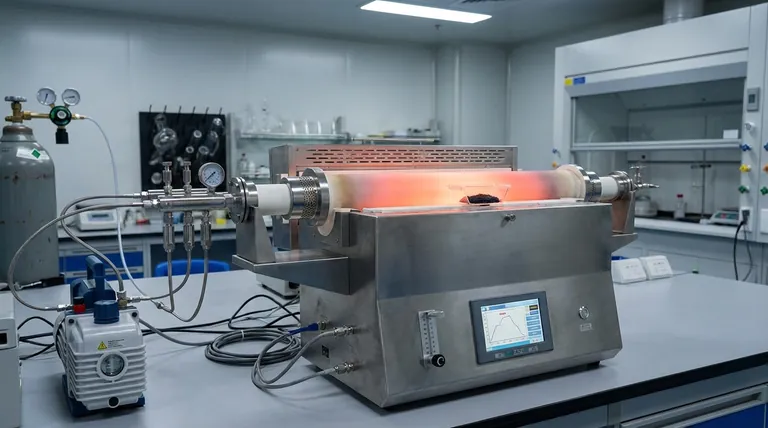
Precise environmental control is the defining feature of a tubular furnace during Carbon Molecular Sieve (CMS) membrane carbonization. It strictly manages the atmosphere through high vacuum and inert gas flow while regulating thermal progression to engineer specific molecular structures.
Core Takeaway A tubular furnace acts as a chemical reactor, not just a heater. By establishing an oxygen-free environment via vacuum and high-purity nitrogen, and applying exacting heating rates, it facilitates the critical chemical transformations—dehydrogenation, cross-linking, and aromatization—required to create a rigid carbon framework with precise sieving capabilities.
Managing the Atmospheric Composition
The primary function of the tubular furnace in this context is to isolate the polymer precursor from the reactive elements of the outside world.
Elimination of Contaminants
Before the heating process begins, the furnace utilizes a high vacuum to purge the chamber. This step removes residual atmospheric gases that could interfere with the delicate chemical process.
Prevention of Oxidation
The most critical environmental goal is creating an oxygen-free environment. If oxygen were present during high-temperature treatment, it would oxidize the carbon framework, effectively destroying the membrane rather than forming it.
The Role of Inert Gas
Once the vacuum stage removes impurities, the furnace introduces a flow of high-purity nitrogen (N2). This serves as a protective blanket, maintaining positive pressure to keep contaminants out while providing a stable medium for carbonization.
Controlling the Thermal Trajectory
Carbonization is not merely about reaching a high temperature; it is about the rate at which that temperature is achieved.
Precise Heating Rates
The tubular furnace applies strictly controlled heating protocols, such as a rate of 5°C/min. This slow, steady climb is essential for managing the release of volatiles without damaging the membrane structure.
Facilitating Chemical Transformation
These stable thermal conditions drive specific chemical reactions: dehydrogenation, cross-linking, and aromatization. These reactions transform the soft polymer chains into a rigid, carbon-rich lattice.
Structural Result
The ultimate goal of this thermal control is to engineer the pore size distribution. The controlled environment ensures the formation of a carbon molecular sieve structure capable of distinguishing between molecules based on size.
Understanding the Trade-offs
While tubular furnaces provide the necessary precision for high-performance CMS membranes, there are operational constraints to consider.
Throughput vs. Quality
The requirement for slow heating rates (e.g., 5°C/min) significantly extends the processing time. You trade manufacturing speed for the molecular precision required for high-selectivity separation.
Complexity of Atmosphere Control
Maintaining a true oxygen-free environment requires rigorous seal integrity and high-quality gas sources. Even minor leaks or impurities in the nitrogen supply can compromise the cross-linking process and degrade the final membrane performance.
Making the Right Choice for Your Goal
When configuring a tubular furnace for CMS production, your settings should reflect your specific performance targets.
- If your primary focus is Membrane Selectivity: Prioritize heating rate precision. A slower, more controlled ramp allows for optimal cross-linking and pore formation, ensuring the membrane can effectively sift specific molecules.
- If your primary focus is Structural Integrity: Prioritize atmospheric purity. Ensure your vacuum and nitrogen purge cycles are aggressive to prevent even trace oxidation that could weaken the carbon framework.
The success of CMS carbonization relies on viewing the tubular furnace as a tool for chemical synthesis rather than simple thermal treatment.
Summary Table:
| Control Feature | Mechanism | Impact on CMS Membrane |
|---|---|---|
| Atmosphere | High Vacuum & N2 Purge | Prevents oxidation and removes contaminants |
| Thermal Ramp | Slow Heating (e.g., 5°C/min) | Manages volatile release and structural integrity |
| Chemical Drive | Controlled High Temp | Facilitates dehydrogenation, cross-linking, and aromatization |
| Pressure | Positive Inert Flow | Maintains purity and prevents external gas ingress |
Elevate Your CMS Membrane Research with KINTEK
Precision is the difference between a failed polymer and a high-selectivity Carbon Molecular Sieve. Backed by expert R&D and world-class manufacturing, KINTEK provides high-performance Tube, Muffle, Vacuum, and CVD systems specifically designed for sensitive carbonization processes.
Our furnaces offer the vacuum integrity and heating rate precision required for optimal cross-linking and pore engineering. Whether you need a standard setup or a fully customizable system for unique high-temperature laboratory needs, our technical team is ready to help you achieve the perfect carbon framework.
Contact KINTEK today to discuss your material specs and get a tailored solution.
References
- Cascade Promotion of Gas Separation Performances in CMS Membranes: MOFs With Functional Groups and Loaded Noble Metals. DOI: 10.1002/advs.202503471
This article is also based on technical information from Kintek Furnace Knowledge Base .
Related Products
- Multi Zone Laboratory Quartz Tube Furnace Tubular Furnace
- Vertical Laboratory Quartz Tube Furnace Tubular Furnace
- Split Chamber CVD Tube Furnace with Vacuum Station CVD Machine
- Laboratory Quartz Tube Furnace RTP Heating Tubular Furnace
- Custom Made Versatile CVD Tube Furnace Chemical Vapor Deposition CVD Equipment Machine
People Also Ask
- Why are multi zone tube furnaces particularly useful for nanomaterial research? Unlock Precise Thermal Control for Advanced Synthesis
- What temperature-related capabilities make multi zone tube furnaces valuable for research? Unlock Precision Thermal Control
- What role do multi zone tube furnaces play in new energy research? Unlock Precise Thermal Control for Innovation
- What environmental protection applications utilize multi zone tube furnaces? Unlock Precision in Waste Treatment and Green Tech
- What are the main applications of multi zone tube furnaces in university laboratories? Unlock Precision in Material Science and Energy Research



















