
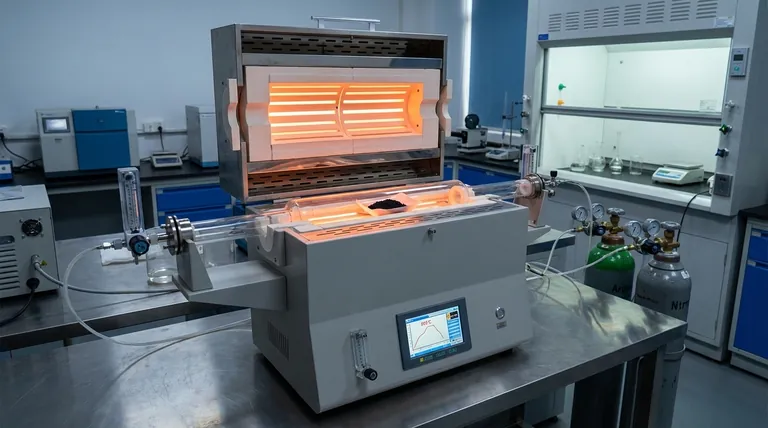
A high-temperature tube furnace functions as a precision instrument for structural evolution, establishing the exact thermal and atmospheric conditions required to tune the porosity of carbon nanofibers. By maintaining an inert environment (typically Argon or Nitrogen) at temperatures usually between 600°C and 900°C, it drives the removal of non-carbon atoms and the controlled shrinkage of micropores to achieve specific molecular sieving capabilities.
The furnace’s primary contribution is the precise regulation of carbonization temperature, which dictates the extent of atomic lattice reorganization and micropore shrinkage, effectively turning the nanofiber into a tunable filter for gas separation.
The Mechanics of Pore Regulation
Precision Temperature Control
The core mechanism for regulating pore size is the specific carbonization temperature, typically ranging from 600°C to 900°C.
The tube furnace maintains this temperature with high precision, which directly determines the degree of micropore shrinkage.
By adjusting this temperature, researchers can fine-tune the pore dimensions to create a "molecular sieving" effect, allowing the material to distinguish between molecules of different sizes, such as separating carbon dioxide from methane.
Inert Atmosphere Management
The tube furnace creates a stable, protective environment using inert gases like Argon or Nitrogen.
This atmosphere is critical because it prevents the carbon nanofibers from oxidizing (burning away) during the high-heat process.
Instead of burning, the material undergoes controlled pyrolysis, where volatile components are safely removed, leaving behind the carbon framework.
Drivers of Structural Evolution
Non-Carbon Atom Removal
As the furnace heats the precursor materials (such as cellulose or polymer nanowires), it induces the release of non-carbon atoms.
This removal of volatile components creates the initial void spaces within the material.
The rate of this release, controlled by the furnace's heating profile, influences the initial formation of the porous structure.
Lattice Reorganization
At high temperatures, the furnace facilitates the rearrangement of the remaining carbon atoms into stable structures.
This process transforms the material into a conjugated aromatic structure, which enhances both structural stability and electrical conductivity.
This reorganization is essential for converting a loose polymer network into a rigid, functional carbon nanofiber.
Chemical Activation Control
When chemical activating agents like potassium hydroxide (KOH) or in-situ porogens (like nitrogen release) are used, the furnace controls the reaction intensity.
The temperature profile determines how aggressively these agents etch the carbon framework.
This precise etching is what allows for the tuning of ultra-high specific surface areas and the specific ratio between micropores (very small) and mesopores (medium).
Understanding the Trade-offs
Temperature vs. Pore Size
There is an inverse relationship between carbonization temperature and pore size that must be balanced.
Higher temperatures generally lead to greater micropore shrinkage and tighter structures suitable for gas separation.
However, excessively high temperatures might collapse desirable larger pores or reduce the total pore volume available for other applications.
Structural Stability vs. Surface Area
Using the furnace to aggressively etch pores (via activation) increases surface area but can weaken the physical framework.
Conversely, focusing solely on high-temperature carbonization creates a stable, conductive wire but may result in lower overall porosity.
You must optimize the heating profile to balance the need for high surface area with the need for a mechanically robust electrode or filter.
Making the Right Choice for Your Goal
To maximize the utility of a high-temperature tube furnace for your specific carbon nanofiber application:
- If your primary focus is Gas Separation (Molecular Sieving): Prioritize precise temperature control between 600°C and 900°C to induce specific micropore shrinkage for size-exclusion of molecules like CO2 and methane.
- If your primary focus is Electrical Conductivity: Utilize higher temperatures (around 800°C) under a nitrogen atmosphere to ensure complete graphitization and the formation of a conjugated aromatic structure.
- If your primary focus is High Surface Area: Focus on controlling heating rates and activation temperatures to manage the intensity of chemical etching (e.g., by KOH) and porogen release.
Mastering the thermal profile is the only way to transition from random defects to engineered porosity.
Summary Table:
| Regulation Factor | Mechanism | Resulting Property |
|---|---|---|
| Temperature (600-900°C) | Micropore shrinkage & lattice reorganization | Molecular sieving & gas separation |
| Inert Atmosphere | Prevents oxidation via Ar/N2 flow | Controlled pyrolysis & carbon framework stability |
| Heating Profile | Volatile non-carbon atom removal | Initial void formation & electrical conductivity |
| Chemical Activation | Controlled etching with KOH/porogens | Ultra-high surface area & mesopore tuning |
Optimize Your Nanofiber Research with KINTEK
Precision is the difference between a random defect and an engineered pore. KINTEK provides industry-leading thermal solutions designed for the rigorous demands of materials science.
Backed by expert R&D and manufacturing, KINTEK offers Muffle, Tube, Rotary, Vacuum, and CVD systems, all fully customizable to your unique research needs. Whether you are aiming for precise molecular sieving or ultra-high surface area electrodes, our high-temperature furnaces deliver the stability and atmospheric control you require.
Ready to elevate your material synthesis?
Contact KINTEK today to discuss your custom furnace requirements.
References
- Victor Selmert, Rüdiger‐A. Eichel. Breakthrough analysis of the CO2/CH4 separation on electrospun carbon nanofibers. DOI: 10.1007/s10450-023-00435-6
This article is also based on technical information from Kintek Furnace Knowledge Base .
Related Products
- 1400℃ High Temperature Laboratory Tube Furnace with Alumina Tube
- 1700℃ High Temperature Laboratory Tube Furnace with Alumina Tube
- 1200℃ Split Tube Furnace Laboratory Quartz Tube Furnace with Quartz Tube
- Vertical Laboratory Quartz Tube Furnace Tubular Furnace
- 1700℃ High Temperature Muffle Oven Furnace for Laboratory
People Also Ask
- How does zone-melting in tube furnaces synthesize bismuth micro-wires? Master Single-Crystal Thermoelectric Growth
- How are high-temp tube furnaces used to measure diffusion coefficients per Fick's law? Master Precision Annealing
- How do high-temperature laboratory tube furnaces ensure environmental stability? Precision Thermal Reduction Tips
- How are high-temperature laboratory tube furnaces applied in long-term vacuum homogenization heat treatments for intermetallic samples?
- How are high-temperature tube furnaces applied in testing ceramic-supported alloy membranes? Insights



















