
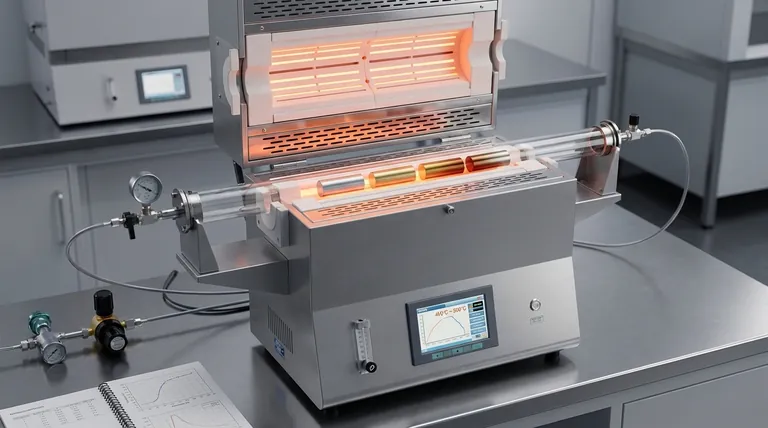
High-temperature tube furnaces offer superior process control for the thermal oxidation of austenitic stainless steel, particularly within the critical 400°C to 500°C window. By maintaining a stable atmospheric pressure environment, these systems allow for precise, long-duration heating cycles that are essential for developing consistent surface properties without complex vacuum equipment.
The core advantage lies in the furnace's ability to maintain uniform heating zones, creating a homogenous oxide layer that enhances both the material's wear resistance and its decorative appearance in a cost-effective, environmentally friendly manner.
Precision and Environmental Control
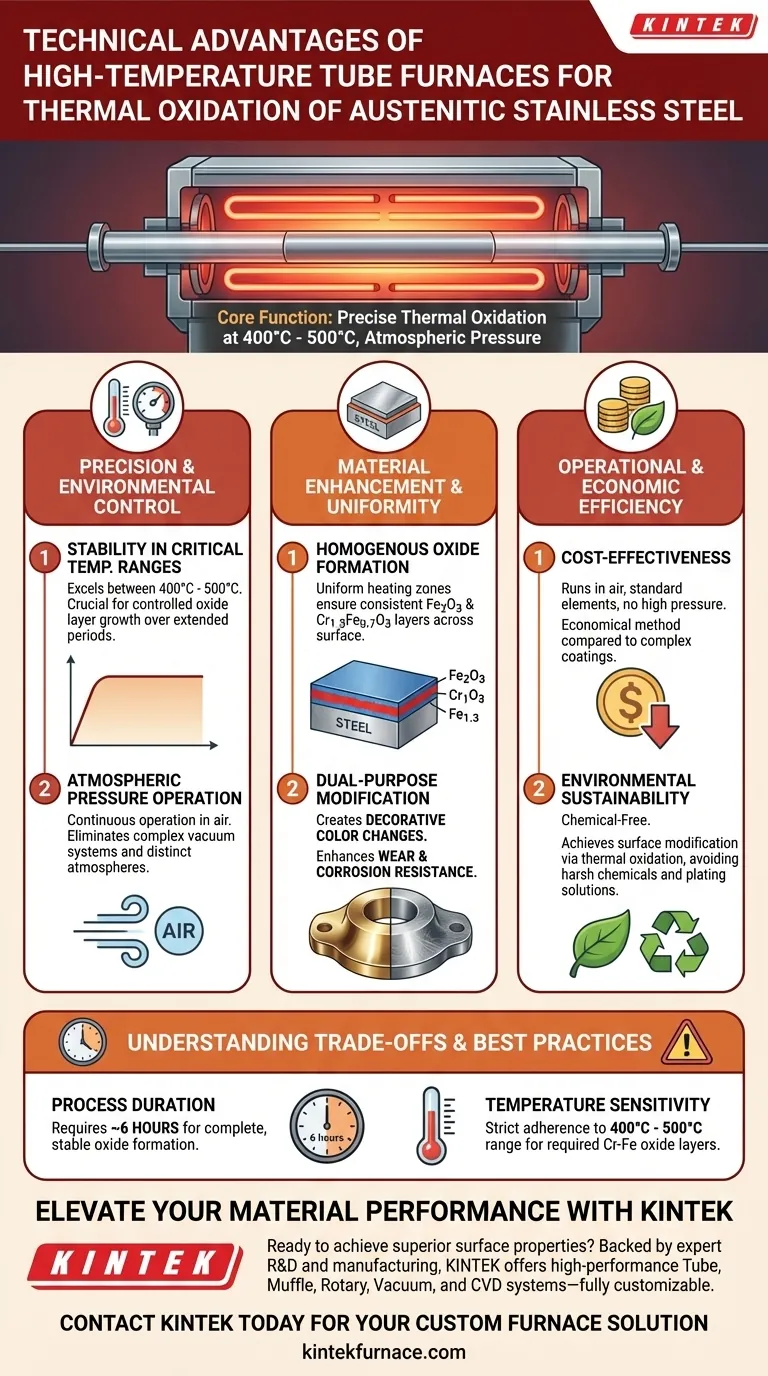
Stability in Critical Temperature Ranges
These furnaces excel at maintaining stable temperatures specifically between 400°C and 500°C. This precise thermal window is crucial for the controlled growth of oxide layers, ensuring the process remains stable over extended periods.
Atmospheric Pressure Operation
The system allows for continuous operation in air at atmospheric pressure. This eliminates the need for complex vacuum systems or chemically distinct atmospheres, streamlining the oxidation process.
Material Enhancement and Uniformity
Homogenous Oxide Formation
Uniform heating zones are a hallmark of tube furnaces. This consistency ensures the formation of homogenous iron oxide (Fe2O3) and chromium-iron oxide (Cr1.3Fe0.7O3) layers across the entire sample surface, avoiding irregular patches or weak spots.
Dual-Purpose Surface Modification
The process yields two distinct technical benefits simultaneously. It creates decorative color changes while significantly improving functional properties, specifically enhancing the steel's wear and corrosion resistance.
Operational and Economic Efficiency
Cost-Effectiveness
Because the process runs in air and utilizes standard thermal elements without high-pressure requirements, it offers a cost-effective method for surface treatment compared to more complex coating technologies.
Environmental Sustainability
The method is inherently environmentally friendly. It achieves surface modification through thermal oxidation rather than utilizing harsh chemical baths or galvanic plating solutions often associated with metal finishing.
Understanding the Trade-offs
Process Duration Requirements
High-quality oxidation is not instantaneous in this configuration. The process requires extended dwell times, typically around 6 hours, to ensure the complete formation and stability of the oxide structures.
Temperature Sensitivity
The benefits described are strictly tied to the 400°C to 500°C range. Deviating from this window may compromise the formation of the specific Cr-Fe oxide layers required for enhanced protection.
Making the Right Choice for Your Goal
To maximize the utility of a high-temperature tube furnace for your specific application:
- If your primary focus is decorative finishes: Leverage the uniform heating zones to ensure consistent, repeatable coloration across the entire surface area of the steel.
- If your primary focus is functional durability: Adhere strictly to the full 6-hour cycle time to maximize the homogeneity of the protective Cr1.3Fe0.7O3 layers for optimal corrosion resistance.
Ultimately, this thermal processing method transforms standard austenitic stainless steel into a higher-performance material through a clean, controlled, and economical mechanism.
Summary Table:
| Feature | Technical Advantage | Benefit for Stainless Steel |
|---|---|---|
| Temperature Range | 400°C - 500°C Stability | Ensures consistent growth of protective oxide layers |
| Atmosphere | Atmospheric Pressure Air | Cost-effective operation without complex vacuum systems |
| Heating Zone | Uniform Thermal Distribution | Homogenous formation of Fe2O3 and Cr1.3Fe0.7O3 |
| Processing Time | 6-Hour Dwell Cycles | Maximizes wear resistance and decorative consistency |
| Sustainability | Chemical-Free Oxidation | Environmentally friendly alternative to plating/baths |
Elevate Your Material Performance with KINTEK
Ready to achieve superior surface properties with precision thermal processing? Backed by expert R&D and manufacturing, KINTEK offers high-performance Tube, Muffle, Rotary, Vacuum, and CVD systems—all fully customizable to meet your unique laboratory or production needs.
Whether you are refining austenitic stainless steel or developing advanced materials, our high-temperature furnaces provide the stability and control required for excellence. Contact KINTEK today to find your custom furnace solution and see how our expertise can drive your innovation forward.
Visual Guide
References
- T. Borowski, Bogusława Adamczyk‐Cieślak. Wear and Corrosion Resistance of Thermally Formed Decorative Oxide Layers on Austenitic Steel. DOI: 10.3390/met15070707
This article is also based on technical information from Kintek Furnace Knowledge Base .
Related Products
- 1700℃ High Temperature Laboratory Tube Furnace with Alumina Tube
- 1400℃ High Temperature Laboratory Tube Furnace with Alumina Tube
- Vertical Laboratory Quartz Tube Furnace Tubular Furnace
- 1200℃ Split Tube Furnace Laboratory Quartz Tube Furnace with Quartz Tube
- High Temperature Muffle Oven Furnace for Laboratory Debinding and Pre Sintering
People Also Ask
- How are high-temp tube furnaces used to measure diffusion coefficients per Fick's law? Master Precision Annealing
- How are high-temperature laboratory tube furnaces applied in long-term vacuum homogenization heat treatments for intermetallic samples?
- How do high-temperature laboratory tube furnaces ensure environmental stability? Precision Thermal Reduction Tips
- How are high-temperature tube furnaces applied in testing ceramic-supported alloy membranes? Insights
- In what scenarios are laboratory high-temperature tube furnaces or muffle furnaces utilized? Study MgTiO3-CaTiO3 Ceramics



















