
A laboratory vacuum drying oven serves as the critical stabilization mechanism during the post-treatment of porous carbon derived from polyethylene terephthalate (PET). Operating typically at 120 °C, its immediate purpose is to thoroughly eliminate moisture and residual solvents retained in the material after the impregnation and washing stages.
By ensuring the carbon powder reaches a constant weight before high-temperature activation, the vacuum drying process prevents the rapid evaporation of moisture that causes pore structure collapse, thereby preserving the material's internal architecture.
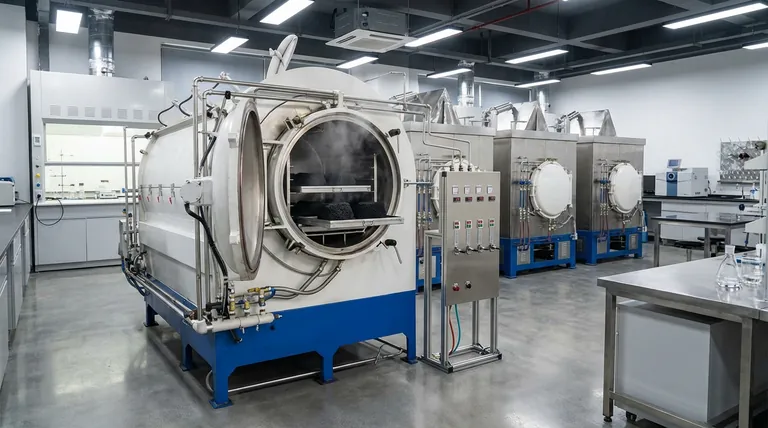
Preparing the Material for Activation
The post-treatment of PET-derived carbon involves complex steps, including impregnation and washing. The vacuum drying oven acts as the bridge between these wet stages and the final high-temperature processing.
Establishing Thermal Stability
The oven provides a consistent thermal environment, typically maintained at 120 °C for this specific application.
This controlled heat is necessary to drive off water and solvents without subjecting the material to thermal shock.
Achieving Constant Weight
The goal of this phase is to dry the sample until it reaches a "constant weight."
This metric confirms that all volatile substances have been removed, ensuring consistency in the subsequent high-temperature infrared activation step.
Preserving Microstructural Integrity
The most vital role of the vacuum drying oven is not just removing water, but doing so in a way that protects the carbon's porous network.
Preventing Pore Collapse
If moisture remains in the pores during high-temperature activation, it will evaporate explosively.
This rapid expansion can destroy the delicate pore structure you are trying to create. Vacuum drying gently removes this moisture beforehand, effectively "freezing" the porous architecture in place.
Minimizing Oxidation
While drying is the primary goal, the vacuum environment also plays a secondary protective role.
By removing air during the heating process, the oven prevents unnecessary oxidation of the carbon surface, preserving its physicochemical characteristics for the final activation.
Understanding the Trade-offs
While vacuum drying is essential for quality, it introduces specific constraints that must be managed.
Processing Speed vs. Quality
Vacuum drying is generally a slower, batch-oriented process compared to continuous drying methods.
While it guarantees structural integrity, it can become a bottleneck in high-throughput manufacturing environments.
Energy and Equipment Costs
maintaining a vacuum at 120 °C requires more energy and sophisticated equipment than standard convection drying.
This increases operational costs, which must be weighed against the necessity of high-performance pore structures.
Making the Right Choice for Your Project
The use of a laboratory vacuum drying oven is dictated by the specific requirements of your final carbon material.
- If your primary focus is high surface area: Prioritize the vacuum drying step to prevent pore collapse and ensure maximum porosity.
- If your primary focus is process speed: You may be tempted to accelerate drying, but understand that doing so risks compromising the structural stability of the carbon.
Ideally, view the vacuum drying oven not merely as a drying tool, but as a preservation chamber that safeguards the material's potential before activation.
Summary Table:
| Aspect | Description |
|---|---|
| Primary Role | Critical stabilization in post-treatment of PET-derived porous carbon. |
| Key Function | Eliminates moisture and residual solvents (typically at 120 °C) before high-temperature activation. |
| Main Benefits | Preserves microstructural integrity (prevents pore collapse), minimizes oxidation, ensures consistent material weight. |
| Application | Essential for achieving high surface area and structural stability in activated carbon. |
| Considerations | Slower, batch process; higher energy/equipment costs compared to conventional drying. |
Need a reliable laboratory vacuum drying oven or other high-temperature solution? KINTEK offers advanced Muffle, Tube, Rotary, Vacuum, CVD systems, and other lab furnaces, all customizable to your unique research and processing needs. Backed by expert R&D and manufacturing, our equipment ensures precise control and consistent results for your critical applications, like porous carbon synthesis.
Enhance your material science research and production today – contact us to discuss your requirements!
References
- М. Н. Ефимов, Г. П. Карпачева. Application of Infrared Pyrolysis and Chemical Post-Activation in the Conversion of Polyethylene Terephthalate Waste into Porous Carbons for Water Purification. DOI: 10.3390/polym16070891
This article is also based on technical information from Kintek Furnace Knowledge Base .
Related Products
- 1200℃ Muffle Oven Furnace for Laboratory
- High Temperature Muffle Oven Furnace for Laboratory Debinding and Pre Sintering
- 1700℃ High Temperature Muffle Oven Furnace for Laboratory
- Laboratory Vacuum Tilt Rotary Tube Furnace Rotating Tube Furnace
- Vacuum Heat Treat Sintering and Brazing Furnace
People Also Ask
- How does a high-temperature laboratory muffle furnace affect material properties? Transform Anodic Oxide Films Fast
- What is the primary function of a high-temperature laboratory muffle furnace in chemical synthesis? Achieve Precision.
- How is a laboratory muffle furnace used in 3D-printed PP-CF cross-linking? Achieve Thermal Stability at 150 °C
- Why is a laboratory high-temperature muffle furnace used for BaTiO3? Achieve Optimal Tetragonal Crystalline Phases
- Why is a laboratory high-temperature muffle furnace required for LaNixFe1-xO3 catalysts? Optimize Two-Stage Synthesis









