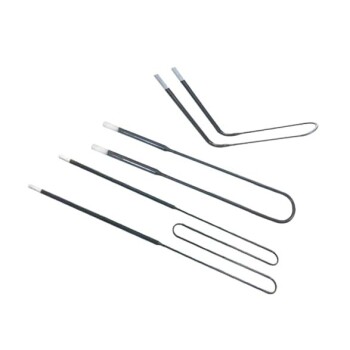
High-temperature furnaces equipped with molybdenum disilicide (MoSi2) heating elements are the critical engine for synthesizing the precursor glass required for gahnite glass-ceramics. These furnaces provide a stable thermal environment reaching temperatures as high as 1620 °C, which is essential for the complete melting, chemical homogenization, and refining (degassing) of the ZnO-MgO-Al2O3-SiO2 raw material system.
The MoSi2 furnace serves as the foundational tool for ensuring compositional uniformity and high purity in the glass matrix. By providing precise, sustained heat in oxidizing atmospheres, it allows complex oxide components to react fully and eliminate gas bubbles, a prerequisite for high-quality glass-ceramic production.
Achieving Peak Thermal Performance
Sustaining Extreme Melting Temperatures
Gahnite glass-ceramics require the melting of a complex ZnO-MgO-Al2O3-SiO2 system, which demands temperatures far exceeding standard industrial limits. MoSi2 heating elements are uniquely capable of operating reliably at temperatures up to 1620 °C, providing the necessary energy to transform solid oxides into a low-viscosity liquid.
Stability in Oxidizing Atmospheres
Unlike metallic elements that may degrade, MoSi2 elements are specifically designed to operate in air or oxidizing atmospheres. This environment is vital for glass-ceramics, as it prevents the unwanted reduction of metal oxides and ensures the finished glass maintains its intended chemical state.
Homogenization and Refining Processes
Facilitating Complete Chemical Reactions
At sustained high temperatures, the raw materials—often including carbonates and oxides—undergo thermochemical reactions to form a uniform molten state. The furnace ensures that all components, such as silicon oxide and alumina, are thoroughly mixed and reacted in a liquid state, preventing localized chemical imbalances.
Elimination of Volatile Impurities and Bubbles
The "refining" or clarification process relies on the furnace's ability to maintain a high, stable temperature field to lower the melt's viscosity. This allows gas bubbles to rise and escape the liquid, resulting in a dense, pore-free precursor glass that is essential for the structural integrity of the final ceramic.
Kinetic Energy for Phase Equilibrium
The furnace provides the sustained kinetic energy required for atomic diffusion between components. This ensures that the solid solutions achieve a uniform composition alignment, which is a critical prerequisite for the subsequent controlled crystallization phase of gahnite.
Understanding the Trade-offs and Limitations
Material Brittleness and Handling
While MoSi2 elements offer superior high-temperature performance, they become extremely brittle at room temperature. This requires careful handling during maintenance and specific furnace "warm-up" protocols to avoid mechanical failure due to thermal shock or physical impact.
"Pest" Oxidation at Intermediate Temperatures
MoSi2 elements are susceptible to a phenomenon known as "pesting"—low-temperature oxidation—when held between 400°C and 700°C. Operators must ensure the furnace transitions through this range efficiently to prevent the disintegration of the heating elements over time.
Atmosphere Sensitivity
While excellent in oxidizing environments, MoSi2 elements can be compromised in heavily reducing atmospheres or under vacuum if not specifically rated for those conditions. Exposure to certain volatile chemicals released during the melting process can also gradually erode the protective silica layer on the elements.
Applying This Technology to Your Production
Strategic Recommendations for Implementation
A high-temperature MoSi2 furnace is an investment in the purity of your final material. The choice of furnace settings should align with the specific viscosity and degassing requirements of your glass batch.
- If your primary focus is Maximum Purity: Prioritize a furnace with high-precision temperature control to ensure complete degassing and the volatilization of unwanted impurities.
- If your primary focus is Large-Scale Homogeneity: Utilize a furnace capable of long-term sustained operation (over 24 hours) to allow for complete diffusion and chemical alignment of the molten oxides.
- If your primary focus is Element Longevity: Implement a ramp-up schedule that minimizes time spent in the 400°C–700°C "pest" oxidation range to extend the life of your MoSi2 elements.
By mastering the stable thermal environment of the MoSi2 furnace, you ensure the production of a chemically uniform, high-quality precursor glass for superior gahnite glass-ceramics.
Summary Table:
| Feature | Performance Detail |
|---|---|
| Max Temperature | Up to 1620°C (Essential for ZnO-MgO-Al2O3-SiO2 systems) |
| Atmosphere Support | Optimized for air and oxidizing environments |
| Primary Role | Precursor glass synthesis, chemical homogenization, and refining |
| Refining Benefit | Lowers melt viscosity to eliminate gas bubbles and impurities |
| Maintenance Note | Requires management of "pest" oxidation (400°C–700°C) |
Elevate Your Materials Synthesis with KINTEK
Achieving the precise thermal conditions required for advanced glass-ceramics demands equipment without compromise. KINTEK specializes in high-performance laboratory equipment, offering a comprehensive range of high-temperature furnaces—including muffle, tube, rotary, vacuum, CVD, and atmosphere furnaces—all fully customizable to meet your unique research and production specifications.
Why Partner with KINTEK?
- Extreme Thermal Precision: Achieve stable temperatures up to 1800°C for flawless material synthesis.
- Versatile Configurations: Solutions tailored for oxidizing, reducing, or vacuum environments.
- Reliable Components: High-quality MoSi2 heating elements designed for longevity and peak performance.
Ready to optimize your glass-ceramic melting process? Contact KINTEK today for a custom consultation and discover how our advanced thermal solutions can enhance your laboratory's efficiency and output.
References
- G. Yu. Shakhgil’dyan, В. Н. Сигаев. One-Step Crystallization of Gahnite Glass-Ceramics in a Wide Thermal Gradient. DOI: 10.3390/chemengineering7020037
This article is also based on technical information from Kintek Furnace Knowledge Base .
Related Products
- Molybdenum Disilicide MoSi2 Thermal Heating Elements for Electric Furnace
- Molybdenum Vacuum Heat Treat Furnace
- 2200 ℃ Graphite Vacuum Heat Treat Furnace
- Vacuum Heat Treat Sintering Furnace Molybdenum Wire Vacuum Sintering Furnace
- High Temperature Muffle Oven Furnace for Laboratory Debinding and Pre Sintering
People Also Ask
- What are the typical application temperatures for molybdenum disilicide (MoSi2) heating elements? Master High-Temp Performance
- What is the primary use of molybdenum disilicide? Ideal for High-Temp Heating Elements
- What are the characteristics of molybdenum disilicide heating elements? Unlock High-Temp Performance
- What are the properties of molybdenum disilicide (MoSi2) that make it suitable for high-temperature applications? Discover Its High-Temp Resilience
- What are the applications of molybdenum disilicide heating elements? Achieve Extreme Heat Stability for Industrial Processes