
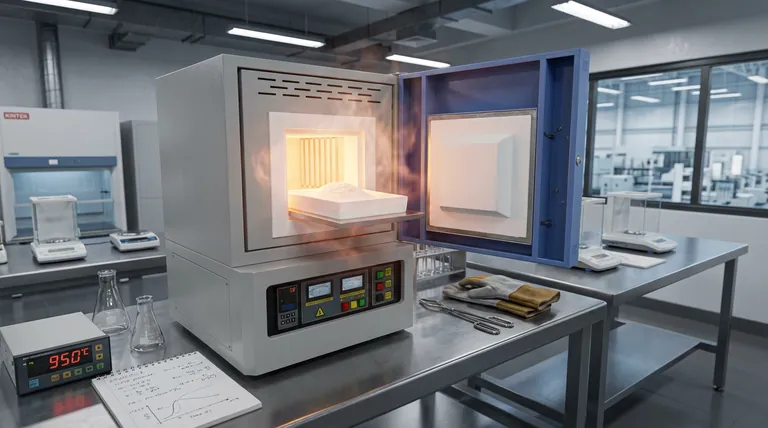
The high-temperature box furnace serves as the critical thermal reactor during the pre-calcination stage of LLZTO synthesis. Its primary function is to provide a controlled environment that drives solid-state diffusion, removes volatile byproducts like carbonates and hydroxyl groups, and initiates the formation of the essential garnet crystal phase.
The box furnace does not merely heat the material; it acts as a constant energy source essential for overcoming phase transformation barriers. This stage converts raw precursors into a pure, stable garnet structure, laying the necessary foundation for subsequent high-density sintering.
The Mechanics of Solid-State Diffusion
Driving Atomic Movement
The fundamental role of the box furnace is to facilitate solid-state diffusion.
In this process, mixed raw material powders are heated to high temperatures, providing the thermal energy required for atoms to migrate.
This long-range atomic diffusion across precursor interfaces is necessary to create a homogenous mixture at the atomic level.
Overcoming Energy Barriers
To transform raw powders into a complex garnet structure, the material must overcome significant phase transformation barriers.
The furnace maintains a stable thermal field, typically between 600°C and 1000°C, for several hours.
This sustained energy input ensures the reaction proceeds to completion, rather than stalling at an intermediate state.
Chemical and Structural Evolution
Removing Volatile Impurities
Before the final structure can form, the raw materials must be purged of non-essential components.
The pre-calcination stage is explicitly designed to decompose precursors and remove volatiles such as carbonates and hydroxyl groups.
Eliminating these impurities early prevents the formation of gas pockets or defects during the final sintering stage.
Initiating the Garnet Phase
The ultimate goal of this thermal treatment is to create the LLZTO garnet structure phase.
While the material is not yet fully densified, this stage establishes the correct crystallographic framework.
This "material foundation" is a prerequisite for the subsequent densification process; without it, high ionic conductivity cannot be achieved.
Understanding the Trade-offs
The Risk of Thermal Gradients
While box furnaces provide high heat, they must be carefully managed to ensure thermal uniformity.
If the temperature varies significantly within the chamber, the powder may develop inconsistent phases.
This can lead to "secondary phases" (impurities) that impede the performance of the final electrolyte.
Atmosphere Limitations
Standard box furnaces (muffle furnaces) are excellent for air-based calcination but may lack precise atmosphere control compared to tube furnaces.
If the synthesis requires strict control over oxygen defects or valence states, the specific atmosphere capabilities of the furnace become a limiting factor.
Standard air calcination is effective for removing organics, but may not prevent lithium loss at the highest temperatures.
Making the Right Choice for Your Goal
To maximize the effectiveness of your pre-calcination stage, consider your specific synthesis objectives:
- If your primary focus is phase purity: Ensure your furnace ramp rates are slow enough to allow complete decomposition of carbonates before the garnet phase forms.
- If your primary focus is material density: Prioritize a furnace with excellent thermal uniformity to ensure the entire batch achieves the target garnet phase foundation for sintering.
The success of your final LLZTO electrolyte is determined by the quality of the phase foundation established in this critical heating stage.
Summary Table:
| Process Stage | Key Function of Box Furnace | Impact on LLZTO Material |
|---|---|---|
| Decomposition | Removal of carbonates and hydroxyls | Prevents gas pockets and structural defects |
| Diffusion | Driving long-range atomic movement | Ensures a homogenous atomic-level mixture |
| Phase Formation | Overcoming energy barriers | Establishes the core garnet crystal framework |
| Thermal Control | Maintaining stable thermal fields | Prevents secondary phases and ensures purity |
Elevate Your LLZTO Synthesis with KINTEK Precision
Achieving high ionic conductivity in LLZTO requires absolute control over thermal uniformity and phase purity. KINTEK provides industry-leading high-temperature solutions—including Muffle, Tube, Rotary, Vacuum, and CVD systems—specifically engineered to meet the rigorous demands of solid-state electrolyte research.
Backed by expert R&D and world-class manufacturing, our furnaces are fully customizable to prevent lithium loss and ensure the perfect garnet structure for your unique needs.
Ready to optimize your pre-calcination process? Contact us today to consult with our technical team and find the ideal thermal reactor for your laboratory.
References
- Chaozhong Wu, Xin Xie. Reoxidation of IF Steel Caused by Cr2O3-Based Stuffing Sand and Its Optimization. DOI: 10.3390/ma18173945
This article is also based on technical information from Kintek Furnace Knowledge Base .
Related Products
- High Temperature Muffle Oven Furnace for Laboratory Debinding and Pre Sintering
- 1400℃ High Temperature Laboratory Tube Furnace with Alumina Tube
- 1700℃ High Temperature Laboratory Tube Furnace with Alumina Tube
- 1200℃ Muffle Oven Furnace for Laboratory
- Laboratory Muffle Oven Furnace with Bottom Lifting
People Also Ask
- What thermal phenomena occur during polymer binder burnout in ceramic green bodies? Lab Furnace Guide
- Why is controlled heat treatment in a muffle furnace necessary for calcined clay? Achieve Optimal Pozzolanic Activity
- What role does a high-temperature muffle furnace play in STFO synthesis? Achieve Pure Perovskite Results
- How does a high-temperature muffle furnace facilitate the formation of LaNbxAl1−xO3+δ perovskite structures? Key Roles
- What role does a high-temperature muffle furnace play in the multi-stage synthesis of Li0.5MnFe1.5O4? Key to Pure Spinel



















