
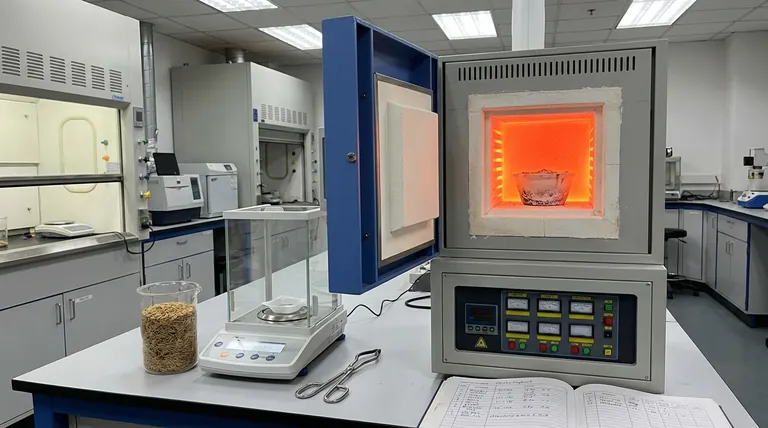
A muffle furnace acts as a precision combustion instrument used to isolate the inorganic structure of rice husks from their organic biomass. specifically, it determines the ash content by heating the sample to 575°C in a controlled oxidative environment, ensuring the complete combustion of all organic matter while preserving the inorganic residue.
The muffle furnace provides the critical baseline for quantitative analysis by converting raw biomass into absolute ash. This process is the fundamental prerequisite for calculating the purity and recovery rate of silica, the primary high-value component derived from rice husks.
The Mechanism of Quantitative Isolation
Controlled Thermal Treatment
The muffle furnace does not simply burn the material; it subjects the rice husk to a specific temperature profile, typically 575°C.
Unlike open-flame combustion, the furnace provides an indirect heat source. This ensures the sample is exposed to a consistent, controlled oxidative environment required for uniform processing.
Elimination of Organic Components
At these elevated temperatures, the carbon-based organic components of the rice husk are completely combusted and removed as gas.
This leaves behind only the inorganic residue, effectively stripping away the "chaff" to reveal the target material.
Determination of Ash Content
The weight of the remaining residue compared to the initial sample weight provides the quantitative ash content.
This metric is the definitive measure of the non-combustible material present in the husk, which is predominantly silica in this context.
The Analytical Value of Ashing
Assessing Silica Purity
The ash produced by the muffle furnace is not waste; it is the subject of the analysis.
By isolating the ash, researchers can calculate the theoretical purity of the silica available in the raw material.
Calculating Recovery Rates
Quantitative analysis allows producers to predict yield.
Knowing the exact percentage of inorganic ash helps in establishing the recovery rate, determining how efficiently silica can be extracted from a specific batch of rice husks.
Understanding the Trade-offs
Destructive Analysis
The use of a muffle furnace is inherently a destructive testing method.
Because the process involves the total combustion of organic matter, the original sample is consumed and cannot be used for further biological or structural testing.
Temperature Sensitivity
While 575°C is the standard for removing organics, strict temperature control is vital.
Deviations in temperature can affect the physical state of the remaining ash, potentially altering the properties of the silica (such as its crystallinity) even if the quantitative weight remains accurate.
Making the Right Choice for Your Goal
To maximize the value of your analysis, apply the results based on your specific objective:
- If your primary focus is Silica Production: Use the ash content percentage to calculate the maximum theoretical yield of your extraction process.
- If your primary focus is Material Characterization: Analyze the remaining ash residue to determine the specific chemical attributes and purity levels of the inorganic components.
Precise thermal treatment transforms undefined agricultural waste into measurable, high-value industrial data.
Summary Table:
| Parameter | Specification/Requirement | Purpose in Rice Husk Analysis |
|---|---|---|
| Standard Temperature | 575°C | Ensures complete combustion of organic biomass |
| Environment | Controlled Oxidative | Facilitates uniform oxidation and gas removal |
| Key Metric | Ash Content (%) | Establishes the baseline for silica purity and yield |
| Sample State | Destructive Testing | Total removal of organic matter for inorganic isolation |
| Target Output | Inorganic Residue | High-value data for industrial silica recovery |
Maximize Your Material Recovery with KINTEK
Ready to transform agricultural waste into high-purity industrial data? KINTEK provides the precision thermal solutions required for rigorous quantitative analysis. Backed by expert R&D and world-class manufacturing, we offer a comprehensive range of Muffle, Tube, Rotary, Vacuum, and CVD systems, all fully customizable to meet your laboratory's unique high-temperature needs.
Don't let inconsistent heating compromise your silica yield. Partner with the experts in thermal processing to ensure accuracy in every ash determination.
Contact KINTEK Today for a Custom Furnace Solution
References
- Multi-step pre-treatment of rice husk for fractionation of components including silica. DOI: 10.3389/fchem.2025.1538797
This article is also based on technical information from Kintek Furnace Knowledge Base .
Related Products
- 1200℃ Muffle Oven Furnace for Laboratory
- High Temperature Muffle Oven Furnace for Laboratory Debinding and Pre Sintering
- 1400℃ Muffle Oven Furnace for Laboratory
- Laboratory Muffle Oven Furnace with Bottom Lifting
- 1800℃ High Temperature Muffle Oven Furnace for Laboratory
People Also Ask
- How does a high-temperature laboratory muffle furnace affect material properties? Transform Anodic Oxide Films Fast
- What is the primary function of a high-temperature laboratory muffle furnace in chemical synthesis? Achieve Precision.
- How is a laboratory muffle furnace used in 3D-printed PP-CF cross-linking? Achieve Thermal Stability at 150 °C
- What functions does a laboratory muffle furnace perform for AISI 1025 steel post-processing? Precision Thermal Control
- What is the critical role of a laboratory high-temperature muffle furnace in TiO2/LDH? Unlock Superior Crystallization





