
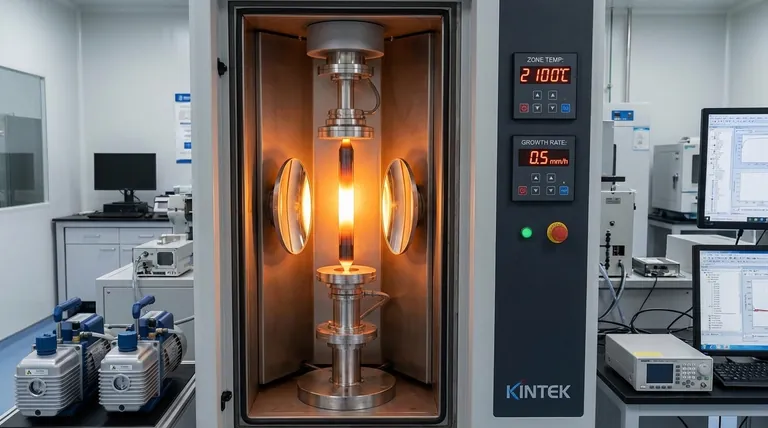
The primary role of a floating zone furnace is to ensure absolute material purity during crystal crystallization. By utilizing focused infrared light or lasers, this furnace creates a localized high-temperature melt zone that travels along a polycrystalline rod. This process allows for recrystallization without the material ever touching a container, thereby eliminating the chemical contamination that plagues traditional growth methods.
Core Takeaway: The defining feature of the floating zone furnace is its "crucible-free" operation. By suspending the melt using surface tension rather than a container, it prevents impurities from leaching into the crystal, making it the definitive tool for growing high-quality superconductors where material integrity is critical.
The Mechanism of Purity
The "Crucible-Free" Advantage
In standard crystal growth, molten material must be held in a container (a crucible). At the high temperatures required for melting, the material often reacts chemically with the crucible walls.
This reaction introduces foreign atoms—impurities—into the crystal lattice. The floating zone furnace eliminates the crucible entirely, removing this primary source of contamination.
Localized Energy Application
Instead of heating an entire chamber, this furnace focuses energy using elliptical mirrors or lasers onto a small section of the feed rod.
This creates a narrow melt zone that moves along the rod. As the zone moves, the material behind it cools and recrystallizes into a single crystal structure with exceptional purity.
Why This Matters for Superconductors
Critical Sensitivity to Impurities
Superconducting materials, such as BSCCO (Bismuth Strontium Calcium Copper Oxide), are highly sensitive to chemical composition. Even trace amounts of contamination from a crucible can alter the superconducting transition temperature.
Using a floating zone furnace ensures that the resulting crystal reflects the intrinsic properties of the material, rather than the artifacts of the container it was grown in.
Studying Material Anisotropy
High-quality single crystals are required to study anisotropy (how properties change depending on the direction of measurement).
Because the floating zone method produces large, highly ordered crystals, researchers can isolate specific crystallographic axes. This allows for precise measurement of electrical and magnetic properties that would be masked in lower-quality samples.
Understanding the Trade-offs
Floating Zone vs. Tube and Box Furnaces
While the floating zone is superior for purity, it is not a universal solution. Other furnace types serve specific roles based on the chemical nature of the material.
Dual-zone tube furnaces, for example, are necessary for materials like ZrTe5 or BiRe2O6. These rely on temperature gradients (e.g., 750°C to 720°C) to drive gas-phase transport agents, a mechanism the floating zone furnace does not support.
Thermal Control vs. Chemical Transport
Box furnaces excel at slow, controlled cooling for materials like Ni3In2Se2, where simple melting and diffusion inside a crucible are sufficient.
If a material has a high vapor pressure or requires a chemical transport agent (like iodine) to move raw materials, a floating zone furnace is generally unsuitable. It is best reserved for materials that melt congruently and require the highest possible purity.
Making the Right Choice for Your Goal
Selecting the correct furnace depends entirely on the physical properties of your target material and your tolerance for impurities.
- If your primary focus is high-purity superconductors: You must use a floating zone furnace to avoid crucible contamination and study intrinsic material physics.
- If your primary focus is materials requiring vapor transport: You should use a two-zone tube furnace to create the precise temperature gradient needed to move gas-phase components.
- If your primary focus is simple melt-growth optimization: You can utilize a box furnace to maintain stable thermal fields for long-duration diffusion and slow cooling.
Ultimately, for cutting-edge superconducting research, the floating zone furnace is the only method that guarantees the structural perfection required to validate theoretical models.
Summary Table:
| Feature | Floating Zone Furnace | Tube Furnace (Dual-Zone) | Box Furnace |
|---|---|---|---|
| Core Mechanism | Crucible-free surface tension melt | Temperature gradient vapor transport | Stable thermal field diffusion |
| Purity Level | Absolute (No contamination) | High (Depends on crucible) | Standard (Depends on crucible) |
| Best For | Superconducting single crystals | Gas-phase transport (e.g., ZrTe5) | Slow cooling & melt-growth |
| Heat Source | Focused infrared light/lasers | Resistance heating elements | Resistance heating elements |
Elevate your material science research with KINTEK’s precision heating solutions. Whether you are growing high-purity superconductors or conducting complex vapor transport, our laboratory high-temp furnaces—including customizable Muffle, Tube, Rotary, Vacuum, and CVD systems—are engineered to meet your exact specifications. Backed by expert R&D and manufacturing, KINTEK provides the reliability your crystals demand. Contact our specialists today to find your ideal furnace solution!
Visual Guide

References
- T. Chattopadhyay. Superconductivity in High-Temperature Materials. DOI: 10.36948/ijfmr.2025.v07i05.55511
This article is also based on technical information from Kintek Furnace Knowledge Base .
Related Products
- Split Multi Heating Zone Rotary Tube Furnace Rotating Tube Furnace
- Multi Heating Zones CVD Tube Furnace Machine for Chemical Vapor Deposition Equipment
- Multi Zone Laboratory Quartz Tube Furnace Tubular Furnace
- Magnesium Extraction and Purification Condensing Tube Furnace
- Mesh Belt Controlled Atmosphere Furnace Inert Nitrogen Atmosphere Furnace
People Also Ask
- What are the main applications of multi zone tube furnaces in university laboratories? Unlock Precision in Material Science and Energy Research
- How are multi zone tube furnaces used in ceramics, metallurgy and glass research? Unlock Precise Thermal Control for Advanced Materials
- What environmental protection applications utilize multi zone tube furnaces? Unlock Precision in Waste Treatment and Green Tech
- What temperature-related capabilities make multi zone tube furnaces valuable for research? Unlock Precision Thermal Control
- Why are multi zone tube furnaces particularly useful for nanomaterial research? Unlock Precise Thermal Control for Advanced Synthesis



















